
Child Safe Blinds: The Complete Parent's Guide
By Prime Decor Furnishing
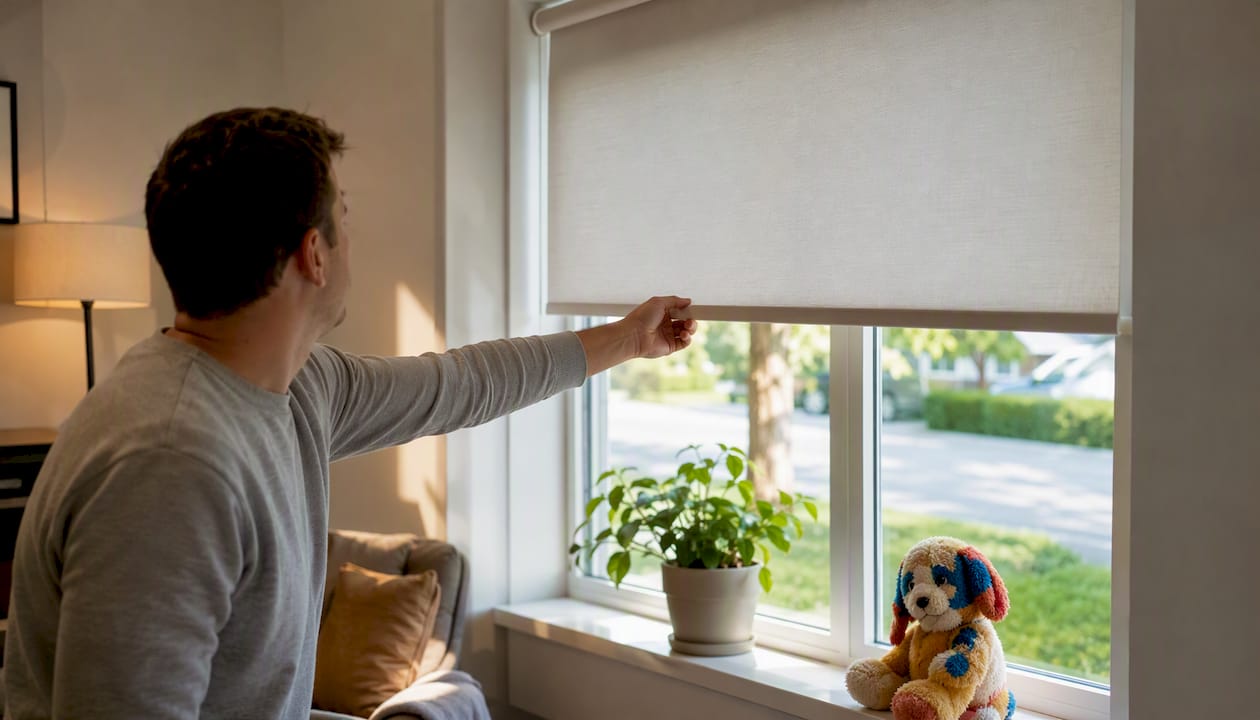
Child Safe Blinds: The Complete Parent’s Guide
Cordless or motorized window coverings are the only options that fully eliminate the strangulation hazard posed by window blind cords. If you have corded blinds in your home right now, the CPSC recommends replacing them with cordless versions as the single most effective fix. While you arrange that replacement, take these three steps today:
- Move all cribs, beds, and furniture away from windows so children cannot reach cords.
- Anchor any continuous-loop cords to the floor or wall using a tension device.
- Call a professional to assess and replace blinds in sleeping and play areas first.
The urgency is real. CPSC reporting documents 46 deaths related to window-covering cord strangulation over a multi-year period, and warns that a child can be strangled in under one minute.
Key takeaways
Cordless and motorized window coverings are the only options that fully eliminate the strangulation hazard from window blind cords, and sleeping areas should be the first rooms you address.
| Point | Details |
|---|---|
| Replace sleeping areas first | Nurseries and toddler bedrooms carry the highest risk; prioritize cordless or motorized replacements there before other rooms. |
| Temporary fixes have real limits | Moving furniture, anchoring loops, and cord cleats reduce risk but do not eliminate it; the CPSC recommends full replacement. |
| Pre-2001 blinds need replacement, not retrofit | Blinds made before November 2000 often have internal lift cords that retrofit kits cannot address safely. |
| Confirm “cordless” on the product page | The word cordless must appear in the product description; “cord-managed” or “cord-reduced” are not equivalent. |
| Primedecorfurnishing provides full-service replacement | Free measurement, cordless and motorized options, professional installation, and a product warranty in one visit. |
Table of Contents
- Why window blind cords are more dangerous than most parents realize
- Which blinds and shades are actually child-safe?
- What to do today if you still have corded blinds
- How to buy child-safe window coverings: a practical checklist
- What a safe installation looks like and how to maintain it
- The case for going fully cordless sooner rather than later
- Primedecorfurnishing offers cordless and motorized replacements with professional installation
- Sources
Why window blind cords are more dangerous than most parents realize
Cords on window coverings create hazards in three distinct ways. Exposed pull cords form loops a child can slip their neck into. Inner lift cords, hidden inside the blind slats, become accessible when a child pulls the slats apart. Continuous-loop cords on older Roman shades and verticals create a fixed noose that tightens under body weight.
Infants and toddlers are most at risk because they cannot free themselves once a cord tightens. Pediatric injury research published in Pediatrics identifies window-covering cords as a recurring home hazard and supports public-health recommendations to remove accessible cords from children’s environments entirely.
46 deaths related to window-covering cord strangulation were reported to the CPSC over a multi-year period. A child can be strangled in under one minute.
| Cord type | Where it appears | Hazard mechanism |
|---|---|---|
| Exposed pull cord | Traditional horizontal blinds | Forms a loop; child can step or fall into it |
| Inner lift cord | Blinds manufactured before 2001 | Accessible when slats are pulled apart |
| Continuous-loop cord | Roman shades, vertical blinds | Fixed loop tightens under body weight |
Tying cords high or using cord cleats reduces the hazard but does not remove it. The CPSC is explicit: children can still reach tied cords, and cleats can be undone. NBC News coverage of fatal incidents reinforces the same point, citing experts who say partial fixes give parents a false sense of security.
Which blinds and shades are actually child-safe?
The term “child safe blinds” in the industry refers to cordless and motorized window coverings, where controls are either eliminated or placed out of a child’s reach. Here is how the main types break down.
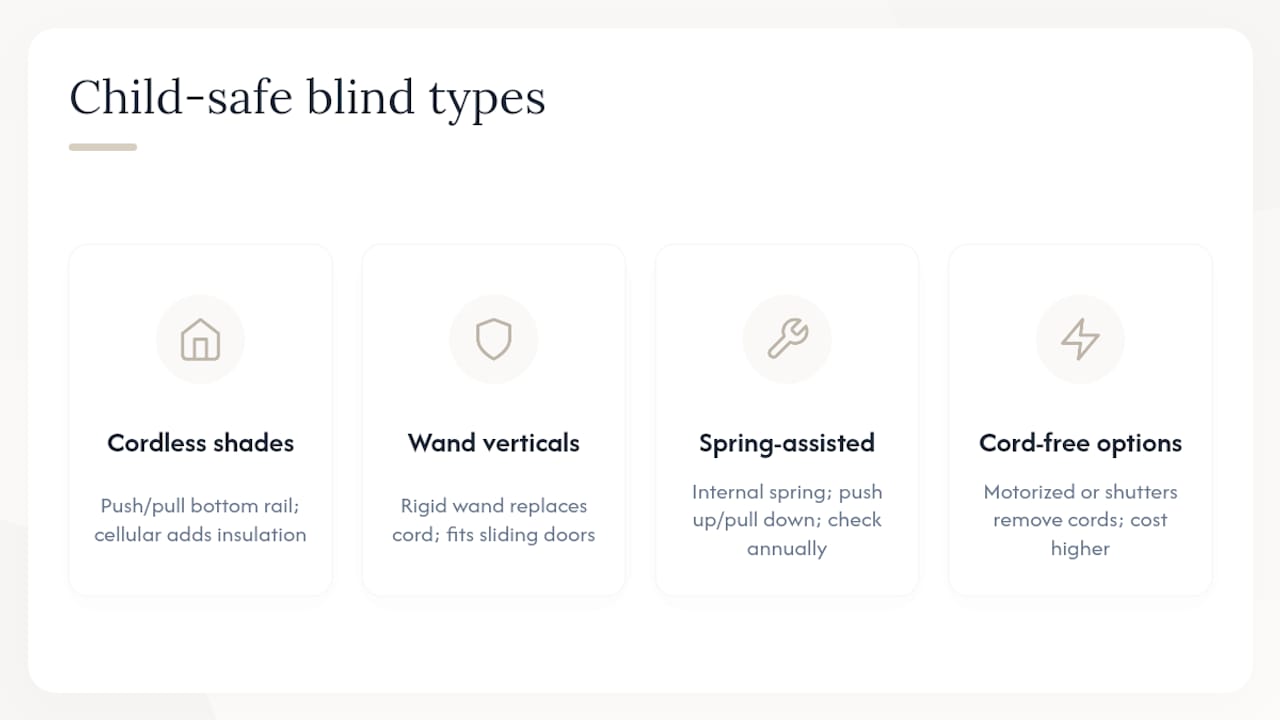
Cordless roller shades are the most common entry point. You raise and lower them by pushing or pulling the bottom rail directly. No cords, no loops, nothing to grab. They work in almost any room, cost less than motorized alternatives, and are easy to find at major retailers. Home Depot’s child safety guide lists them as a top pick for families.
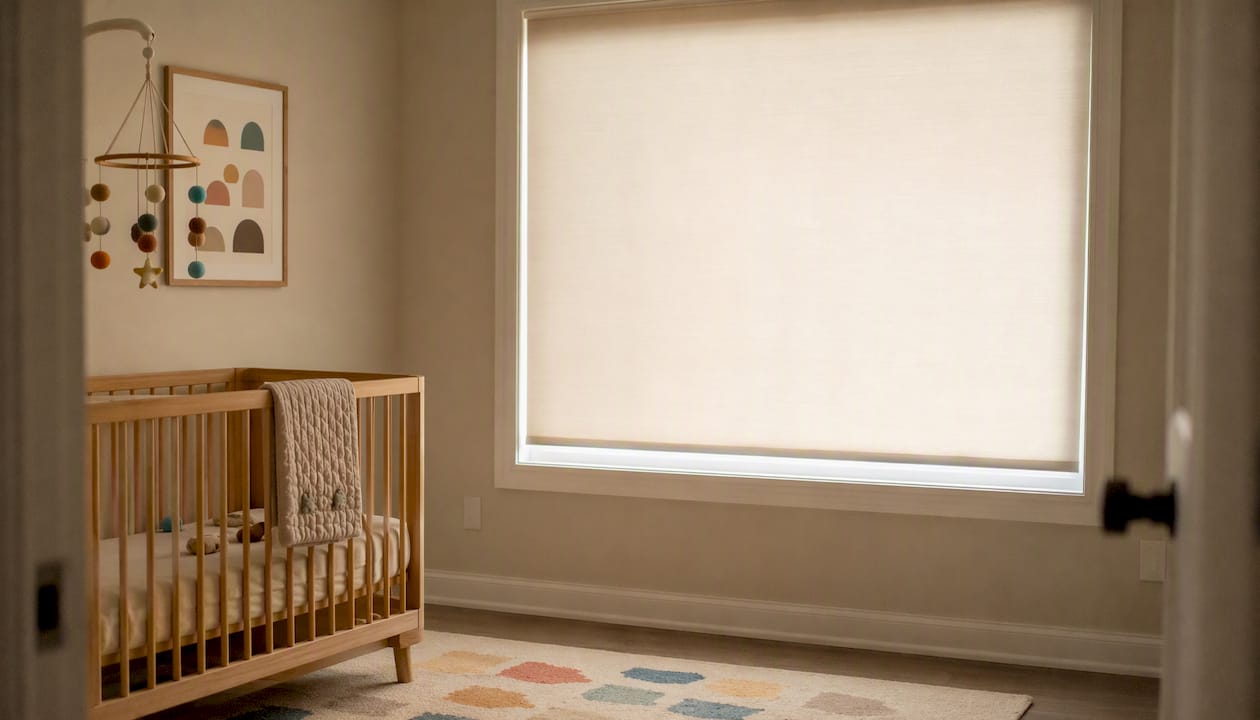
Cordless cellular (honeycomb) shades do the same thing mechanically but add insulation. The honeycomb structure traps air, which helps with both temperature and noise. Best for nurseries and bedrooms where you want blackout or light-filtering options alongside the safety benefit.
Wand-operated vertical blinds replace the pull cord with a rigid wand that rotates and slides the vanes. The wand is long and thin, not a loop, so the strangulation risk is dramatically lower. A good fit for sliding glass doors and large openings.
Spring-assisted cordless blinds use an internal spring mechanism to hold position. You push up to raise, pull down to lower. Simple, durable, and budget-friendly. The spring can wear out over years of heavy use, so check the mechanism annually.
Motorized blinds remove the control problem entirely. A remote, wall switch, or smartphone app operates the covering. Hunter Douglas notes that motorization is particularly recommended for high, hard-to-reach, or numerous windows where tucking cords away is impractical. They also integrate with smart-home systems, which is a genuine convenience bonus.
Shutters (plantation style) have no cords at all. Louvers tilt with a center rod, and panels swing open on hinges. The highest upfront cost of any option here, but essentially zero ongoing cord hazard and a long lifespan.
Pro Tip: When shopping online, do not rely on a product photo alone. Search the product page for the word “cordless” in the description. If the listing says “cord included” or shows a pull cord in the image, keep looking.
What to do today if you still have corded blinds
Replacement is the goal, but it takes time to measure, order, and install. Here is an ordered plan for the days between now and your installation appointment.
- Prioritize sleeping and play areas first. Nurseries, toddler bedrooms, and playrooms are where children spend unsupervised time. These rooms need attention before living rooms or kitchens.
- Move furniture away from windows. Cribs, beds, chairs, and toy shelves give children a platform to reach cords. Push everything at least two feet from any window with a corded covering.
- Shorten dangling cords. Use a cord wind-up or tie-down device to keep pull cords as short as possible. The goal is to keep them above 5 feet from the floor.
- Anchor continuous-loop cords. A tension device screwed into the baseboard or wall holds the loop taut and prevents it from forming a free-hanging noose. The Window Covering Safety Council provides free retrofit kits for many continuous-loop systems.
- Install cord cleats for any remaining pull cords. Wrap the cord in a figure-eight around the cleat and mount it high on the wall frame. This is a partial fix only.
What not to rely on: Tying cords in a knot, tucking them behind the blind, or using only a cleat are not substitutes for replacement. The CPSC is clear that these measures reduce but do not eliminate the hazard. Retrofit kits from the WCSC help with continuous-loop systems, but the council notes they do not address dangling pull-cord hazards.
Blinds manufactured before November 2000 often have internal lift cords that retrofit kits cannot fix. If you cannot confirm when your blinds were made, treat them as pre-2001 and prioritize replacement. Temporary fixes are not acceptable long-term for these units.
How to buy child-safe window coverings: a practical checklist
Shopping for safe window blinds for kids is straightforward once you know what to confirm. Use this checklist before you buy.
- The product page explicitly says “cordless.” Not “cord-reduced” or “cord-managed.” The word cordless should appear in the product title or description.
- No exposed operating cords at any position. Lower the shade in the store or ask the retailer to demonstrate. Cords should not appear at any height.
- Motorized option available. For windows above 6 feet or rooms with many windows, motorization is worth the added cost. Hunter Douglas and other manufacturers offer retrofit motor kits for some existing cordless frames.
- Complies with current industry standards. Ask whether the product meets ASTM International standard F3254 or the Window Covering Manufacturers Association (WCMA) voluntary safety standard. Most products sold after 2018 at major U.S. retailers do.
- Professional installation is available. Custom-sized coverings need accurate measurements. An installer who measures on-site reduces the chance of gaps that expose hardware or cords.
- Warranty is included. A product warranty signals the manufacturer stands behind the mechanism. Ask specifically whether the cordless mechanism is covered.
Questions to ask your installer:
- Are continuous-loop systems anchored as part of the install?
- Where will the motorized receiver or wand be mounted?
- What is the lead time from measurement to installation?
- Are cord stops included and adjusted to limit inner cord movement to 1–2 inches from the headrail?
On cost: cordless roller shades typically run less than motorized systems, which carry a higher upfront price but lower long-term maintenance. Trade resources note that motorization is the longer-term safe choice for families, especially as children grow and windows become harder to supervise.
What a safe installation looks like and how to maintain it
A professional installer doing this job correctly will confirm several things before leaving your home.
The controls on every covered window should be inaccessible to a child standing on the floor or on nearby furniture. For motorized systems, the receiver should be mounted at the headrail, not left dangling. Cord stops on any remaining inner-cord systems must be set so the cord moves no more than 1–2 inches from the headrail when the blind is fully lowered. Mounting hardware should be secured into wall studs or with appropriate anchors, not just drywall.
Maintenance schedule:
| Frequency | What to check |
|---|---|
| Quarterly | Cord position and anchor security on any remaining corded units |
| Every 6 months | Functional test of cordless spring mechanism; confirm controls remain inaccessible |
| Annually | Professional safety check for motorized systems; inspect motor, remote, and mounting |
Pro Tip: To identify older blinds with internal lift cords, look at the bottom rail. If you can see a small hole where a cord exits the slat stack, or if pulling the slats apart reveals a cord running through them, the blind likely has internal lift cords. Check the product label on the headrail for a manufacture date. Any blind without a date label and purchased before 2001 should be replaced, not retrofitted.
When you remove unsafe blinds, do not simply throw them in the trash with cords intact. Cut all cords before disposal to prevent hazards if the unit is accessed by children during or after removal. Some municipal recycling programs accept window coverings; contact your local waste authority or the retailer where you purchase replacements to ask about take-back options.
The case for going fully cordless sooner rather than later
Most parents who read the statistics act quickly on nurseries and toddler rooms, then stall on the rest of the house. That partial approach is understandable, but it leaves real risk in place. A child who is mobile does not stay in their bedroom.
The argument for delaying is usually cost. Motorized systems cost more than cordless pull-down shades, and replacing every window in a home at once is a significant project. But the cost calculation changes when you factor in that cordless roller shades are now widely available at prices comparable to mid-range corded blinds. The premium is smaller than most people expect.
The other common hesitation is aesthetics. Parents worry that “safe” means plain. It does not. Cordless cellular shades, shutters, and motorized roller systems come in the same range of fabrics, colors, and opacity levels as their corded counterparts. Safety and design are not a trade-off here.
What the evidence actually points to is a sequencing problem, not a budget problem. Sleeping areas first, then play areas, then the rest of the home. A professional consultation that covers the whole house in one measurement visit is more efficient than piecemeal replacements and usually costs less per window.
Primedecorfurnishing offers cordless and motorized replacements with professional installation
Replacing every corded blind in your home is a project that goes faster and costs less when measurement, supply, and installation happen in a single coordinated visit. Primedecorfurnishing handles all three, with free on-site measurement, a full range of cordless and motorized blind options, and professional installation backed by a product warranty.

For families prioritizing sleeping and play areas first, Primedecorfurnishing can assess which rooms need immediate attention and schedule installation accordingly. Motorized systems for high or hard-to-reach windows are part of the catalog, and the team handles anchoring and cord-stop placement as part of every install. Over 5,000 customers have used the service, and the brand has been recognized in The Straits Times for pricing transparency.
Browse the full product range or request a free home measurement to get started with a safety-first replacement plan.
Sources
The guidance in this article draws on the following high-authority sources. Each is worth bookmarking for ongoing reference.
- Cpsc
- Window Covering Safety Council
- Pediatric injuries related to window blinds/shades | Pediatrics (AAP)
- Best Blinds for Child Safety - The Home Depot
- How parents can make window blinds safer for kids … - NBC News
- Cordless Blinds and Shades - Hunter Douglas
Recommended
Ready to transform your home?
Chat with us on WhatsApp for a free consultation or quote.
Chat with us on WhatsApp