
Composite vs PVC Decking: Which Is Best for Homeowners
By Prime Decor Furnishing

Composite vs PVC Decking: Which Is Best for Homeowners
Pick capped composite for most backyard decks when you want a natural wood look at a lower upfront cost. Choose cellular PVC when the deck faces constant moisture, salt air, or sits over water — pools, coastal homes, and docks. Capped composite typically carries a 25–30 year warranty, while premium PVC warranties last 50 years or more, reflecting a real difference in how each material handles water over time. Both eliminate the annual sanding, staining, and sealing that wood demands, so either way you’re trading upfront dollars for years of low-maintenance weekends.
Pro Tip: Both materials expand and contract with temperature swings. Leave the manufacturer-specified gap at board ends and use the recommended hidden fastener system — skipping this step is the most common DIY installation mistake and can void your warranty.
Table of Contents
- How does composite vs PVC decking compare at a glance?
- What is PVC decking, and when should you choose it?
- What is composite decking, and when does it make sense?
- What product types will you actually see when shopping?
- How do composite and PVC actually perform side by side?
- What do composite and PVC decking actually cost over time?
- How do you decide which material is right for your deck?
- Common myths about composite and PVC decking, debunked
- Key Takeaways
- What most homeowners get wrong about this decision
- Primedecorfurnishing handles the hard parts of your decking project
- Useful sources for verifying product claims before you buy
How does composite vs PVC decking compare at a glance?
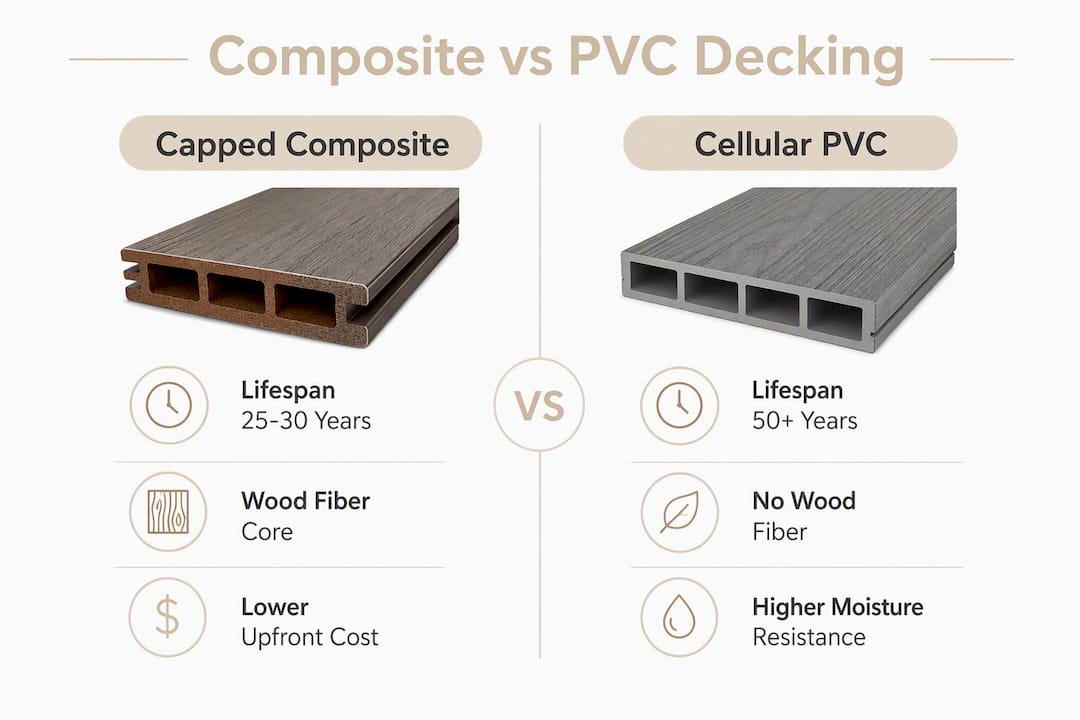
Before diving into each material, here’s the side-by-side snapshot across the dimensions that drive most buying decisions.
| Dimension | Capped Composite | Cellular PVC |
|---|---|---|
| Lifespan / warranty | 25–30 years | 50+ years |
| Water & mold resistance | Good (capped boards) | Excellent (no wood fiber) |
| Maintenance | Low (clean 1–2x/year) | Very low (clean 1–2x/year) |
| Upfront board cost | ~$5–$18/sq ft | ~$8–$22/sq ft |
| Aesthetics / wood look | Strong — closest to real wood | Good, improving, but less grain depth |
| Installation / ease | Moderate weight | Lighter, slightly easier DIY |
| Heat retention | Moderate to high (color-dependent) | Moderate (color-dependent) |
| Environmental impact | Higher recycled content typical | 100% synthetic; no wood fiber |
| Best use cases | Shaded yards, general backyard, value projects | Pools, docks, coastal, high-humidity climates |
Board cost ranges reflect material grade and cap style. The installed cost gap between premium capped composite and PVC often narrows once framing, railings, and labor enter the equation — those line items tend to dominate the total project budget regardless of which decking surface you choose.
What is PVC decking, and when should you choose it?
PVC decking is made entirely from polyvinyl chloride — no wood fiber, no organic content. That single fact explains most of its performance profile. Without wood fiber, there’s nothing for moisture to penetrate, rot, or feed mold. It’s the reason PVC is the go-to choice for pool surrounds, docks, and coastal applications where water exposure is constant rather than occasional.

Two main constructions exist. Cellular PVC uses a foamed core with a dense outer shell, making it lighter than it looks and giving it excellent insulating properties. Solid (closed-cell) PVC is denser and heavier but extremely rigid. Most residential products today are cellular, and that’s what you’ll see marketed as “premium PVC decking.”
PVC strengths:
- Zero wood fiber means the highest moisture and mold resistance of any decking category
- Warranties up to 50+ years, often including fade and stain coverage
- Lighter boards reduce labor time and make complex patterns more manageable for DIYers
- No annual sealing, staining, or sanding required
- Consistent color through the board (scratches are less visible than on some composite products)
PVC downsides:
- Higher upfront board cost ($8–$22/sq ft) compared with most composite options
- Thermal movement is more pronounced — spacing and fastener specs matter more
- Some darker colors retain significant heat underfoot in direct sun
- Less convincing wood grain texture than top-tier capped composite
Before you buy, pull the warranty document and check three things: fade and stain coverage length, whether the warranty transfers to a new owner, and what voids it (many require specific fasteners and installation gaps).
What is composite decking, and when does it make sense?
Composite decking combines wood fiber with plastic — typically recycled polyethylene or polypropylene — pressed into boards that look and feel closer to natural lumber than PVC does. The wood fiber content is what gives composite its grain depth and warmth, and it’s also what makes the cap layer so important.
Capped composite wraps the wood-fiber core in a protective polymer shell. A 3-sided cap covers the top and two long edges; a 4-sided cap adds coverage to the bottom face as well. 4-sided capping reduces moisture intrusion from cut ends and underside exposure, which matters most on elevated decks where the underside sees humidity and rain splash. Uncapped composite skips the shell entirely — it’s cheaper upfront but absorbs moisture, stains more easily, and carries shorter warranties. Avoid uncapped boards for any outdoor application with real weather exposure.
Composite strengths:
- The most realistic wood grain texture and color variation available in synthetic decking
- Lower upfront board cost than comparable PVC ($5–$18/sq ft for capped grades)
- Strong mid-range durability when fully capped — holds up well in typical backyard conditions
- Higher recycled content in many products, appealing for sustainability-minded buyers
- Wide color range with good color retention on capped products
Composite downsides:
- Shorter typical warranty than PVC (25–30 years for capped composite)
- Cut ends on 3-sided capped boards expose the wood-fiber core — requires end-grain sealant or capped stair nosing
- Not the best choice for constant water immersion (docks, pool decks with standing water)
- Heavier than cellular PVC, which adds to labor time on large or complex installs
Composite tends to win in shaded suburban yards, covered porches, and projects where budget timing matters and the deck won’t face extreme or sustained moisture.
What product types will you actually see when shopping?
Walk into any decking showroom and you’ll encounter four product categories. Knowing what they are before you go saves you from being upsold on something you don’t need.
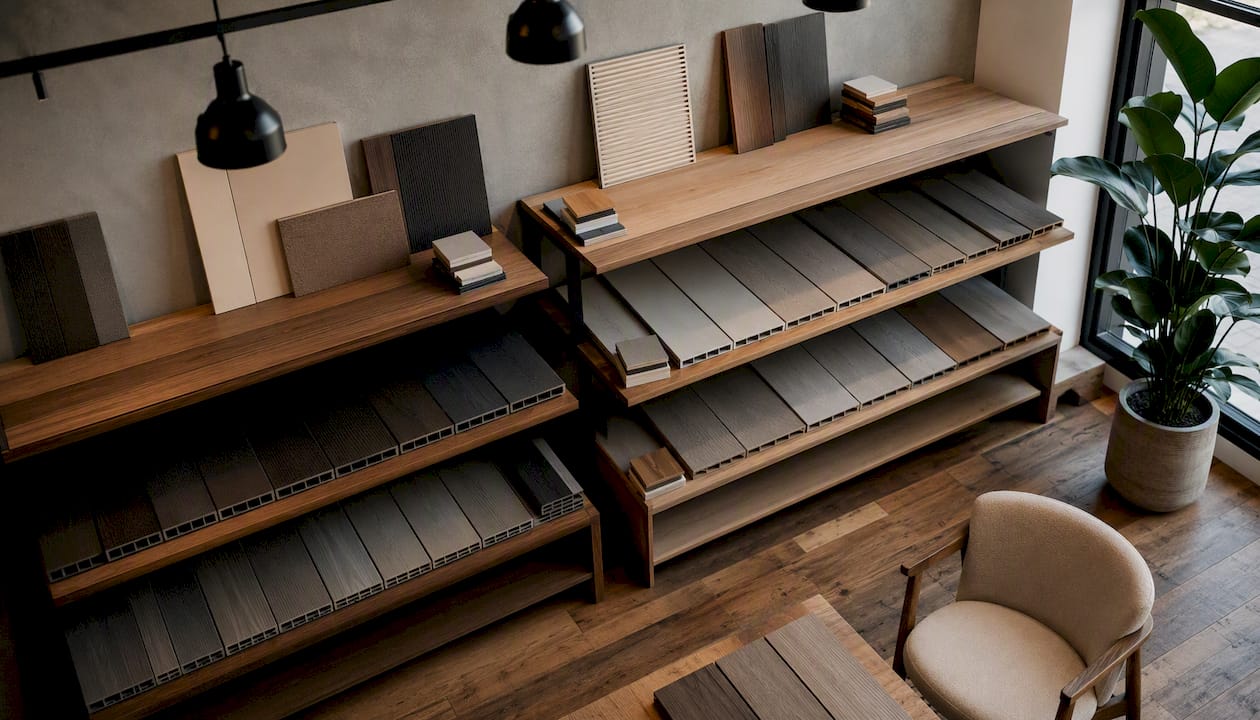
Capped composite: Wood-fiber core with a polymer cap on 3 or 4 sides. The mainstream choice for residential decks. Look for 4-sided capping if your deck is elevated or in a humid climate.
Uncapped composite: No cap layer. Lower cost, but significantly more vulnerable to moisture, staining, and fading. Suitable only for very dry climates or covered applications — and even then, capped composite is a better long-term value.
Cellular PVC: Foamed polyvinyl chloride core, dense outer shell, no wood fiber. The premium moisture-resistant option. Lighter than it looks and easier to handle on-site.
Solid/closed-cell PVC: Denser, heavier, extremely rigid. Less common in residential decking; more often used in commercial or marine applications.
Pro Tip: On any capped composite board, check the cut end before installation. If the core color contrasts sharply with the cap color, exposed cuts at stair nosing, picture framing, and railing posts will be visible. Use manufacturer-supplied end-grain sealant or pre-capped trim pieces on every exposed cut.
How 3-sided vs 4-sided capping plays out in practice: a 3-sided board is fine for flat, ground-level decks in moderate climates. For elevated decks, pool surrounds, or anywhere the board underside sees regular moisture, 4-sided capping is worth the price premium. The bottom face is where moisture wicks in on 3-sided products, and that’s where early delamination typically starts.
How do composite and PVC actually perform side by side?
Lifespan and warranty
Capped composite warranties typically run 25–30 years; premium PVC warranties reach 50+ years. That’s not just marketing — it reflects the underlying material science. Wood fiber degrades over time even when capped, and manufacturers price that into their coverage terms.
Water and mold resistance
PVC wins here, and it’s not close. No wood fiber means no organic material for mold to colonize. Capped composite resists moisture well at the surface, but cut ends and the board underside (on 3-sided products) remain vulnerable. For pools, docks, and coastal decks, PVC is the correct call.
Maintenance
Both materials eliminate annual sanding, staining, and sealing — the main reason homeowners switch from wood. Routine care for either is a seasonal wash with mild soap and water, plus spot treatment for stubborn stains. PVC is marginally easier to clean because it doesn’t absorb anything; composite can hold tannin stains from wet leaves if left too long.
Aesthetics
Composite holds a clear edge in wood realism. The grain embossing, color variation, and texture depth on top-tier capped composite boards are difficult to distinguish from real hardwood at a glance. PVC has improved significantly, but the surface still reads as synthetic to most eyes. If the look of natural wood matters to you, composite is the better choice.
Cost
Board costs run lower for capped composite compared to cellular PVC, with wide ranges depending on material grade. The installed cost gap often narrows because framing, railings, and labor make up the majority of total project cost regardless of which surface material you choose. Don’t make your decision on board cost alone.
Installation and ease
PVC boards are lighter, which helps on large decks and complex layouts. Both materials use hidden fastener systems; follow the manufacturer’s spacing recommendations exactly. Thermal expansion is more pronounced in PVC, so the end-gap spec is non-negotiable. Composite is heavier but dimensionally stable enough that some installers find it easier to work with on long straight runs.
Heat and slip resistance
Dark-colored boards of either material get hot in full sun. Color choice drives surface temperature more than material type — a light gray PVC board and a dark brown composite board are not comparable on heat. Some manufacturers now offer heat-mitigating formulations that reduce surface temperature in direct sun; ask specifically about this if the deck faces south or west and will be used barefoot.
Pro Tip: If barefoot comfort matters, choose the lightest color option available in your preferred material. Light colors can meaningfully reduce surface temperature compared with dark tones in the same product line.
Environmental impact
Composite typically contains a higher percentage of recycled content (wood waste and recycled plastic) than PVC. PVC is 100% synthetic and petroleum-derived, though some manufacturers incorporate recycled PVC. If sustainability is a priority, look for third-party recycled-content certifications on the product data sheet rather than relying on marketing claims.
Quick use-case guide:
- Poolside or dock: cellular PVC
- Coastal home: cellular PVC
- Shaded suburban backyard: capped composite
- Covered porch: capped composite
- Budget-conscious general deck: capped composite
- Maximum lifespan priority: cellular PVC
What do composite and PVC decking actually cost over time?
Board costs give you a starting point, but the real number is installed cost over the deck’s lifespan.
| Item | Capped Composite | Cellular PVC |
|---|---|---|
| Board cost (per sq ft) | $5–$18 | $8–$22 |
| Typical installed cost (per sq ft, incl. labor) | Varies by project | Varies by project |
| Warranty / expected lifespan | 25–30 years | 50+ years |
| Annual maintenance cost | Low (cleaning supplies) | Very low (cleaning supplies) |
Simple lifecycle example: A 400 sq ft deck installed with capped composite costs less upfront than the same deck with cellular PVC, though exact pricing varies. Over 25 years, both materials require minimal maintenance spend. But PVC’s 50-year warranty means you may never replace the surface — composite may require a re-deck around year 25–30, adding another $10,000+ at future prices.
Budgeting tips:
- Get a line-item quote: framing, decking surface, railings, and labor are separate costs — don’t let a low board price obscure a high labor estimate
- Factor in stair nosing, trim boards, and hidden fasteners — these add $1–$3/sq ft to material cost
- Request product data sheets before signing anything — they list thermal expansion coefficients, fastener specs, and warranty conditions
- Ask whether the warranty is transferable if you sell the home; transferable warranties add resale value
How do you decide which material is right for your deck?
Work through this checklist before contacting a supplier.
Step-by-step decision checklist:
- Site conditions: Is the deck near a pool, on a dock, or within a mile of saltwater? If yes, cellular PVC.
- Sun exposure: Does the deck face south or west with no shade? Prioritize light colors in either material.
- Barefoot use: Will kids or adults walk on it barefoot in summer? Factor heat retention into color choice.
- Budget timing: Is upfront cost a constraint? Capped composite costs less to install today.
- Lifespan priority: Do you want to install once and never replace? Cellular PVC’s 50-year warranty is the answer.
- Aesthetics: Is a natural wood look the priority? Capped composite wins.
- Maintenance tolerance: Both are low-maintenance, but PVC is marginally easier to clean.
Questions to ask your supplier or installer:
- What is the exact warranty length, and does it cover both fade and stain?
- Is the warranty transferable to a future homeowner?
- Is this board 3-sided or 4-sided capped?
- Can I see a product data sheet with thermal expansion specs?
- What fastener system does the manufacturer require, and does using a different system void the warranty?
- What end-gap and side-gap spacing do you recommend for my climate zone?
- Are samples available so I can test color and texture in my actual outdoor light?
Red flags to watch for:
- Warranty language that covers “manufacturing defects” only, with no fade or stain protection
- No transferability clause
- Installer unwilling to follow manufacturer-specified gaps or fastener systems
- No product data sheet available on request
- Verbal warranty promises not backed by a written document
Common myths about composite and PVC decking, debunked
“PVC is always hotter than composite.” Not accurate. Surface temperature depends primarily on color and finish, not material type. A light-colored PVC board can run cooler than a dark composite board in the same sun conditions.
“Composite molds easily.” Capped composite resists mold well at the surface. Mold issues on composite decks are almost always caused by debris accumulation in board gaps — leaves, dirt, and organic matter sitting on the surface. Regular cleaning prevents it.
“PVC scratches more than composite.” Both materials scratch. On capped composite, scratch visibility depends on how much the cap color contrasts with the core. PVC tends to be more color-consistent through the board, so light scratches are less visible — but deep gouges show on either material.
“Composite is always the greener choice.” It depends on the product. Some composite lines use high recycled content; others don’t. PVC manufacturers increasingly use recycled PVC. Check the product data sheet for actual recycled-content percentages rather than assuming.
“Both materials need the same maintenance as wood.” Neither does. Both composite and PVC eliminate the annual sanding, staining, and sealing that wood requires. Maintenance is a seasonal wash and occasional spot treatment.
Pro Tip: For tannin stains from wet leaves on composite, a diluted oxalic acid cleaner (available at most hardware stores) works better than general-purpose deck wash. Apply it before the stain sets — waiting until spring makes removal significantly harder.
Key Takeaways
PVC wins on moisture resistance and lifespan; capped composite wins on wood aesthetics and upfront cost — and the right choice depends on your site conditions, not a universal ranking.
| Point | Details |
|---|---|
| Warranty gap is real | Capped composite warranties run 25–30 years; cellular PVC warranties reach 50+ years. |
| Moisture drives the decision | No wood fiber in PVC means superior resistance for pools, docks, and coastal sites. |
| Installed cost gap narrows | Framing, railings, and labor dominate total project cost regardless of surface material. |
| Color matters more than material for heat | Surface temperature is driven by color and finish, not composite vs PVC material type. |
| Primedecorfurnishing offers supply + install | Onsite measurement, installation, and warranty handling for composite and PVC decking projects. |
What most homeowners get wrong about this decision
The composite vs PVC debate gets framed as a cost question, and that framing leads people to the wrong answer. The real question is: what does your site actually demand?
A homeowner who chooses capped composite for a shaded, dry backyard deck is making a smart call. The same homeowner choosing composite for a pool deck because it costs $4/sq ft less upfront is setting up a warranty headache in year 10. The material science isn’t subtle here: wood fiber and sustained moisture are a bad combination, regardless of how good the cap is.
What I’d push back on is the idea that PVC is automatically the premium choice. For most American backyards — not coastal, not poolside, not in the Pacific Northwest with 60 inches of annual rainfall — capped composite delivers the better overall package. You get a more convincing wood look, a lower install bill, and a 25–30 year warranty that outlasts most homeowners’ tenure in a house. The lifecycle cost math only favors PVC if you’re staying in the home long enough to hit the 30-year mark and avoid a re-deck.
The one thing both materials share: they’re long-term investments that pay back in maintenance hours, not just dollars. Anyone who has spent a weekend re-staining a pressure-treated deck knows exactly what that’s worth.
Primedecorfurnishing handles the hard parts of your decking project
Choosing between composite and PVC is the easy part. Getting the install right — correct fastener spacing, proper end-gap for your climate, sealed cut ends, and a warranty that actually holds — is where most DIY and budget-contractor projects fall short.

Primedecorfurnishing supplies and installs both composite and vinyl decking with onsite measurement, professional installation, and full warranty handling included. You get the material that fits your site, installed the way the manufacturer requires, without spending a weekend on a ladder second-guessing fastener specs. Over 5,000 homeowners have used Primedecorfurnishing for exactly this kind of project. To get a quote tailored to your deck dimensions and site conditions, visit primedecorfurnishing.com and book an onsite consultation.
Useful sources for verifying product claims before you buy
Before signing a contract or placing a material order, pull these resources and check the specifics yourself.
Where to verify warranty and product specs:
- PVC vs. Composite Decking: Benefits and Differences — TimberTech: Detailed breakdown of warranty terms, material composition, and maintenance differences from a major manufacturer.
- Material Comparison: PVC vs Composite — Decks.com: Independent resource covering both materials with installation and structural framing guidance.
- Composite vs. Advanced PVC — Weatherguard Construction: Contractor-level guidance on product data sheets, fastening systems, and thermal expansion specs.
- Composite Decking Benefits — Triple A Decking: Practical overview of composite performance, real costs, and maintenance expectations.
What to check on any product page before buying:
- Fade and stain warranty: length in years and what voids coverage
- Whether the warranty transfers to a new homeowner
- Cap style: 3-sided or 4-sided, and what the manufacturer says about cut-end treatment
- Thermal expansion coefficient and manufacturer-required fastener system
- Recycled content percentage (if sustainability matters to your project)
- Availability of physical samples — always test color in your actual outdoor light before ordering full quantities
Request an on-site quote and samples before committing. Board colors look different in a showroom than they do on a south-facing deck at noon in July.
Recommended
Ready to transform your home?
Chat with us on WhatsApp for a free consultation or quote.
Chat with us on WhatsApp