
Cost of Curtains in Singapore: 2026 Pricing Guide
By Prime Decor Furnishing

Cost of Curtains in Singapore: 2026 Pricing Guide
Curtains in Singapore typically run a moderate price range per window for mid-range custom fabric, or can cost several thousand Singapore dollars for a full HDB 4-room flat depending on fabric grade, track type, and whether installation is included. Budget shoppers can dress a 2-room HDB economically; premium day-and-night curtains for a 3-bedroom condo can be significantly more expensive. The single most useful thing you can do before committing to any supplier is request a free home measurement and an itemized quote that breaks out fabric, track, installation, and warranty separately.
Quick cost snapshot:
- HDB 2-room (budget): S$600–S$900 all-in
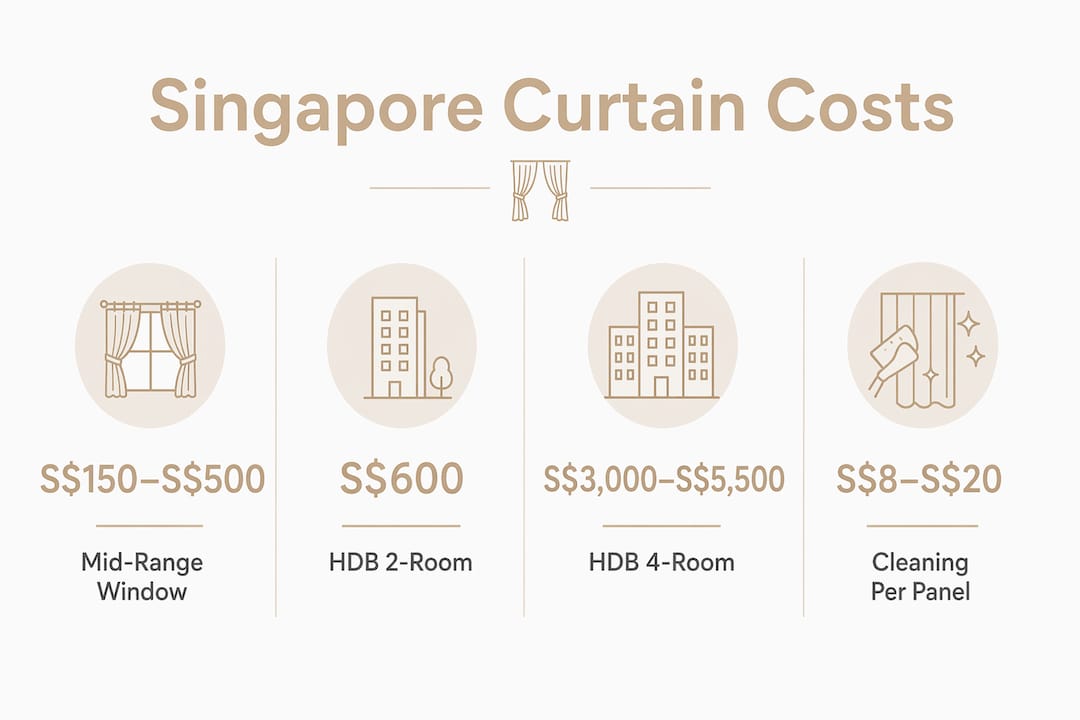
- HDB 4-room (day-and-night curtains, mid-range): S$3,000–S$5,500 all-in
- Condo 3-bedroom (mid-range): S$10,000–S$22,000 all-in
- Per-window range: S$80–S$600+ depending on fabric and style
- Standard installation (up to 3 windows): S$80–S$120 in 2026
Pro Tip: Never accept a quote that says only “per window” with no fabric grade specified. Insist on a line-item breakdown showing fabric cost per metre, fullness ratio, lining type, track, and installation separately. That one step eliminates most post-installation billing surprises.
Primedecorfurnishing offers free home measurement and itemized quotes across Singapore, which is the fastest way to get a number specific to your windows.
Table of Contents
- How suppliers price curtains in Singapore
- What curtains actually cost by Singapore home type
- What drives curtain prices up or down
- Manual tracks, rods, and motorised systems: what they cost
- What happens during a free home measurement
- How long does ordering and installation take?
- Cleaning, maintenance, and total cost of ownership
- Why Primedecorfurnishing is worth considering
- Key Takeaways
- What experienced installers wish Singapore homeowners knew
- Primedecorfurnishing: free measurement and a firm quote
- Useful resources for Singapore curtain buyers
- The part most buyers get wrong
How suppliers price curtains in Singapore
Three billing models dominate the Singapore market, and knowing which one a supplier uses changes how you compare quotes.
Per-window pricing is the most common model for ready-made and standard custom curtains. The supplier measures each window opening and quotes a flat rate that bundles fabric, basic track, and installation. It is convenient but can obscure how much of the cost is fabric versus labour.
Per-metre (fabric) pricing is standard for high-end custom work, motorised systems, and unusually wide or tall windows. The supplier calculates the total fabric width needed, applies a fullness multiplier (typically 1.5x–2.5x the window width for pleated curtains), adds lining, then prices each component separately. This model is more transparent.
Fixed room or package pricing is popular at HDB BTO showrooms and heartland shops. Package pricing often bundles tracks and installation and can be economical for standard-sized windows, though the fabric grade is usually entry-level.
A professionally built quote typically includes these line items:
- Fabric cost per metre (with fullness multiplier stated)
- Lining type (sheer, blackout, fire-rated)
- Hem and finish (standard vs. weighted hem)
- Track or rod type (manual, concealed ceiling, motorised)
- Brackets and fittings
- Installation labour
- Warranty terms
What curtains actually cost by Singapore home type
The table below uses 2026 market estimates for typical window counts and mid-range fabric. “All-in” means fabric, track, installation, and a standard warranty are included.
| Property Type | Budget All-In | Mid-Range All-In | Premium All-In | Notes |
|---|---|---|---|---|
| HDB 2-room | S$600–S$900 | — | — | 3–4 windows; roller blinds at budget end |
| HDB 3-room | — | — | — | 5–6 windows; day curtains mid-range |
| HDB 4-room | — | S$3,000–S$5,500 | — | 7–8 windows; day-and-night curtains mid-range |
| Condo 3-bedroom | — | S$10,000–S$22,000 | — | Floor-to-ceiling windows push cost up 10–20% vs HDB |
| Landed property | S$10,000–S$22,000 | — | — | Large spans and ceiling heights add 20–40% premium |
Budget packages typically include basic roller blinds or sheer day curtains with a standard aluminum track. Mid-range adds a day-and-night layered system with a concealed ceiling track. Premium covers motorised systems, imported fabric, and a multi-year motor warranty.
For HDB BTO buyers, BTO curtain packages from local suppliers often bundle tracks and installation at a fixed price, which simplifies budgeting when you are furnishing from scratch.
What drives curtain prices up or down
Fabric grade is the single biggest variable. A sheer polyester panel costs a fraction of a Belgian linen or a blackout-lined velvet, and the difference shows in how the curtain hangs, how long it lasts, and how well it blocks heat.
Primary cost drivers:
- Fabric grade: Entry-level polyester vs. mid-range cotton-blend vs. premium imported linen or velvet
- Lining: Unlined (cheapest), sheer lining, blackout lining, or fire-rated treatment
- Fullness ratio: A 1.5x fullness uses less fabric than a 2.5x pencil-pleat; the latter looks fuller but costs more
- Pleat type: Eyelet and rod-pocket are cheapest; pinch-pleat, goblet, and wave-pleat add labour and fabric
- Panel count and width: More panels or wider windows multiply every per-metre cost
- Custom shapes: Bay windows, arched frames, and angled ceilings require bespoke cutting and fitting
Secondary drivers that often surprise buyers:
- Recessed ceiling tracks (concealed coves) require carpentry work and add S$50–S$150 per window
- Floor-to-ceiling windows in condos need longer fabric drops and heavier hardware
- Access difficulty (high ceilings, scaffolding needed) adds to installation labour
Fire-rated lining is worth flagging specifically. Standard blackout panels run S$85–S$150 per panel; fire-rated treatment adds roughly S$40–S$60 per panel. For HDB units above the 5th floor, some buildings require fire-rated materials, so confirm with your town council before ordering.
Pro Tip: UV-treated fabric costs more upfront but pays for itself. Cheap polyester without UV treatment can fade and weaken in 12–18 months under Singapore’s direct sun. Spending 20–30% more on UV-treated fabric typically doubles the usable lifespan, which lowers your 5-year total cost.

Balancing upfront cost against longevity is the real skill here. A fabric choice guide that matches material to room function (bedroom blackout vs. living room sheer) prevents the most common mistake: buying cheap for a west-facing window that gets four hours of direct afternoon sun.
Manual tracks, rods, and motorised systems: what they cost
Hardware is where quotes diverge most sharply, and where buyers most often underestimate the total.
Typical 2026 price ranges by track type:
- Basic aluminum track (manual): S$15–S$35 per metre
- Concealed ceiling track (manual): S$40–S$80 per metre
- Decorative rod and rings: S$60–S$150 per window
- Basic motorised roller blind: S$380–S$550 per window
- Premium day/night smart motorised system: S$680–S$980 per window
Motorised systems have decreased in price in recent years, improving accessibility for mid-range HDB renovations. The catch is motor quality. Branded motors add S$200–S$400 over unbranded options but typically last 8–12 years. Unbranded motors often fail around the 12–18 month mark, just after the warranty expires.
Motorisation makes the most sense for windows above 2.4 metres, rooms where manual operation is awkward (above a bed, behind furniture), or when you want smart-home integration. For a standard HDB bedroom window, a quality manual concealed track is often the better value call.
For broader hardware quality context, the same principle applies to interior fittings generally: branded hardware with documented warranty coverage consistently outlasts budget alternatives over a 5–10 year horizon.
What happens during a free home measurement
A professional measurement visit takes 30–60 minutes for a typical HDB flat. The measurer records window width and height, checks whether the track will mount on the wall or ceiling, notes any obstructions (air-con units, grilles, cornices), and confirms your preferred fullness and drop length.
Questions to ask during the measurement visit:
- Is the track included in this quote, or priced separately?
- What fabric grade is this quote based on, and what is the fullness ratio?
- Is installation labour included, or charged per trip?
- What is the warranty on the fabric, track, and motor (if motorised)?
- Which motor brand do you use, and is the warranty backed by you or the manufacturer?
- Are ceiling-recess or carpentry charges included?
- What is the lead time from order confirmation to installation?
- What happens if a panel is mis-measured or damaged on arrival?
Common quotation pitfalls to watch for:
- A “per window” rate with no fabric grade or fullness ratio stated
- Installation quoted as a separate line item only after you ask
- Ceiling-recess charges appearing on the final invoice but not the initial quote
- Motor brand listed as “imported” with no manufacturer name
Collect two or three itemized quotes and normalize them: confirm each quote uses the same fabric grade, fullness ratio, and track type before comparing prices. A quote that looks S$300 cheaper may be using a 1.5x fullness ratio versus a competitor’s 2x, which means thinner-looking curtains. The installation guide from Primedecorfurnishing walks through exactly what to check before signing off.
How long does ordering and installation take?
Lead times vary by product type and season. Avoid ordering during the Lunar New Year period or major renovation peaks (typically March–May and September–October) if you need a fast turnaround.
Typical lead times:
- Ready-made curtains: 3–7 days
- Custom fabric curtains (standard): 2–4 weeks
- Custom with motorised track: 3–6 weeks
- Express or fast-track service: 5–10 business days (usually carries a surcharge of S$50–S$150)
What the installation visit covers:
- Measurer or installer confirms final dimensions on-site before drilling
- Track or rod is mounted (wall or ceiling, per the agreed spec)
- Panels are hung, adjusted for drop and fullness, and checked for level
- Motorised systems are tested: remote pairing, limit settings, and speed calibration
- Homeowner walks through operation and signs off
- Installer removes packaging and debris
Plan for 1–3 hours for a standard HDB flat, 3–5 hours for a full condo. If motorised systems are involved, budget an extra hour for testing and pairing. The 2026 installation guide covers what to prepare before the team arrives.
Cleaning, maintenance, and total cost of ownership
Singapore’s humidity and dust levels mean curtains need cleaning more often than in temperate climates. Skipping maintenance shortens fabric life and voids some warranties.
Recommended cleaning cadence:
- Sheer and day curtains: every 3–4 months (machine wash if fabric allows)
- Blackout and lined curtains: every 6 months (dry clean or specialist curtain cleaning)
- Motorised track and motor: annual check for dust buildup and lubrication
- Smart motor firmware: update when the manufacturer releases patches
Professional curtain cleaning in Singapore typically runs S$8–S$20 per panel depending on size and fabric. For a 4-room HDB with 16 panels, that is S$128–S$320 per clean.
5-year total cost comparison (HDB 4-room, all-in):
| Tier | Initial Cost | Cleaning (5 yrs) | Replacement Risk | 5-Year Total |
|---|---|---|---|---|
| Budget (unlined polyester) | S$1,500 | — | High (may replace at yr 2–3) | S$3,500–S$5,000 |
| Mid-range (UV-treated, lined) | S$3,500 | — | Low | — |
| Premium (imported fabric, motorised) | — | — | Very low | — |
The budget tier looks cheapest upfront, but a replacement cycle at year 2–3 erases the savings. Mid-range UV-treated fabric is typically the best value over a 5-year horizon for most Singapore homeowners.
Why Primedecorfurnishing is worth considering
Primedecorfurnishing has served over 5,000 customers across Singapore and has been recognized by The Straits Times for pricing transparency, which is a meaningful signal in a market where vague quotes are common.
Standard service inclusions:
- Free home measurement (no obligation)
- Itemized written quotation breaking out fabric, track, installation, and warranty
- Professional installation by trained fitters
- Post-installation check and adjustment
- Warranty coverage on fabric and hardware
The itemized quote model matters because it lets you compare like-for-like against other suppliers. When Primedecorfurnishing specifies the fabric grade, fullness ratio, track brand, and motor manufacturer in writing, you can verify each line against competitor quotes rather than guessing what is included.
For motorised systems specifically, Primedecorfurnishing uses branded motors with documented warranty coverage, which addresses the most common failure point in the Singapore market: unbranded motors that fail shortly after the standard 1-year warranty expires.
Key Takeaways
Mid-range custom curtains in Singapore cost S$150–S$500 per window all-in, and a full HDB 4-room fit-out typically runs S$3,000–S$5,500 with day-and-night curtains, tracks, installation, and warranty included.
| Point | Details |
|---|---|
| Budget by property type | HDB 4-room mid-range runs S$3,000–S$5,500; condo 3-bedroom mid-range runs S$10,000–S$22,000 all-in. |
| Always get itemized quotes | A line-item quote showing fabric grade, fullness ratio, track, and installation prevents hidden charges. |
| UV-treated fabric saves money long-term | Budget polyester can need replacement in 12–18 months; UV-treated fabric lasts significantly longer. |
| Motorised systems are now more accessible | Basic motorised rollers start at S$380–S$550 per window in 2026, down 30–40% from earlier years. |
| Primedecorfurnishing next step | Book a free home measurement and itemized quote to get a firm, comparable price for your specific windows. |
What experienced installers wish Singapore homeowners knew
Most cost overruns come from two sources: inaccurate measurements and last-minute fabric changes. Neither is hard to avoid.
Installer tips that actually save money:
- Measure window width at three heights (top, middle, bottom) because HDB walls are rarely perfectly plumb. A 10mm difference across the span changes how a track sits.
- Choosing a simpler pleat style (eyelet or rod-pocket) over pencil-pleat or wave-pleat cuts fabric cost by 15–25% with minimal visual difference for most rooms.
- Order during off-peak months (June–August or November) when suppliers have shorter queues and are more willing to negotiate on package pricing.
- For motorised systems, test every limit setting and remote pairing before the installer leaves. Calling them back for a firmware issue costs a return-trip fee.
Common mistakes that inflate the final bill:
- Measuring floor-to-ceiling height without accounting for the ceiling track recess. If the track sits 50mm inside a cove, the fabric drop needs to be 50mm shorter. Getting this wrong means re-hemming, which adds cost and delay.
- Assuming a “concealed track” is always included in a package quote. It rarely is. Ask explicitly.
- Choosing a motorised system without confirming the motor brand and warranty. Unbranded motors are a documented failure point in Singapore; they often fail just after the 1-year mark.
Whether to hire a professional or attempt self-installation is a real question for some homeowners. A DIY vs. professional installation comparison consistently shows that for anything involving ceiling tracks, motorised systems, or floor-to-ceiling drops, professional installation pays for itself in avoided re-work.
Primedecorfurnishing: free measurement and a firm quote
Skip the guesswork on curtain prices. Primedecorfurnishing sends a trained measurer to your home at no charge, records every window dimension and obstruction, and returns a written itemized quote within 48 hours. No vague “per window” rates. No surprise charges on installation day.

What the free measurement and quote covers:
- Onsite measurement of all windows (wall and ceiling mount options noted)
- Written quote with fabric grade, fullness ratio, track type, installation, and warranty on separate lines
- Motor brand and warranty terms stated in writing for motorised systems
- Transparent pricing with no hidden ceiling-recess or access surcharges
Primedecorfurnishing’s curtains and blinds service page has the full product range and service details. To book your free home measurement, visit primedecorfurnishing.com and submit a measurement request. A consultant will confirm your slot within one business day.
Useful resources for Singapore curtain buyers
A short list of Singapore-focused sources worth bookmarking when comparing prices and verifying specifications:
- Primedecorfurnishing curtains and blinds page: Service inclusions, fabric options, and how to book a free measurement. Start here if you want a firm quote.
- Primedecorfurnishing BTO curtain packages: Package pricing and what is included for HDB BTO units. Useful for new flat owners furnishing from scratch.
- 2026 curtains and blinds cost guide (KakiList): Detailed price bands by property type and product category. Good for benchmarking quotes.
- What’s changed in 2026 (KakiList): Covers motorisation price drops, fire-rated material updates, and installation cost trends. Read this before finalizing a motorised system budget.
- Seedly curtains and blinds guide: Community-sourced pricing data and cleaning cost estimates. Useful for cross-checking package quotes from heartland shops.
- Primedecorfurnishing installation guide: Step-by-step walkthrough of the installation process and what to confirm before sign-off.
- Primedecorfurnishing blog: Measurement checklists, fabric guides, and maintenance tips organized by home type.
The part most buyers get wrong
The conventional wisdom on curtain shopping in Singapore is to collect three quotes and pick the middle one. That approach is not wrong, but it misses the real variable: what is actually included in each quote.
Two quotes for “curtains for an HDB 4-room” can differ by S$2,000 and still be comparing completely different products. One uses 1.5x fullness with a basic aluminum track and no lining. The other uses 2x fullness, a concealed ceiling track, and UV-treated blackout lining. The cheaper quote is not a bargain; it is a different product.
The smarter move is to normalize before you compare. Fix the spec first: agree on fabric grade, fullness ratio, track type, and whether installation and warranty are included. Then collect quotes against that fixed spec. Suddenly the price differences become meaningful, and the “expensive” supplier sometimes turns out to be the better value once you account for what is actually in the box.
Motorisation is the other area where buyers consistently underestimate the long-term cost. The S$150 saving from choosing an unbranded motor looks attractive until the motor fails at month 14. A branded motor with an installer-backed warranty costs more upfront and almost always costs less over five years.
The total cost of ownership framing applies to fabric too. A west-facing bedroom window in Singapore gets punishing afternoon sun. Spending S$300 more on UV-treated fabric for that one window is not a luxury; it is the difference between replacing curtains every two years and replacing them every six.
Recommended
Ready to transform your home?
Chat with us on WhatsApp for a free consultation or quote.
Chat with us on WhatsApp