
Curtain Lining Types: A Complete Homeowner's Guide
By Prime Decor Furnishing
Curtain Lining Types: A Complete Homeowner’s Guide
The six curtain lining types you’ll encounter are standard/weighting, dimout/privacy, blackout, thermal/insulating, interlining/acoustic, and unlined. Standard lining adds weight and protects fabric; dimout suits living rooms where you want privacy without full darkness; blackout is the go-to for bedrooms and nurseries; thermal lining cuts heat loss at the window; interlining builds mass for noise reduction and a luxurious drape; and unlined works for sheer decorative panels where light filtering is the whole point. According to Edmund Bell’s curtain lining guide, choosing the correct lining is as important as choosing the face fabric itself.
- Standard/weighting lining: Best for protecting decorative fabrics and improving drape in low-demand rooms.
- Dimout/privacy lining: Reduces a significant amount of light without full blackout; ideal for living rooms and dining areas.
- Blackout lining: Blocks virtually all light; use in bedrooms, nurseries, and media rooms. Look for products certified to Oeko-Tex Standard 100 to avoid off-gassing from coatings.
- Thermal/insulating lining: Reduces heat loss through windows; best for drafty rooms, north-facing windows, or anywhere energy bills are a concern.
- Interlining: A thick middle layer sewn between face fabric and lining; adds acoustic damping and a full, opulent drape.
- Unlined: No lining at all; suits sheers, voiles, or casual rooms where light filtering is the goal.
Pro Tip: If you’re unsure which to pick, start with the room’s biggest problem. Sleeping badly because of early light? Blackout. Cold drafts in winter? Thermal. Everything else is secondary.
Key Takeaways
Choosing the right curtain lining type depends on matching the lining’s core function to the room’s primary need, whether that’s full darkness, thermal efficiency, noise reduction, or a cleaner drape.
| Point | Details |
|---|---|
| Match lining to room function | Blackout for bedrooms and nurseries; dimout or thermal for living rooms; easy-care polyester for kitchens and bathrooms. |
| Fullness ratio drives cost | Designers recommend 2–2.5 times the window width; each additional lining layer multiplies fabric yardage and cost. |
| Interlining for acoustics and drape | A dense, multi-layer assembly is needed for meaningful noise reduction; light retrofit linings add minimal acoustic benefit. |
| Retrofit vs. custom-built | Retrofit thermal linings work for existing panels; an integrated multi-layer curtain gives better drape and combined performance. |
| Primedecorfurnishing for custom work | Onsite measurement, custom fabrication, professional installation, and warranty coverage for any lining specification. |
Table of Contents
- What does a curtain lining actually do?
- What are the common curtain lining types?
- What materials are curtain linings made from?
- How do you choose the right lining for your window?
- How are curtain linings attached and installed?
- How do you care for lined curtains?
- Which lining works best in each room?
- What do lined curtains cost, and how long do they take?
- When does custom lining make sense?
- Primedecorfurnishing makes custom lining straightforward
- Sources
What does a curtain lining actually do?
A lining transforms a curtain from a decorative panel into a functional one. The face fabric handles aesthetics; the lining handles performance. Strip the lining out and you lose most of the practical benefits that justify the cost of quality curtains.
The core functions a lining adds:
- Light control: Linings range from sheer-backing (minimal effect) to 100% blackout, giving you precise control over how much daylight enters a room.
- Privacy: Even a standard sateen lining makes silhouettes invisible from outside at night, which unlined sheers cannot do.
- Thermal insulation: A lining traps a layer of air between the glass and the room, reducing heat loss in winter and blocking solar heat gain in summer.
- UV protection: Direct sun degrades silk, linen, and cotton face fabrics within a few years. A lining absorbs the UV load instead, extending fabric life significantly.
- Acoustic damping: Mass reduces sound transmission. A heavy lining or interlining adds enough mass to take the edge off street noise, though meaningful noise reduction requires a dense, multi-layer assembly.
- Improved drape and fullness: Weight makes fabric hang in clean, even folds rather than collapsing flat against the window.
Pro Tip: A lining is non-negotiable in any room with direct sun exposure. UV degradation is the single fastest way to ruin an expensive face fabric, and it’s entirely preventable.
What are the common curtain lining types?
Each lining type solves a different problem. Here’s what you need to know about each one before you commit.
Standard (sateen) lining
The baseline. Standard lining is typically a cotton-polyester sateen weave in cream or white. It adds weight, protects the face fabric from UV, and gives curtains a cleaner hang. Light blocking is minimal — you’ll see daylight through it clearly. It’s the right choice when aesthetics and fabric protection matter more than darkening or insulation.
Best rooms: Living rooms, dining rooms, hallways, any space where you want a polished look without performance demands.
Dimout/privacy lining
It won’t make a room dark enough to sleep in at noon, but it eliminates glare, kills silhouette visibility from outside, and softens the room considerably. The drape is similar to standard lining, so it works with most pleat styles.
Best rooms: Living rooms, home offices, dining rooms, west-facing bedrooms where full blackout feels too heavy.
Blackout lining
Common lining categories include blackout as a distinct type, and it often delivers thermal benefit alongside full light blocking. True blackout lining uses either a triple-weave construction or an acrylic foam coating bonded to the back of the fabric. Both approaches block virtually all light when the curtain is properly fitted to the window. The coating version is heavier and stiffer; the triple-weave version drapes more naturally and tends to age better.
Best rooms: Bedrooms, nurseries, media rooms, shift workers’ rooms, any space where sleep quality depends on darkness.
Thermal/insulating lining
Thermal lining adds an insulating layer, typically through a reflective metallic backing, a foam interlayer, or a dense brushed fabric. The goal is to reduce the temperature differential at the window, keeping rooms warmer in winter and cooler in summer. Retrofit thermal linings designed for pencil-pleat and eyelet headings can be attached to existing curtains to add insulation without replacing panels entirely.
Best rooms: Bedrooms, living rooms, any north-facing or drafty room, rooms over unheated garages or basements.
Interlining
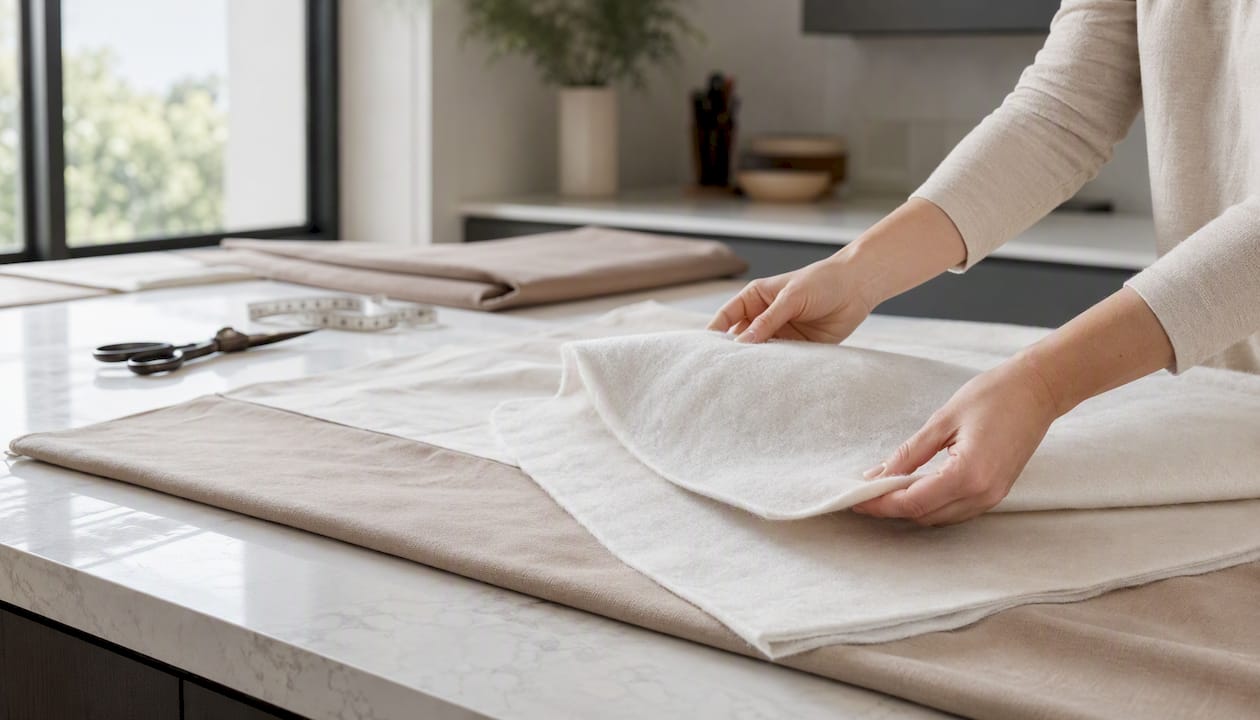
Interlining is a separate layer of thick, soft fabric (usually bump, domette, or a synthetic equivalent) sewn between the face fabric and the lining. Adding interlining increases mass, which improves drape and opacity, and it’s commonly used for a fuller, more opulent look. The acoustic benefit is real but requires density: noticeable noise reduction needs a dense, multi-layer assembly rather than a light retrofit lining. Interlining is almost always a custom or professional job because the layers need to be sewn together precisely to avoid bunching.
Best rooms: Formal living rooms, master bedrooms, home theaters, any room where you want curtains that look genuinely luxurious and provide meaningful noise attenuation. For urban homeowners weighing acoustic benefits, noise insulation in condo living is worth understanding as a whole-room strategy.
Unlined curtains
No lining means maximum light transmission and a casual, airy feel. Sheers, voiles, and lightweight linens often look better unlined because a lining would kill the translucency that makes them work. The tradeoff: no UV protection for the face fabric, minimal privacy at night, and a flatter hang.
Best rooms: Layered window treatments (sheer under a lined drape), sunrooms, casual spaces where light filtering is the goal.
How do the lining types compare?
Pro Tip: Mixing lining types across a room is perfectly valid. A blackout lining on bedroom curtains and a dimout on the living room panels in the same home is a common, practical approach.
What materials are curtain linings made from?
Construction matters more than fabric name when it comes to lining performance. Two linings can both be labeled “polyester” and behave completely differently depending on how they’re woven or coated.
- Polyester sateen: The most common lining material. Durable, resistant to shrinkage, easy to care for, and available in every performance tier from standard to blackout. The tight sateen weave gives it a slight sheen on the face side.
- Cotton sateen: Preferred for natural-fiber projects and breathability. It handles UV well and feels softer than polyester, but it’s more prone to shrinkage and typically costs more.
- Triple-weave fabric: Three interlocked layers woven as one. No coating, no foam. The construction itself blocks light and adds insulation. It drapes more naturally than coated alternatives and doesn’t crack or peel over time.
- Acrylic foam-coated fabric: A base cloth with an acrylic foam layer bonded to the back. Delivers reliable blackout performance but can stiffen with age and may crack if folded sharply. Avoid high-heat drying.
- Metallized/reflective backing: A thin metallic layer (often aluminum-based) applied to the back of a thermal lining. Reflects radiant heat back into the room in winter and reflects solar heat away in summer. Some commercial products combine this with a blackout weave for year-round performance.
- Bump/domette (interlining): A thick, loosely woven or needled fabric used as the middle layer in interlined curtains. Bump is heavier and denser; domette is softer and lighter. Both add significant mass and thermal value.
- FR-treated linings: Flame-retardant treatments are applied to linings used in commercial spaces, rental properties, and some residential applications. FR linings are available in most construction types. If you prefer natural fibers, look for inherently FR materials (such as certain wool blends) rather than chemically treated synthetics.
A well-designed interlined or multi-layer curtain can significantly increase mass and therefore attenuate noise more than a single light lining, according to research on multi-layer curtain performance. The physics is straightforward: more mass means more energy required to vibrate the panel, which means less sound passes through.
How do you choose the right lining for your window?
Start with the room’s primary problem, not the lining’s feature list. Most homeowners get this backwards and end up with a lining that solves a problem they don’t have.
Core questions to ask first:
- What does this room need most? (Privacy, full darkness, warmth, noise reduction, or just better drape?)
- Who uses this room and when? (A shift worker’s bedroom has different needs than a formal dining room used twice a week.)
- How much natural light do you want to keep? (Blackout in a living room often feels oppressive during the day.)
- What’s the face fabric? (Heavy velvet doesn’t need interlining for drape; lightweight linen does.)
- How will you clean these curtains? (Dry-clean-only linings add ongoing cost.)
Decision checklist:
- Assess room usage. Bedrooms and nurseries almost always need blackout or at minimum dimout. Living rooms usually need dimout or thermal. Kitchens and bathrooms need moisture-resistant, easy-care options.
- Measure and plan fullness. Designers recommend panels 2–2.5 times the window width for proper fullness. A heavier lining (interlining, thermal) increases bulk, so factor that into pleat style and track capacity.
- Pick your performance priority. If you need both blackout and insulation, a thermal-blackout combination lining handles both rather than layering two separate linings.
- Check fabric compatibility. A stiff coated blackout lining paired with a lightweight voile face fabric will fight the drape. Match lining weight to face fabric weight.
- Consider attachment method. Sew-in lining gives the cleanest result; clip-on or tape-on retrofit linings work for existing panels but won’t match the drape of a purpose-built curtain.
- Think about care. If the lining requires dry cleaning and the face fabric is machine-washable, you’ll need to remove the lining for cleaning — which means either a detachable lining or a professional clean every time.
Red flags to watch for:
- A heavy interlining on a small window with a narrow track: too much bulk, curtains won’t stack back cleanly.
- Coated blackout lining on a delicate silk face fabric: the stiffness will distort the drape.
- FR-treated synthetic linings in a nursery if you prefer chemical-free environments: look for Oeko-Tex Standard 100 certified options or inherently FR natural fibers instead.
- Choosing unlined curtains for a south- or west-facing room with direct sun: the face fabric will fade within a year or two without UV protection.
How are curtain linings attached and installed?
The attachment method determines how the curtain hangs, how easy it is to clean, and whether you can upgrade the lining later without replacing the whole panel.
Common attachment methods:
- Sew-in (permanent): The lining is sewn directly to the face fabric at the sides and top, then hemmed separately at the bottom. This gives the cleanest drape and the most professional result. It’s the standard for custom curtains.
- Clip-on/eyelet-compatible retrofit: Pre-made lining panels with their own heading tape or eyelets that hang on the same rod as the face curtain. Easy to add or remove, but the drape is never quite as clean as a sewn-in lining.
- Hook-and-loop (Velcro) tape: The lining attaches to the back of the face curtain via adhesive or sewn tape. More secure than clip-on, easier to remove than sewn-in. Works well for thermal retrofit linings.
- Detachable lining with separate heading tape: A lining with its own heading tape that hooks onto the same curtain hooks as the face fabric. Allows independent removal for cleaning.
DIY vs. professional installation:
DIY works well for clip-on or tape-on retrofit linings on standard-sized windows. The process is straightforward and the products are designed for it. Where DIY tends to fall short: large spans (anything over 8 feet wide), interlined curtains (the layers need to be locked together precisely), integrated multi-layer systems, and motorized tracks where the curtain weight must be calculated against the motor’s load rating.
For an integrated multi-layer curtain designed from the start, professional fabrication and fitting gives a more homogeneous drape and better combined performance for insulation and acoustic attenuation than a retrofit approach.
Installation checklist:
- Measure the window width and multiply by 2–2.5 for fullness.
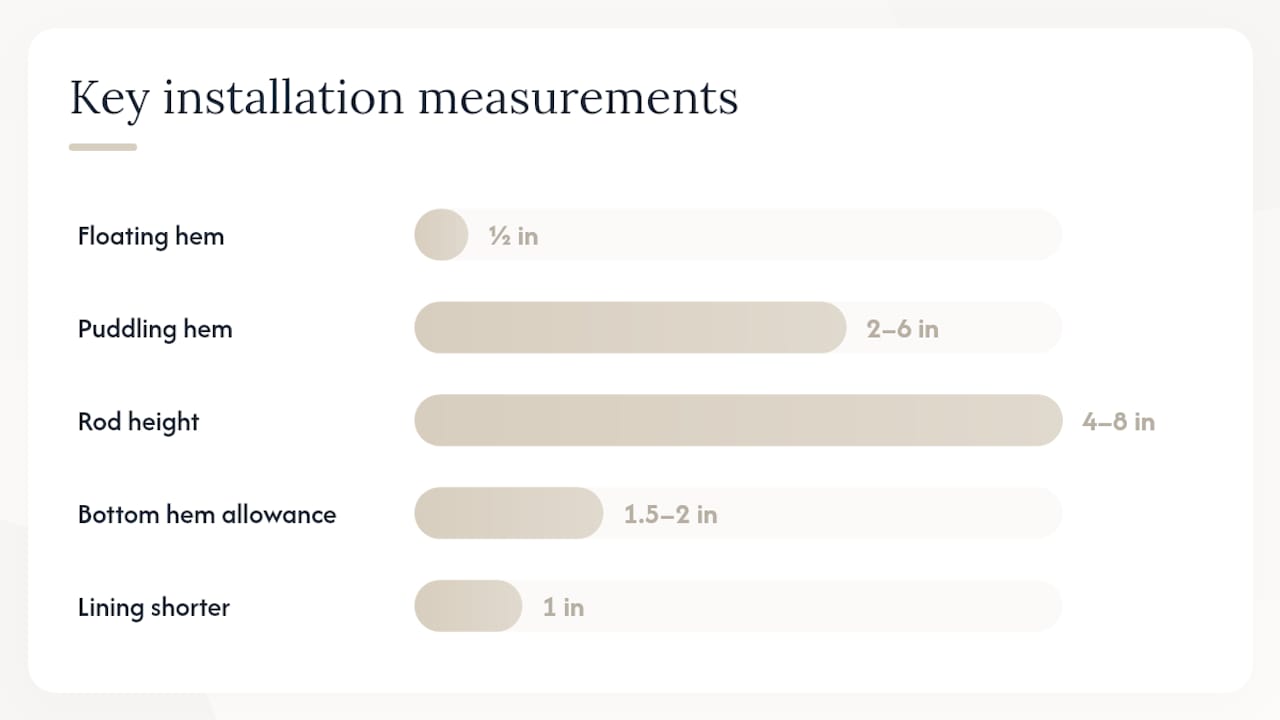
- Decide on hem style: floating (½ inch above floor), kissing (just touching), or puddling (2–6 inches extra). Kissing is the most practical; puddling suits formal rooms.
- Install the rod 4–8 inches above the window frame, or as close to the ceiling as possible, to maximize perceived height.
- Account for lining bulk in your pleat calculation: interlining adds significant depth to each pleat.
- Allow a 1.5–2 inch hem allowance at the bottom for the lining (slightly shorter than the face fabric hem so it doesn’t show).
- Test the track or rod capacity with the combined weight of face fabric and lining before finalizing.
Pro Tip: Always hem the lining 1 inch shorter than the face fabric at the bottom. If the lining is the same length or longer, it will peek out below the hem and ruin the finish.
How do you care for lined curtains?
Lined curtains need a little more thought at cleaning time than unlined panels, mostly because different layers may have different care requirements.
General dos and don’ts:
- Do check the care label on both the face fabric and the lining before washing. If either says dry clean only, treat the whole curtain as dry clean only.
- Do remove curtains from the rod before washing to avoid stressing the heading tape.
- Do test for shrinkage on a small swatch before washing a new lined curtain for the first time, especially with cotton linings.
- Don’t machine wash coated blackout linings on a high spin cycle. The centrifugal force can crack or delaminate the coating. Use a gentle cycle or hand wash.
- Don’t tumble dry acrylic-coated linings at high heat. Air dry flat or hang immediately after washing.
- Don’t iron directly on a coated or metallized lining. Use a pressing cloth or iron the face fabric side only.
Stain care: Spot-treat stains on the lining with a mild detergent and cold water before they set. Most polyester sateen linings respond well to gentle spot cleaning. For interlining, avoid saturating the fabric — the thick middle layer takes a long time to dry and can develop mildew if left damp.
UV degradation: Sun damage is cumulative and irreversible. Rotate curtain panels every 6–12 months in south- or west-facing rooms to even out UV exposure. Pairing lined curtains with a UV-blocking solar film on the glass reduces the load on the lining significantly and extends the life of both the lining and the face fabric. For more on how face fabrics pair with different linings, the curtain material guide covers fabric-lining compatibility in detail.
Pro Tip: If your blackout lining starts letting light through in patches, the coating is delaminating. There’s no fix for this — the lining needs replacing. Budget for lining replacement every 7–10 years in high-sun rooms.
Which lining works best in each room?
Room function drives lining choice more than personal preference. Here’s the practical breakdown.
Bedroom: Blackout lining is the default. Even a small amount of early morning light disrupts sleep quality. If the room gets direct sun, add a thermal layer or choose a thermal-blackout combination lining.
Nursery: Blackout for sleep schedules, but prioritize safety alongside performance. Use cordless or motorized tracks to eliminate cord hazards entirely. Choose Oeko-Tex Standard 100 certified linings to minimize chemical exposure. Easy-care machine-washable linings are worth the slight performance tradeoff.
Living room: Dimout or thermal lining suits most living rooms. Full blackout can feel cave-like during the day. A dimout lining gives privacy and glare control while keeping the room usable in daylight. For rooms with significant heat loss, a thermal lining pays for itself in energy savings over a few winters.
Kitchen: Moisture and cooking grease make heavy linings impractical. A lightweight, machine-washable dimout or standard lining works best. Avoid foam-coated blackout linings in kitchens — grease penetrates the coating and is nearly impossible to clean.
Bathroom: Similar to kitchens: moisture resistance and easy care matter most. Polyester linings outperform cotton here because they resist mildew better. Keep the lining short enough that it doesn’t wick water from the floor.
Media room/home theater: Blackout is non-negotiable for screen visibility. Interlining adds acoustic damping, which improves sound quality in the room. If the room doubles as a living space, consider a motorized track that lets you switch between open and closed positions easily. For a broader view of how interior noise control works room by room, noise-reducing interior door options offer useful context on the full acoustic picture.
A note on child and pet safety: Cord-operated curtain tracks are a documented hazard for young children. The U.S. Consumer Product Safety Commission recommends cordless or motorized window treatments in any room accessible to children under 6. Tiebacks should be secured high enough that children cannot reach them.
What do lined curtains cost, and how long do they take?
Cost varies more than most homeowners expect, and the lining type is only one of several drivers.
Main cost factors:
- Lining type and weight: Standard sateen is the least expensive; interlining adds the most cost because it requires additional fabric and labor.
- Fabric width and fullness ratio: At 2–2.5 times the window width, a single 60-inch window requires 120–150 inches of fabric per panel pair. Every extra layer (lining, interlining) multiplies that yardage.
- Custom measurement and installation: Professional fitting adds to the upfront cost but reduces the risk of expensive mistakes on large or unusually shaped windows.
- FR treatments: Flame-retardant treatments add a modest premium, typically applied at the fabric stage.
- Custom vs. ready-made: Most ready-made panels come in standard lengths of 63, 84, 95, and 108 inches. Custom lengths cost more but are the only option for ceilings above 9 feet or windows with non-standard proportions.
Lead times: Ready-made lined panels are available immediately from retail. Custom-lined curtains typically take 3–6 weeks from measurement to installation, depending on the fabricator and the complexity of the lining specification. Interlined curtains at the higher end of complexity can take 6–8 weeks.
Sizing and price: The fullness ratio directly affects cost. For interlining, that’s three layers of fabric across the full width. The hem style also matters: a puddling hem adds 2–6 inches of fabric per panel, which is negligible on a single window but adds up across a whole house.
When does custom lining make sense?
Ready-made lined panels work for standard windows in standard rooms. Custom lining is worth the investment in specific situations.
Situations that justify custom work:
- Windows that fall outside standard dimensions (too wide, too tall, or arched)
- Rooms requiring integrated blackout and thermal performance in a single curtain
- Multi-layer interlining for acoustic needs in a home theater or music room
- Pattern matching across multiple panels where the repeat must align precisely
- Motorized tracks where curtain weight must be calculated against motor specifications
- Period homes where ceiling heights exceed 9 feet and standard panel lengths fall short
What a professional service delivers:
- Onsite measurement accounting for ceiling height, rod placement, window depth, and any architectural quirks
- Custom fabrication with the correct fullness ratio, pleat style, and lining combination for the specific window
- Professional installation with proper track or rod hardware
- Warranty coverage on both materials and workmanship
Pro Tip: Ask your installer to show you the lining fabric before fabrication begins. The lining is invisible in the finished curtain, but its weight and construction determine how the whole curtain hangs. A cheap lining under an expensive face fabric is a false economy.
What experienced fitters get wrong about lining choices
The most common mistake isn’t choosing the wrong lining type. It’s choosing the right lining for the wrong window size. A heavy interlining on a narrow window with a shallow track creates a curtain that won’t stack back properly and blocks half the window when open. The lining adds bulk, and bulk needs space.
The second mistake: ignoring rod height. Hanging a rod at the top of the window frame instead of 4–8 inches above it makes even a beautifully lined curtain look squat. The lining can’t fix a poorly placed rod.
Measure the drop multiple times. Measure the width multiple times. Then factor in the lining bulk before finalizing the pleat style. A pinch pleat in a heavy interlined curtain needs more depth per pleat than the same pleat in a standard-lined panel. Get that calculation wrong and the heading will look cramped.
Primedecorfurnishing makes custom lining straightforward
Getting the lining right on a custom curtain requires precise measurement, the right fabric pairing, and installation that accounts for track capacity and pleat depth. That’s exactly where Primedecorfurnishing’s service is built to help.

Primedecorfurnishing offers onsite measurement, custom fabrication across the full range of lining types (standard through interlining), professional installation, and warranty coverage on both materials and workmanship. Whether you need blackout lining for a nursery, a thermal-blackout combination for a drafty bedroom, or interlined drapes for a formal living room, the process starts with a single consultation. Browse the full range of curtain and lining options or visit the product catalog to request a quote and schedule an onsite measurement.
Sources
- The Ultimate Guide to Curtain Linings | Edmund Bell
- How to choose curtain length | Martha Stewart
- John Lewis ANYDAY Thermal Pencil Pleat & Eyelet Curtain Lining, Natural
Recommended
Ready to transform your home?
Chat with us on WhatsApp for a free consultation or quote.
Chat with us on WhatsApp