
Curtain Track vs Rod: Which Is Right for Your Windows?
By Prime Decor Furnishing
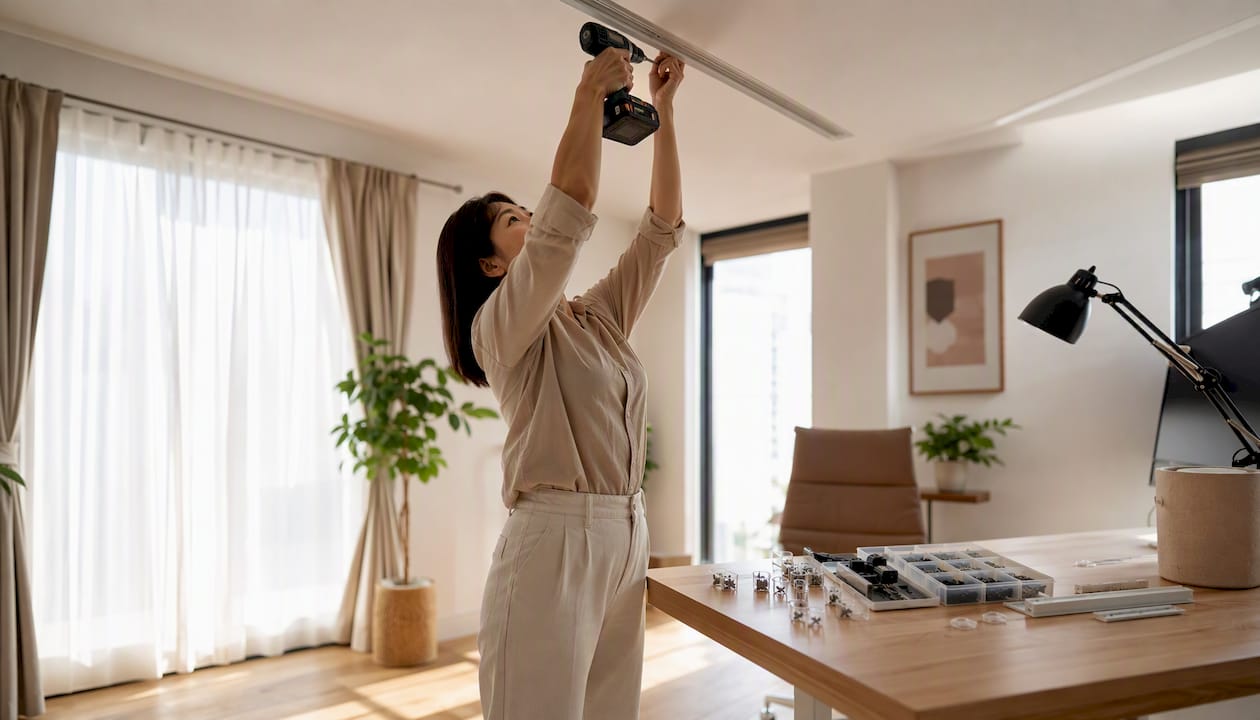
Curtain Track vs Rod: Which Is Right for Your Windows?
Choose a curtain track when your windows are large, your fabric is heavy, or you need a curved bay or wall-to-wall run. Choose a rod when the hardware itself is part of the room’s look and your curtains are lightweight to medium weight. Those two sentences cover most decisions. The remaining considerations come down to header style, motorization, and how much you want to spend on installation.
A few factors settle the question fast: window size and shape, curtain heading type, fabric weight, and whether you want the hardware visible or hidden. If any of those push toward a track, a rod will fight you every step of the way. Primedecorfurnishing offers on-site measurement and professional installation for both systems, which matters most when the stakes are high: heavy drapes, ceiling mounts, or motorized setups where a wrong anchor costs you the whole job.
“If fabric should be the focus, use concealed tracks. If the room needs architectural detail, choose a decorative rod.” — design principle cited by The Arches
Table of Contents
- Curtain track vs rod: at-a-glance comparison
- What exactly are curtain tracks and rods?
- Pros and cons of curtain tracks
- Pros and cons of curtain rods
- Which curtain headers work with tracks vs rods?
- How to measure and what to budget
- Which system fits your room?
- When does motorization make sense?
- Maintenance, longevity, and noise
- Decision checklist before you buy or hire
- Which system should you choose?
- Key Takeaways
- The case for getting the hardware decision right the first time
- Primedecorfurnishing: measurement, installation, and warranty in one visit
- Useful sources
Curtain track vs rod: at-a-glance comparison
| Dimension | Curtain Track | Curtain Rod |
|---|---|---|
| Aesthetic | Concealed hardware; fabric is the feature | Visible hardware; rod/finial is a design element |
| Best window types | Bay, curved, floor-to-ceiling, sliding doors, wide spans | Standard rectangular windows, smaller openings |
| Weight capacity | High; distributes load evenly across gliders | Moderate; prone to sag on long spans with heavy fabric |
| Compatible headers | Pencil pleat, pinch pleat, S-fold/wave, hooks | Eyelet/grommet, tab-top, rod pocket, rings |
| Installation complexity | Moderate to high; ceiling mounts need structural fixings | Low to moderate; most DIY-friendly |
| Cost (product + install) | Moderate to high; motorized adds more | Low to moderate; DIY saves significantly |
| Motorization | Readily available; battery or hardwired | Rare; not standard for most rod systems |
| Maintenance | Clean gliders periodically; replace carriers if worn | Re-tighten brackets; replace rings if bent |
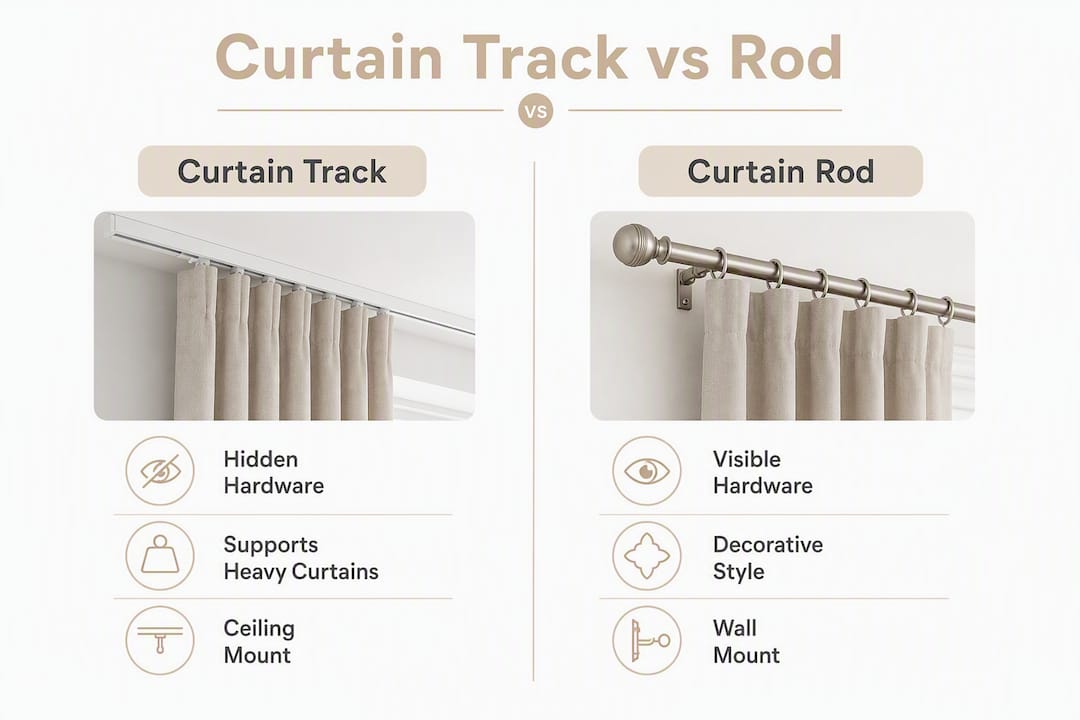
The single row that changes most decisions is weight capacity. Standard decorative poles struggle with heavy or interlined drapes and distribute load unevenly, while tracks spread tension across every glider in the channel. If your fabric is substantial, that difference shows up within months.
Browse Primedecorfurnishing’s curtain and track product range to see both systems side by side before committing.
What exactly are curtain tracks and rods?
Curtain tracks: the anatomy
A curtain track is a channel, usually aluminum or reinforced plastic, fixed to the ceiling or wall. Fabric hangs from gliders (also called carriers or runners) that slide inside the channel. The system can be:
- Hand-drawn: you pull the curtain directly or via a cord loop
- Corded: a pulley system opens and closes both panels from one point
- Motorized: an electric motor drives the gliders, controlled by remote, wall switch, or a smart-home platform
Tracks mount either to the ceiling (the preferred method for a high-and-wide look) or to the wall just above the window frame. Ceiling-mounted tracks create a hotel-style curtain wall that visually raises the ceiling line and minimizes edge gaps. Flexible aluminum tracks can be bent on-site to follow curved or angled bays, which rigid rods simply cannot do.
The parts that most affect function: the gliders determine how smoothly the curtain moves; the end stops prevent panels from sliding off; and the bracket spacing determines whether the track sags under load.
Curtain rods: the anatomy
A curtain rod (or pole) is a horizontal bar, typically steel, brass, wood, or wrought iron, supported by wall brackets at each end and, on longer spans, by a center bracket. Panels hang from rings, grommets, or a rod pocket sewn into the curtain header. Finials cap each end and are a major decorative variable.
Rod types include:
- Single rod: one panel layer
- Double rod: two parallel bars for a sheer layer plus a blackout or decorative layer
- Tension rod: spring-loaded, no drilling required, suited for lightweight curtains in small openings
Pro Tip: On any rod span longer than about 6 feet, add a center support bracket. Without it, even a steel rod will bow noticeably under medium-weight fabric within a year.
Pros and cons of curtain tracks
Tracks earn their place on large, demanding installations. For floor-to-ceiling windows and sliding doors, track systems handle heavy fabrics with minimal resistance and run continuous spans without joins. They also close more tightly at the edges than typical rods, which matters for blackout performance in bedrooms and media rooms.
Functional advantages:
- Smooth, low-friction glide even with heavy or interlined fabric
- Handles curved bays and angled walls via flexible aluminum
- Stacks panels neatly with minimal bunching
- Motorization-ready without retrofitting
- Double-track systems run a sheer and a blackout on the same channel, independently
Aesthetic advantages:
- Hardware disappears behind the fabric or into the ceiling recess
- Ceiling mounting maximizes visual height
- Works with S-fold/wave systems for a tailored, contemporary look
Trade-offs:
- More technical to install correctly, especially ceiling mounts
- Requires solid structural fixings; plasterboard-only anchors are not sufficient for heavy curtains
- Less decorative on its own; if the rod is the room’s jewelry, a track won’t deliver that
Pro Tip: For ceiling-mounted tracks carrying heavy drapes, always fix into joists or use toggle anchors rated for the combined fabric weight. A track that pulls away from the ceiling mid-span is a safety issue, not just an aesthetic one.
Pros and cons of curtain rods
Rods work best when the hardware is part of the design. A brushed-brass pole with oversized finials reads as a deliberate interior choice in a way a concealed track never will. That visibility is the point.
Style advantages:
- Wide range of finishes: matte black, brushed nickel, antique brass, wood, wrought iron
- Finials add a sculptural detail that anchors the window treatment
- Pairs naturally with eyelet, tab-top, and rod-pocket headers, which are the most common curtain styles sold in retail
- Double rods layer sheers and drapes without visible hardware overlap
Practical advantages:
- Easier DIY install for standard rectangular windows
- Lower upfront cost on product and installation
- Tension rods need no tools at all for lightweight panels
Trade-offs:
- Standard poles sag on spans longer than a few meters unless reinforced with intermediate brackets or sectional poles
- Rings and grommets create friction and uneven stacking on heavy fabric
- Not suited for curved bays or continuous wall-to-wall runs
- Motorization is rarely available for standard rod systems
Pro Tip: If you love the look of a decorative rod but need blackout performance, pair a front decorative rod with a ceiling-mounted track behind it for the blackout layer. You get the visual detail and the function.
Which curtain headers work with tracks vs rods?
Header compatibility is where most buying mistakes happen. The wrong header on the wrong hardware means the curtain either won’t hang or won’t move properly.
Track-compatible headers:
- Pencil pleat (via hooks clipped to gliders)
- Pinch pleat (via hooks)
- S-fold / wave fold (requires a dedicated S-fold track with specific glider spacing)
- Eyelet curtains can work on a track only with an adapter ring or by re-heading the panel
Rod-compatible headers:
- Eyelet / grommet (slides directly onto the rod)
- Tab-top (loops over the rod)
- Rod pocket (fabric sleeve slides over the rod)
- Pencil pleat and pinch pleat (via curtain rings with clips)
Tracks are necessary for S-fold curtain styles, and that system requires a track with the correct glider pitch. You cannot hang a wave-fold curtain on a standard rod and get the same effect.
Converting a header to a different system:
- Identify the existing header type and whether it has a tape or fixed pleats.
- For pencil pleat on a rod: attach curtain rings with clips to each pleat hook, then slide rings onto the rod.
- For eyelet on a track: source adapter rings that clip to gliders, or have the curtain re-headed by a workroom.
- For rod-pocket on a track: not practical without re-heading; the sleeve cannot attach to gliders.
Pro Tip: S-fold curtains are the one case where the track and the curtain must be specified together from the start. The glider spacing is fixed at manufacture and determines the wave depth. Order the track and fabric from the same supplier, or confirm the pitch before ordering.
Double-track systems solve the layering problem cleanly: one channel for sheers, one for blackout, both on the same ceiling run with no visible hardware between them.
How to measure and what to budget
Measurement checklist
Getting the numbers right before you order saves a costly re-cut. Measure in this order:
- Drop: floor to ceiling (or to where you want the track/rod) at three points across the window. Use the shortest measurement.
- Width: wall-to-wall or reveal-to-reveal, depending on whether you’re mounting inside or outside the frame.
- Stack-back allowance: add some extra curtain width on each side so panels clear the glass when open.
- Ceiling vs wall offset: for ceiling mounts, measure from the ceiling down; for wall mounts, measure from the bracket position.
- Bay windows: measure each facet individually and note the angle between facets for flexible track bending.
Cost ranges
Costs vary by region, material, and whether you hire a professional. As a general guide:
| Item | DIY estimate | Professional install |
|---|---|---|
| Motorized track system | $200–$600+ | — |
Motorization, ceiling mounts, and structural fixings push costs up the most. Planning motorized tracks during a renovation is significantly cheaper than retrofitting, because running power to the right position before walls are finished costs a fraction of what it costs afterward.
Tools for DIY install: drill, masonry or wood bits, spirit level, tape measure, pencil, wall anchors, and a stud finder for ceiling mounts.
Pro Tip: For curtain installation on ceiling mounts or heavy tracks, always locate joists or structural members before drilling. A stud finder is a worthwhile investment that prevents costly repairs.
Improper anchors are the leading cause of track installation failures in DIY installs. Plasterboard-only fixings are not sufficient for heavy curtains on ceiling tracks.
Which system fits your room?
Bedroom
Tracks win here. Tracks reduce side gaps and stack curtains more neatly, making them the right call for blackout performance. A double track running sheer plus blackout handles every light condition without two separate hardware runs.
Living room
Either works, depending on the look. A decorative rod with eyelet drapes in a neutral linen reads as relaxed and intentional. A ceiling-mounted track with wave-fold panels reads as architectural. The question is whether you want the hardware to be part of the room’s story.
Bay windows
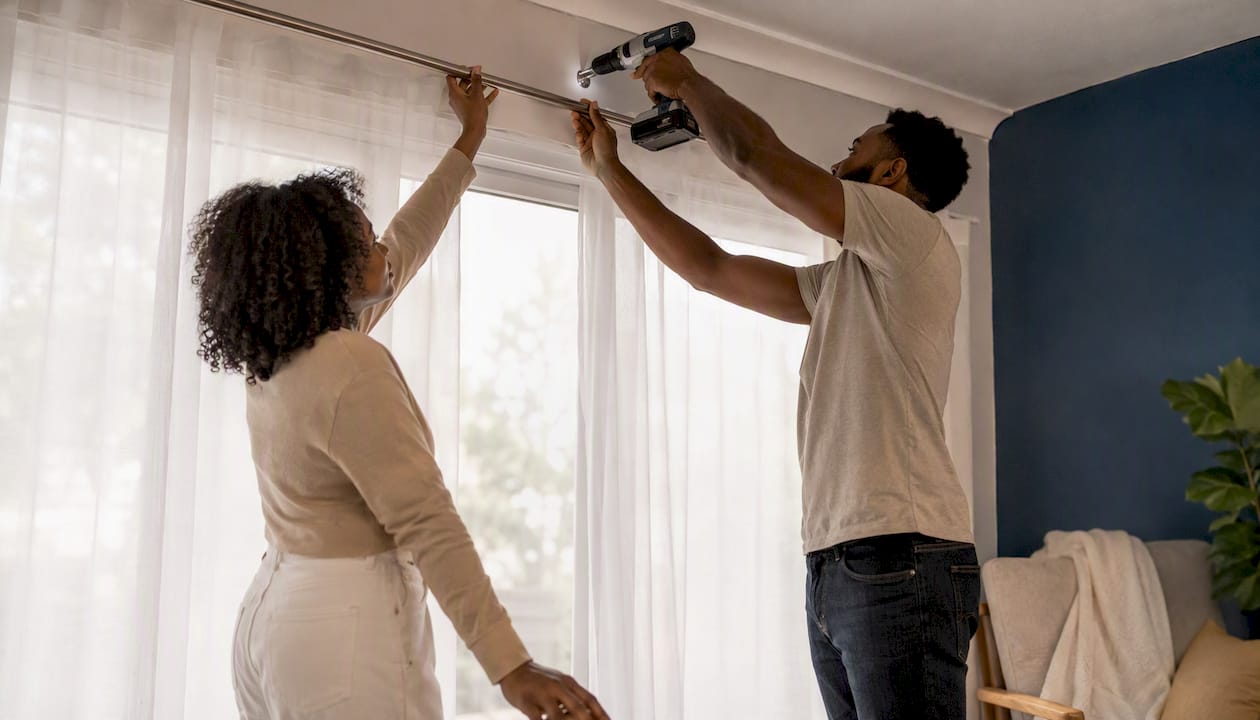
Tracks only. Flexible aluminum tracks bend on-site to follow window contours where rigid rods cannot. A rod on a bay requires separate poles for each facet with visible joins at every angle, which rarely looks intentional. For BTO and HDB-style bay windows, a bent track is the standard professional solution.

Sliding doors
Tracks again. A long, continuous run with heavy panels needs the load distribution and smooth glide that only a track provides. A rod on a wide sliding door will sag and the rings will bind.
Small windows or rentals
Rods, and possibly tension rods. Low cost, no drilling required for tension versions, and easy to remove without patching walls.
Combined solution
For a living room where you want decorative hardware at the front and blackout performance behind: mount a decorative rod for the face panel and a ceiling track for the blackout lining. The rod provides the visual detail; the track does the functional work. Interior door hardware choices follow a similar logic, where visible hardware sets the room’s tone. Choosing the right interior door style involves the same visible-vs-concealed hardware trade-off.
Pro Tip: For homes with young children or pets, corded tracks are a strangulation risk. Specify cordless or motorized systems, or use wand-operated tracks where a child cannot reach the control.
When does motorization make sense?
Motorized tracks are worth the cost in specific situations: windows taller than 9 feet, spans wider than 12 feet, hard-to-reach locations above stairs or in double-height rooms, and any home where smart-home integration is a priority.
Battery vs hardwired:
- Battery-operated motors are available and require no electrical planning, but need periodic recharging (frequency depends on usage)
- Hardwired motors are more reliable for daily use but require a power point near the track, which is easiest to plan during a renovation before walls are finished
- Both types can integrate with remotes, wall switches, and platforms like Amazon Alexa or Google Home
Cost premium: motorized systems add roughly $200–$600 or more to the hardware cost, plus wiring if hardwired. For outdoor or semi-outdoor applications, motorized zip-track systems are a separate category worth exploring. Primedecorfurnishing’s zip track blind options cover that use case.
Pro Tip: If you’re renovating and even slightly considering motorization, run the conduit now. Adding it after the walls are finished costs three to five times more and usually means visible cable runs.
Maintenance, longevity, and noise
Tracks
Aluminum tracks are durable and largely maintenance-free. The main tasks: wipe the channel clean every six months to prevent grit from wearing the gliders, and replace individual carriers if they crack or bind. Motorized systems need occasional motor servicing per the manufacturer’s schedule.
Noise is minimal on quality tracks. Cheap plastic gliders on a low-grade channel will click and scrape; aluminum gliders on a powder-coated aluminum track are nearly silent.
Aluminum tracks handle humidity well, making them suitable for bathrooms and covered outdoor areas. Plastic tracks degrade faster in UV-exposed or high-humidity environments.
Rods
Steel and brass rods are durable but need bracket re-tightening every year or two, especially if the curtains are opened and closed frequently. Wooden poles can warp in high-humidity rooms. Rings wear at the contact point with the rod and may need replacing after several years of daily use.
Noise is the main complaint with rings on rods. Metal rings on a metal rod produce an audible scrape with every open and close. Nylon rings or rings with nylon inserts reduce this significantly.
Pro Tip: A drop of silicone lubricant on the rod or inside the track channel every year keeps both systems moving quietly. Avoid oil-based lubricants; they attract dust and make the problem worse over time.
For troubleshooting: a sagging rod needs an intermediate bracket, not a heavier rod. Sticky gliders on a track usually mean grit in the channel or a bent section from a hard pull. Noisy runners on a track are almost always a lubrication issue.
Decision checklist before you buy or hire
Work through these before placing an order or booking a consultation:
- What is the window width and drop? (Measure at three points.)
- What is the fabric weight? (Light, medium, or heavy/interlined?)
- Which header style do you prefer, and is it compatible with your chosen hardware?
- Do you want the hardware visible or concealed?
- Do you need motorization now, or is it a future option to plan for?
- What is your total budget, including installation?
- Is the window a standard rectangle, a bay, or a curved/angled shape?
- Do you need blackout performance or layered light control?
Questions to ask an installer:
- Will you do an on-site measurement before quoting?
- What fixing method do you use for ceiling mounts, and what are the structural requirements?
- What warranty do you offer on product and installation?
- What are your lead times from measurement to installation?
Red flags in a quote:
- No on-site measurement offered (phone or photo quotes for tracks are unreliable)
- Vague fixing method (“we’ll use whatever works”)
- No warranty on installation labor
- No mention of structural fixings for ceiling mounts
Pro Tip: Ask specifically whether the installer will fix into joists or structural members for ceiling-mounted tracks. If the answer is vague, that is your signal to find someone else.
Which system should you choose?
For most homeowners, the decision breaks down cleanly. Heavy fabric, large windows, curved bays, blackout bedrooms, or sliding doors: choose a track. Decorative hardware, standard rectangular windows, lighter curtains, or a rental where you can’t drill: choose a rod. The combined approach (decorative rod in front, track behind) solves the cases where you want both.
Primedecorfurnishing handles both systems with on-site measurement, professional installation, motorized-track options, and a product warranty. That matters most on the installs where a DIY mistake is expensive: ceiling mounts, heavy drapes, curved bays, and motorized setups. The free home measurement service removes the guesswork on sizing and fixing points before a single bracket goes into the wall.
Pro Tip: Book the measurement appointment before you buy fabric. The track or rod specification (length, bracket positions, ceiling vs wall mount) affects how much fabric you need and where the pleats fall. Getting the hardware confirmed first saves a re-cut.
Key Takeaways
Curtain tracks outperform rods on heavy fabric, large spans, curved bays, and blackout applications; rods win on visible hardware aesthetics and simple DIY installs for standard windows.
| Point | Details |
|---|---|
| Weight capacity decides most | Tracks distribute load across gliders; rods sag on heavy or interlined fabric over long spans. |
| Header compatibility is non-negotiable | S-fold and wave-fold curtains require a dedicated track; eyelet and rod-pocket headers need a rod. |
| Ceiling mounts need structural fixings | Plasterboard-only anchors are insufficient for heavy ceiling-mounted tracks; fix into joists. |
| Motorization needs early planning | Hardwired motorized tracks are far cheaper to plan during renovation than to retrofit afterward. |
| Primedecorfurnishing | Offers on-site measurement, professional installation, motorized-track options, and a product warranty for both systems. |
The case for getting the hardware decision right the first time
Most people spend weeks choosing fabric and ten minutes choosing hardware. That ratio should be closer to even. The hardware determines whether the curtain moves smoothly in five years, whether the blackout actually works, and whether the ceiling mount stays in the wall. Fabric is replaceable; a ceiling that’s been patched twice because the anchors failed is not.
The conventional wisdom is that tracks are “functional” and rods are “decorative,” as if those are mutually exclusive. They’re not. A ceiling-mounted track with a wave-fold panel in a textured linen is one of the most considered-looking window treatments you can install. The hardware is invisible, which is exactly the point: the fabric does all the work. Conversely, a beautifully finished brass rod with oversized finials in a reading room is doing real architectural work, not just holding fabric up.
What professionals see repeatedly is homeowners choosing rods for large windows because rods feel more familiar, then living with sagging poles and uneven stacking for years. The fix is always a track. Getting that conversation right at the start, with someone who will measure the window and specify the correct fixing method, is worth more than any amount of time spent on Pinterest.
Primedecorfurnishing: measurement, installation, and warranty in one visit

Choosing between a track and a rod is straightforward once someone has measured your window, assessed the wall structure, and confirmed which header your fabric uses. That’s exactly what Primedecorfurnishing does on every project: one visit covers measurement, hardware specification, fabric samples, and a fixed quote with no surprises.
The service includes motorized-track options for large or hard-to-reach windows, a product warranty, and installation by experienced fitters who specify the correct structural fixings for ceiling mounts. Sample fabric swatches are available so you can see how the material behaves in your light before committing.
Book a free home measurement to get a confirmed specification and quote. Browse the full product catalog to see track systems, decorative rods, and motorized options before your appointment.
Useful sources
- Curtain track rail guide | Goodrich Global
- Curtain Poles vs Tracks: Pros, Cons & Which One to Choose | DotcomBlinds
- Curtain Pole vs Track: Soft Furnishings Guide | HouseJester
- Advice: Ceiling-mounted curtains | NYT Wirecutter
- Curtain Tracks vs. Traditional Curtain Rods: Which is Better for Your Home? | The Arches
- Choosing rods or tracks for curtains | Spotlight Stores
Recommended
Ready to transform your home?
Chat with us on WhatsApp for a free consultation or quote.
Chat with us on WhatsApp