
Curtains vs Blinds: What Every Homeowner Should Know
By Prime Decor Furnishing
Curtains vs Blinds: What Every Homeowner Should Know
Blinds win on light control and easy cleaning; curtains win on insulation, softness, and style. For most rooms, the smartest answer is both.
- Bedrooms: Blackout curtains or a blackout roller blind paired with drapery gives you total darkness and a finished look.
- Kitchens and bathrooms: Moisture-resistant vinyl or aluminum blinds handle steam and grease far better than fabric.
- Living rooms: A layered approach, sheer curtains over a roller or Venetian blind, balances daytime privacy with evening warmth.
The single most useful rule in the curtains vs blinds debate: match the treatment to the room’s moisture level and light-control demand first, then layer for style. Measurement accuracy and cord safety matter just as much as the product you pick.
Jump to the room-by-room guide if you already know the basics, or keep reading for the full comparison.
Table of Contents
- How curtains and blinds compare at a glance
- What blinds are and which type fits your window
- What curtains and drapes actually are
- Pros and cons head-to-head across what homeowners actually care about
- Room-by-room: which treatment works best where
- How to choose and measure correctly
- Installation, maintenance, and how long treatments last
- When and how to layer blinds and curtains
- Choosing materials and colors that actually work
- When to hire a professional installer
- Key Takeaways
- The case for getting the basics right before the aesthetics
- Primedecorfurnishing takes the guesswork out of window treatments
- Useful sources for homeowners who want to go deeper
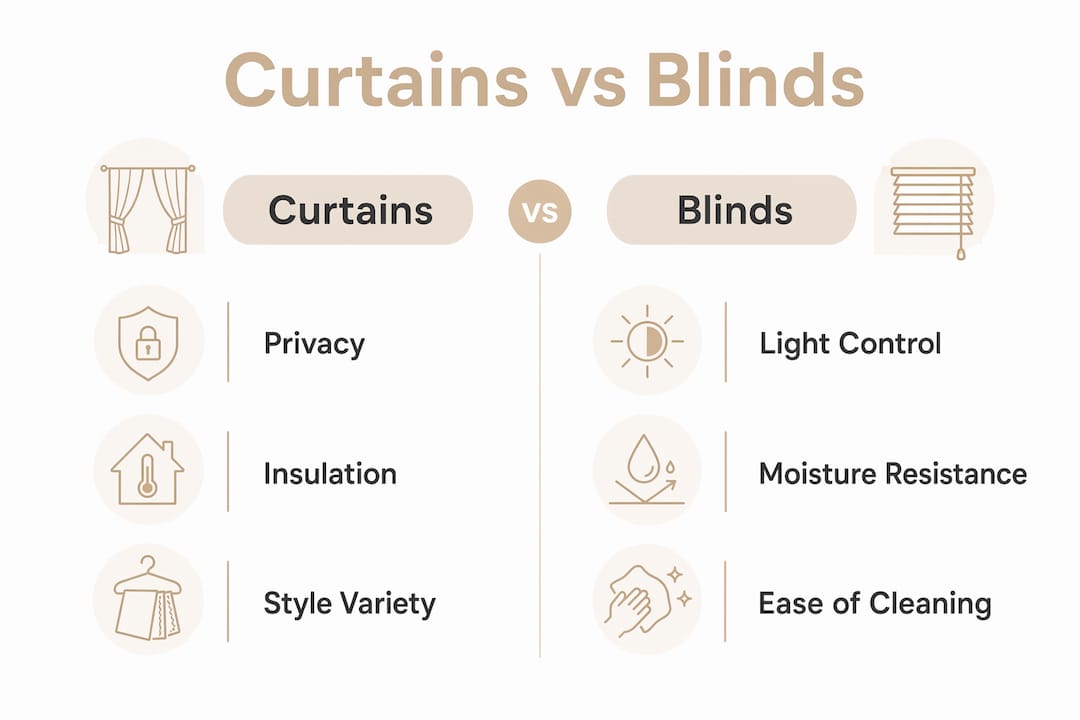
How curtains and blinds compare at a glance
| Dimension | Blinds | Curtains |
|---|---|---|
| Light control | Precise, adjustable via slats or roll | Broad; blackout linings needed for full block |
| Privacy | Good with slats closed; some light bleed | Excellent when closed; sheers allow filtered view |
| Insulation / energy | Reflective blinds cut summer heat gain; cellular blinds trap air | Lined/thermal drapes reduce drafts and heat loss |
| Maintenance | Wipe-clean slats; dust weekly | Machine wash (cotton/poly) or dry-clean (velvet/silk) |
| Cost | Ready-made from ~$20; custom wood from ~$150+ per window | Panels from ~$15; custom lined drapes from ~$200+ per window |
| Aesthetic impact | Clean, modern, minimal | Soft, layered, formal or casual depending on fabric |
| Durability | Metal/PVC: 7–10 years; wood: 5–8 years | Quality lined drapes: 5–10 years; sheers: 3–5 years |
| Installation | Inside or outside mount; DIY-friendly for standard sizes | Rod and bracket; high-and-wide mounting adds complexity |
| Best rooms | Kitchens, bathrooms, offices, small spaces | Bedrooms, living rooms, dining rooms, nurseries |
| Safety | Corded systems pose strangulation risk; cordless/motorized preferred | Fabric pooling can be a trip hazard; tie-backs recommended |
Three differences that actually decide the choice:
- Light bleed: Even closed slats let in thin lines of light at the edges. A blackout fabric panel eliminates that entirely.
- Insulation gap: Cellular (honeycomb) blinds trap air in their cells and reduce heat loss measurably, but a floor-length lined drape covering the full window frame still outperforms them in cold climates.
- Cleaning reality: Blinds with horizontal slats collect dust on every surface. A machine-washable cotton curtain panel is genuinely faster to clean once a month.
Budget reality: ready-made panels and standard roller blinds are among the most affordable window treatments you can buy. The cost jumps sharply when you move to custom sizing, motorization, or premium materials like real wood or velvet-lined drapes.
What blinds are and which type fits your window
Blinds use rigid slats, vanes, or a rolled sheet to control how much light enters a room and how much of the view is exposed. Tilting the slats redirects daylight without blocking it entirely, which is something fabric panels simply cannot do.
The main blind types and what sets each apart:
- Venetian blinds: Horizontal aluminum or wood slats that tilt and raise. Aluminum is the budget pick for kitchens and bathrooms; real wood adds warmth to living rooms and offices.
- Roller blinds: A single fabric sheet that rolls onto a tube. Simple, space-efficient, and available in blackout fabrics. One of the most popular choices for bedrooms and home offices.
- Cellular (honeycomb) blinds: Fabric cells that trap air and provide the best insulation of any blind type. Single-cell for mild climates, double-cell for colder regions.
- Roman blinds: Fabric that folds into horizontal pleats when raised. They sit closer to curtains in feel, adding softness while keeping a structured look. Roman or roller blinds is a common sub-decision: Romans suit formal rooms; rollers suit minimal or functional spaces.
- Vertical blinds: Fabric or PVC vanes that hang and rotate. The standard choice for wide sliding glass doors and patio openings.
- Panel track blinds: Wide fabric panels that slide on a track. A modern alternative to vertical blinds for large windows and room dividers.
Materials matter more than most buyers realize. PVC and aluminum handle moisture and are easy to wipe down. Faux wood (PVC-core with a wood veneer) looks like real wood but won’t warp in humid rooms. Real wood warps in bathrooms and kitchens, so save it for dry spaces.
Pro Tip: Cordless and motorized blinds are not just a convenience upgrade. The U.S. Consumer Product Safety Commission has linked corded window covering cords to child strangulation incidents. If you have children or pets at home, cordless or motorized options are the only versions worth considering.

What curtains and drapes actually are
The terms get used interchangeably, but they mean different things in practice. Curtains are lighter-weight fabric panels, usually unlined, that hang from a rod and stop at or just below the windowsill. Drapes are heavier, typically lined or interlined, and fall to the floor. Sheers are translucent panels that filter light without blocking the view. Blackout panels have an opaque lining sewn in or bonded to the back.
Fabric and lining choices by room:
- Cotton and linen: Breathable, casual, machine-washable. Good for kitchens, family rooms, and informal bedrooms.
- Polyester blends: Wrinkle-resistant and affordable. Hold color well and suit most rooms.
- Velvet: Heavy, sound-absorbing, and excellent for insulation. Best in formal living rooms or bedrooms where you want maximum warmth and drama. Dry-clean only.
- Sheer voile or organza: Lets in diffused light while maintaining daytime privacy from the street. Often layered over a roller blind or heavier drape.
- Blackout-lined panels: The lining is bonded or sewn to the back of any fabric. You can have a linen curtain with a blackout lining, which gives you the look of natural fabric with the sleep-quality darkness of a dedicated blackout product.
How you hang curtains changes how the window looks. Mounting the rod 4–6 inches above the frame and extending it 6–12 inches beyond each side makes windows look taller and wider. That trick works especially well in low-ceiling rooms where you want to draw the eye upward.
Pro Tip: A thermal interlining, a layer of thick cotton batting sewn between the face fabric and the lining, adds meaningful draft reduction in older homes with single-pane windows. It also makes curtains hang with a fuller, more structured drape. Ask your fabricator specifically about thermal interlining if energy efficiency is a priority.
Pros and cons head-to-head across what homeowners actually care about
Light control Blinds give you more precision. Tilting aluminum or wood slats lets you bounce light toward the ceiling while keeping glare off a screen. Adjustable slats let you control the direction of daylight in a way fabric panels cannot. Curtains are binary: open or closed. The exception is sheers, which soften light without eliminating it.
Privacy Curtains win here, especially at night when interior lighting makes you visible from the street. Closed slat blinds leave thin light gaps at the edges and between slats. A lined curtain panel pulled shut leaves no gaps.
Insulation and energy efficiency Both can contribute, but differently. Reflective blinds reduce summer heat gain through glass, which matters in south- and west-facing rooms. Cellular blinds trap air and reduce heat loss in winter. Lined and thermal-backed drapes cover the full window frame, including the edges where most drafts enter, making them the stronger performer in cold climates.
Maintenance Blinds with horizontal slats collect dust on every slat surface. A quick pass with a microfiber cloth or a vacuum brush attachment handles weekly maintenance, but a deep clean requires removing the blind and washing or wiping each slat individually. Curtains made from cotton or polyester blends can go straight into the washing machine. Velvet and silk-alternative drapes need dry cleaning or careful hand washing.
Cost Ready-made panels and standard blinds are both affordable entry points. The price gap opens at the custom end: custom-lined drapes with professional installation cost significantly more than a standard roller blind on the same window. Neither category is inherently expensive, but custom fabrication and motorization add up fast.
Safety Corded blinds are the one area where the choice has real consequences. The U.S. Consumer Product Safety Commission has issued warnings about looped cords on window coverings. Cordless, motorized, or tension-cord systems eliminate the risk. Curtains present a different hazard: long pooling fabric can be a trip hazard and a fire risk near stoves or candles.
Environmental note PVC blinds are difficult to recycle and contain plasticizers. Aluminum blinds are more recyclable. Natural-fiber curtains (cotton, linen) biodegrade; synthetic blends do not. If sustainability matters to you, ask your supplier about recyclable aluminum blinds or certified-organic fabric curtains.
Pro Tip: When comparing costs, factor in the full window, not just the product price. A $30 roller blind that requires a $60 installation visit costs more than a $50 curtain panel you hang yourself in ten minutes.
Room-by-room: which treatment works best where
Bedroom
Blackout is the priority. A blackout roller blind handles the functional need; adding a lined drape over it gives you the layered, finished look most bedrooms call for. For a nursery, cordless blackout roller blinds are the only safe choice. Paired solutions combining blinds and curtains are the standard recommendation for bedrooms where both total darkness and styling matter.
Living room
The living room is where layering pays off most. A sheer curtain filters daytime light and softens the window; a roller or Venetian blind underneath gives you privacy and glare control when you need it. For a more formal room, floor-length lined drapes over a cellular blind handle both insulation and style. Blinds for the living room work well as a standalone in modern, minimal spaces where fabric would feel heavy.
Kitchen
Moisture, grease, and steam rule out most fabric options. Vinyl or aluminum Venetian blinds are the practical standard. A short café-style curtain in a washable cotton can work at the lower half of the window for a softer look, but keep it away from the stovetop. Synthetic or metal blinds handle steam and grease far better than any fabric treatment.
Bathroom
Same logic as the kitchen: moisture resistance first. A waterproof roller blind in PVC or polyester is the standard choice. Avoid wood, faux wood, and any fabric that will absorb humidity and develop mildew.
Sliding glass doors and patio openings
Vertical blinds or panel track blinds are purpose-built for wide openings. They stack neatly to one side and don’t interfere with the door mechanism. Floor-length drapes on a wide track rod work too, but require more clearance and a heavier rod system.
Home office
Glare on screens is the main problem. A roller blind or Venetian blind lets you tilt or lower to cut direct sun without darkening the room entirely. If you’re on video calls, a light-filtering roller blind behind you keeps the background bright without washing out your face.
Nursery
Cordless blackout roller blinds, full stop. No looped cords, no pooling fabric, no exceptions. Add a sheer panel on a tension rod if you want softness during daytime naps.
Pro Tip: In bathrooms and kitchens, avoid real wood blinds entirely, even if the finish looks sealed. Steam penetrates over time and causes warping. Faux wood (PVC-core) looks nearly identical and lasts years longer in humid conditions.
How to choose and measure correctly
Decision checklist
Work through these questions before you order anything:
- What is the room’s primary need? Blackout for sleep, glare control for work, moisture resistance for wet rooms, or style for a formal space?
- Do you have children or pets? If yes, cordless or motorized only.
- What is the moisture level? High humidity means synthetic or metal blinds, not fabric or real wood.
- What is your budget? Ready-made fits standard windows; custom fabrication is needed for anything non-standard.
- Do you want a single treatment or a layered look? Layering adds cost and complexity but delivers better performance and style.
- How much maintenance are you willing to do? Blinds need regular dusting; curtains need washing or dry cleaning.
Measurement basics
- Inside mount: Measure the width and height of the window opening at three points (top, middle, bottom for width; left, center, right for height). Use the smallest measurement. Deduct 1/4 inch from the width for clearance.
- Outside mount: Measure the full area you want covered, including the frame and any overlap onto the wall. Add 2–3 inches on each side for light blockage.
- Curtain width: For a full, gathered look, the total fabric width should be 2–2.5 times the rod width. For a flat, modern panel look, 1.5 times is enough.
- Curtain length: Measure from the rod to where you want the hem. Add 1/2 inch for a clean break at the floor, 1–2 inches for a slight puddle, or 4–6 inches for a formal pool.
- Clearance for handles and locks: When mounting a blind inside the frame, check that the bottom rail clears any window locks or handles when fully lowered.
When to DIY vs. when to call a professional
- DIY is reasonable for standard-size windows, ready-made products, and simple rod-and-bracket curtain installations.
- Call a professional for floor-to-ceiling drapery, motorized systems, irregular or arched windows, bay windows, or any project where a measurement error means a $300+ custom order has to be remade.
Primedecorfurnishing offers free home measurement for exactly these situations, removing the risk of ordering the wrong size.
Installation, maintenance, and how long treatments last
Installation overview
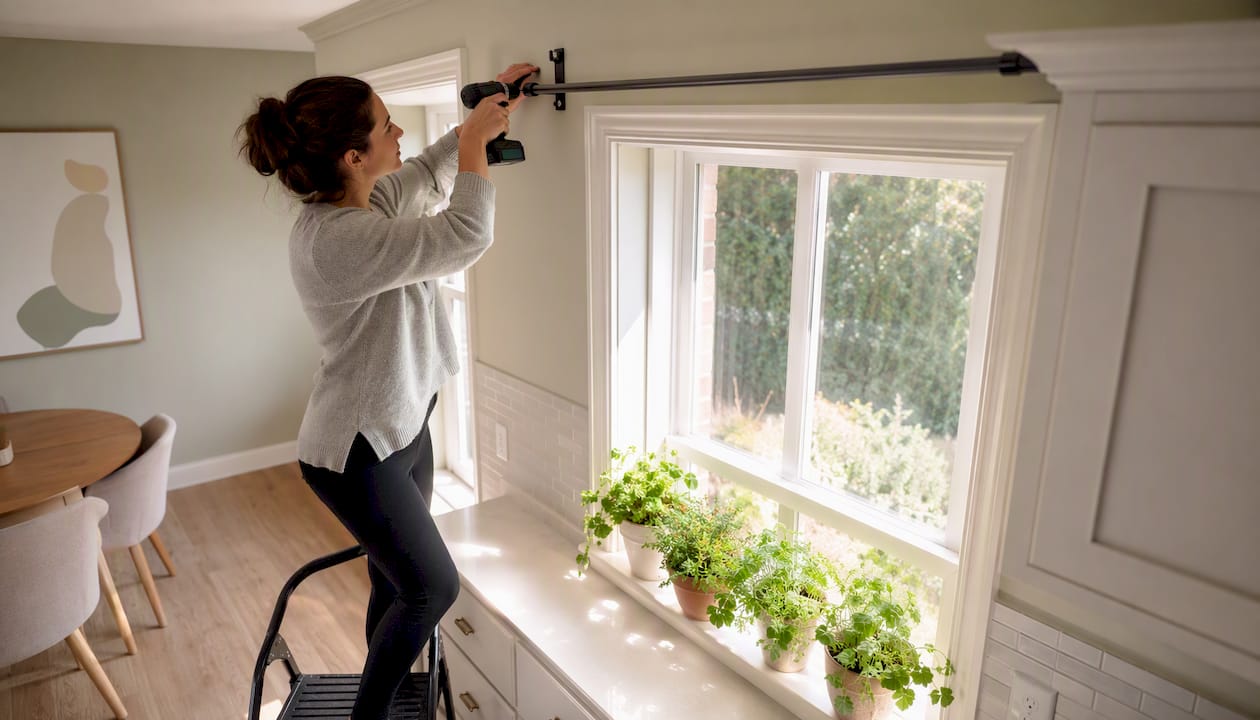
A standard inside-mount roller blind on a flat window takes about 15 minutes with a drill and a level. Outside-mount curtain rods on drywall take longer because you need to locate studs or use appropriate anchors for the bracket weight. The common mistakes are mounting the rod too low (kills the illusion of height), using anchors too small for the bracket load, and not checking that the blind clears the window handle.
For motorized systems, the installation involves running power or checking battery access, pairing the remote or app, and setting upper and lower limits. That is a job most homeowners can do, but it takes 45–60 minutes per window and requires reading the manual carefully.
Maintenance schedule
Blinds:
- Weekly: dust slats with a microfiber cloth or vacuum brush.
- Monthly: wipe aluminum or PVC slats with a damp cloth and mild soap.
- Annually: remove fabric roller or Roman blinds and hand wash or spot-clean per manufacturer instructions.
Curtains:
- Monthly: shake out or vacuum with an upholstery attachment.
- Every 3–6 months: machine wash cotton and polyester panels on a gentle cycle; hang to dry to prevent shrinkage.
- Annually: dry-clean velvet, silk-alternative, or heavily lined drapes.
- Steam cleaning works well for drapes you don’t want to take down; a handheld steamer removes wrinkles and refreshes fabric between washes.
Lifespan expectations
- PVC and aluminum blinds: 7–10 years with regular cleaning.
- Real wood blinds: 5–8 years in dry rooms; less in humid conditions.
- Fabric roller and Roman blinds: 5–7 years before fabric fades or the mechanism wears.
- Quality lined drapes: 5–10 years, longer if dry-cleaned and stored properly.
- Sheers: 3–5 years before UV degradation yellows the fabric.
Signs it’s time to replace: slats that won’t stay level, cords that fray or jam, fabric that has yellowed or developed permanent stains, and mechanisms that no longer hold position.
Motorized system maintenance
- Check battery level or power connection every 6 months.
- Wipe the motor housing with a dry cloth; never use liquid near the motor.
- Re-set upper and lower limits if the blind overshoots or stops short.
- Review your warranty terms annually; most manufacturers require professional service for motor replacement to keep the warranty valid.
When and how to layer blinds and curtains
Layering is not just a style choice. It is the most effective way to get full blackout, strong insulation, and a finished look simultaneously. A single treatment almost always involves a trade-off; layering eliminates most of them.
Common layering combinations:
- Blackout roller blind + lined drapes: The most popular bedroom combination. The roller handles blackout; the drapes add insulation, softness, and style. Mount the roller inside the frame and the curtain rod outside, 4–6 inches above the frame.
- Venetian blind + sheer curtain: The standard living room pairing. The sheer filters light and softens the window during the day; the blind gives you privacy and glare control when needed. Designers recommend pairing blinds with drapery for complete solutions.
- Cellular blind + panel curtains: Best for rooms where insulation is the priority. The cellular blind traps air; the panel curtains cover the frame edges where drafts enter.
Mounting order and clearance
Always mount the blind first, then the curtain rod above it. The rod should sit high enough that the curtain stack-back (the bunched fabric when curtains are open) doesn’t cover the blind’s operating cord or chain. Leave at least 3 inches of clearance between the top of the blind and the bottom of the rod bracket.
To minimize light gaps at the edges, extend the curtain rod 6–10 inches beyond the window frame on each side. When the curtains are closed, they overlap the wall rather than just the frame, blocking the side gaps that even a well-fitted blind leaves.
Pro Tip: The biggest layering mistake is mounting both treatments at the same height. The blind goes inside or at frame level; the curtain rod goes above the frame, as high as 4–6 inches from the ceiling in rooms with tall ceilings. That separation is what makes the window look intentional rather than cluttered.
Choosing materials and colors that actually work
Fabric by function
- Thermal lining: Adds a layer of insulating cotton or polyester batting between face fabric and lining. Best for north-facing rooms and older homes with drafty windows.
- Blackout lining: An opaque, usually white or cream, coated fabric bonded to the back. Works with any face fabric and blocks 99% of light when properly fitted.
- Sheer voile: Polyester or linen-blend, translucent. Filters UV and softens light without blocking the view. Pairs well with a heavier treatment behind it.
- Moisture-resistant polyester: The standard for roller blinds in kitchens and bathrooms. Wipes clean and resists mildew.
Color and pattern guidance
Light neutrals (white, cream, warm gray) reflect light and make rooms feel larger. They also show dust and stains more readily. Dark colors (charcoal, navy, forest green) absorb light and create a cocooning effect in bedrooms; they hide dust better but can make small rooms feel smaller. Bold prints work best on a single focal window rather than across an entire room. Texture (linen weave, velvet pile, woven cotton) adds visual interest without the commitment of a pattern.
Blind finishes and aging
Aluminum blinds hold their finish well but can dent. Real wood develops a patina over time that many homeowners like; it also fades in direct sun. Faux wood resists fading and warping but can look slightly plastic up close. Fabric roller blinds fade faster than hard blinds in south-facing rooms; UV-resistant coatings extend their life.
Sustainability note
Ask your supplier whether aluminum blinds are made from recycled content and whether they offer a take-back program. For curtains, OEKO-TEX certified fabrics have been tested for harmful substances including VOCs. Natural fibers (cotton, linen) are biodegradable; most synthetic blends are not. Coordinating your interior door style and window treatments from suppliers who share sustainability standards makes the whole project more cohesive.
When to hire a professional installer
Some window treatment projects are genuinely DIY-friendly. Others are not, and the cost of a measurement error on a custom order is usually higher than the cost of a professional fitting.
Hire a pro when:
- Windows are irregular, arched, bay-style, or floor-to-ceiling.
- You are installing motorized systems that require wiring or app integration.
- The project spans multiple rooms and you need consistent height and alignment across windows.
- You are ordering custom-fabricated, lined drapes where a 1-inch error means a remake.
- You want a warranty-backed installation that covers both product and fitting.
What a reputable installer provides
A professional service should include an on-site measurement visit before any fabrication begins, a written order confirmation with exact dimensions, and a clear warranty covering both the product and the installation. Primedecorfurnishing’s free home measurement service covers all of these, with warranty-backed installation and project management across curtains, blinds, and motorized systems.
Questions to ask before you sign
- What is the lead time from measurement to installation?
- Does the warranty cover the mechanism and the fabric, or just one?
- What happens if the product arrives with a defect?
- Are motorized systems compatible with my existing smart-home setup?
- Can I see fabric samples and finish samples before fabricating?
Pro Tip: Always get a written order with exact dimensions before fabrication starts. Verbal confirmations and email summaries are not enough. A written order protects you if the product arrives at the wrong size and the supplier disputes who measured.
Verify that the installer carries liability insurance and that the warranty is in writing. A professional who hesitates on either point is worth reconsidering.
Key Takeaways
Blinds and curtains each have a clear home: match the treatment to the room’s moisture level and light-control demand, then layer for style and insulation when the budget allows.
| Point | Details |
|---|---|
| Match treatment to room function | Moisture-prone rooms need synthetic or metal blinds; bedrooms and living rooms benefit from curtains or layered treatments. |
| Layering outperforms single treatments | A blackout roller blind paired with lined drapes delivers better light control, insulation, and style than either alone. |
| Cord safety is non-negotiable | Cordless or motorized systems are the only safe choice in homes with children or pets. |
| Measure before you order | Inside-mount blinds need 1/4-inch clearance; curtain rods should sit 4–6 inches above the frame for best results. |
| Primedecorfurnishing | Offers free home measurement, custom fabrication, and warranty-backed installation for curtains, blinds, and motorized systems. |
The case for getting the basics right before the aesthetics
Most homeowners approach the curtains vs blinds decision backwards. They pick a fabric or a finish they like, then try to make it work for the room. The result is a beautiful bedroom that lets in light at 6 AM, or a kitchen with linen curtains that smell like last Tuesday’s dinner.
The functional requirements are not complicated: moisture resistance, light control, and cord safety. Get those right first, and the style choices become much easier because you have already eliminated the options that won’t work. A blackout roller blind in a bedroom is not a compromise; it is the correct tool for the job. A lined drape over it is where the style lives.
The one thing most guides underplay is the measurement step. A curtain panel that is 2 inches too short looks wrong every single day. A blind that is 1/4 inch too wide for the inside mount won’t fit at all. Spending 20 minutes measuring carefully, or booking a professional to do it, saves more frustration than any amount of research into fabric weights and slat materials.
Primedecorfurnishing takes the guesswork out of window treatments
Getting window treatments right means accurate measurements, the right materials for each room, and an installation that holds up over time. That is exactly what Primedecorfurnishing delivers.

The service starts with a free on-site measurement visit, so you never order the wrong size. From there, you choose from a full range of curtains and blinds, including motorized options, blackout fabrics, moisture-resistant blinds, and custom-lined drapes. Every installation is warranty-backed, and the team handles multi-room coordination so your window treatments are consistent across the whole home. With over 5,000 satisfied customers and recognition in The Straits Times for pricing transparency, Primedecorfurnishing has built a track record worth trusting.
Ready to get the right fit the first time? Book a free measurement or browse the full product range to get started.
Useful sources for homeowners who want to go deeper
- Blinds vs. Curtains: Which Are Right for Your Home? — Bob Vila: Solid overview of cost ranges, energy efficiency, and the six core differences between blinds and curtains.
- Drapes vs. Curtains, Shades, and Blinds — The Spruce: Clear definitions of curtains, drapes, sheers, and shades with practical guidance on fabric and lining choices.
- Drapes vs. Curtains: When to Choose Drapery, Curtains, or Blinds — Martha Stewart: Design-focused guidance on pairing blinds with drapery and when each treatment suits formal vs. casual rooms.
- Blinds or Curtains: Which Is Best for Your Home? — B&Q / DIY.com: Practical room-by-room advice with a strong focus on moisture-resistant options for kitchens and bathrooms.
- Window Treatments — IKEA US: Useful for understanding ready-made size ranges, sheer vs. blackout categories, and budget entry points.
- Do’s and Don’ts of Pairing Blinds With Curtains — Bumble Bee Blinds: Specific guidance on layering combinations, mounting order, and how to avoid common pairing mistakes.
- Curtains and Blinds — Primedecorfurnishing: Full-service option for homeowners who want free measurement, custom fabrication, and warranty-backed installation in one place.
Recommended
Ready to transform your home?
Chat with us on WhatsApp for a free consultation or quote.
Chat with us on WhatsApp