
Faux Wood vs Wood Blinds: Which Should You Buy?
By Prime Decor Furnishing
Faux Wood vs Wood Blinds: Which Should You Buy?
Choose faux wood for bathrooms, kitchens, laundry rooms, and any rental where moisture or rough handling is a daily reality. Choose real wood for living rooms, dining rooms, and primary bedrooms where the grain and finish are part of the room’s design story. The two materials are not interchangeable, and the room you’re covering should drive the decision before price or style even enter the conversation.
- Faux wood wins on moisture resistance and cost. PVC, composite, and vinyl-wrapped cores resist humidity and warping where real wood would buckle within a season. Stock faux wood typically runs $25–$120 per window, while real wood usually costs $70–$300+ per window.
- Real wood wins on authenticity and finish depth. Basswood and hardwood slats carry a tactile grain and stain richness that even high-end composites can’t fully replicate, which matters in rooms where the blinds are a design feature rather than a utility item.
A hybrid approach works well in most homes: faux wood in the wet and secondary rooms, real wood in the spaces you actually show off. Primedecorfurnishing handles both materials and can coordinate finishes across a mixed installation so everything reads as intentional rather than mismatched.
Key Takeaways
Faux wood is the practical default for most rooms; real wood earns its premium only where authentic grain and a controlled environment justify the cost.
| Point | Details |
|---|---|
| Humidity decides the material | Use faux wood in bathrooms, kitchens, and laundry rooms; real wood warps in high-moisture conditions. |
| Price gap is significant | Faux wood runs $25–$120 per window; real wood runs $70–$300+, about two to three times more for whole-home coverage. |
| Mix materials across the home | Real wood in living and dining rooms, faux wood in wet and secondary rooms, with matched finish tones throughout. |
| Warranty terms matter | Insist on written coverage for UV yellowing, warping, and motor failure before signing any order. |
| Primedecorfurnishing coordinates both | Primedecorfurnishing supplies wooden and composite blinds, matches custom stains, and provides free on-site measurement for precise fit. |
Table of Contents
- How do faux wood and real wood blinds compare side by side?
- What does each option actually cost, including installation?
- Cleaning, repairs, and what breaks first on each material
- Do real wood blinds still look better, or has faux wood caught up?
- Which type blocks more light and keeps rooms cooler?
- How do the two materials compare on sustainability?
- Installation, slat sizes, and when to call a professional
- How to choose the right blind for each room in your home
- What to insist on from any seller or installer
- Do faux wood blinds resist termites and pests?
- How much sound do wood and faux wood blinds absorb?
- The case for not overthinking this decision
- Useful sources and further reading
- Primedecorfurnishing fits both materials into one coordinated installation
How do faux wood and real wood blinds compare side by side?
The table below covers the dimensions that most directly affect which material you should specify for a given room.
| Dimension | Faux Wood Blinds | Real Wood Blinds |
|---|---|---|
| Best for | Bathrooms, kitchens, laundry, rentals | Living rooms, dining rooms, bedrooms |
| Price range (per window) | $25–$120 (stock to custom) | $70–$300+ (stock to custom) |
| Moisture resistance | Excellent; PVC/composite won’t warp | Poor; warps and cracks in humidity |
| Maintenance | Damp-wipe; low effort | Dust only; occasional refinishing |
| Appearance / finishes | Wide color range; grain embossing | Authentic grain; rich stain depth |
| Repairability | Replace individual slats cheaply | Sand and refinish; matching stain is tricky |
| Weight / installation | Lighter hollow PVC; composite can be heavy | Heavier; max single-blind ~72" wide |
| Insulation / light control | Good with thicker slats | Slightly better with dense hardwood slats |
| Environmental notes | Petroleum-based PVC; some recycled-content options | Renewable if FSC-certified; biodegradable |
| Typical warranty | 3–5 years (UV, warping); varies by brand | 3–5 years (finish, warping); varies by brand |
The two dimensions that most affect room choice are moisture resistance and appearance. Get those two right and the rest of the decision follows naturally.
What does each option actually cost, including installation?
Faux wood is cheaper up front, and the gap is larger than most buyers expect. Manufacturing PVC and composite slats costs less than milling and finishing real wood, and that difference passes through to retail pricing.
Typical retail price ranges put faux wood stock blinds at $25–$120 per window and real wood at $70–$300 or more per window. Outfitting a whole house with real wood blinds generally costs substantially more than using faux wood blinds for the same coverage.
| Type | Stock price (per window) | Custom price (per window) | Typical lifespan | Approx. cost per year |
|---|---|---|---|---|
| Faux wood | moderate price range | variable custom pricing | estimated lifespan varies | estimated annual cost based on lifespan |
| Real wood | higher price range | variable custom pricing | estimated lifespan varies under ideal conditions | estimated annual cost based on lifespan |
The per-year cost math narrows the gap somewhat, because real wood lasts longer in the right conditions. The catch is that “the right conditions” means low humidity and stable temperature. Put real wood in a bathroom and the lifespan collapses, making the per-year cost far worse than the table suggests.
Installation cost drivers worth knowing: wide windows require heavier-duty brackets and sometimes a center support; custom stains add lead time and a finishing fee; motorization adds $50–$200 per blind depending on the motor type. Professional measurement before ordering custom blinds pays for itself by eliminating remakes from incorrect dimensions. Primedecorfurnishing recommends on-site measurement for any blind wider than 48 inches, where a quarter-inch error creates a visible light gap or prevents the blind from fitting inside the frame at all.
Cleaning, repairs, and what breaks first on each material
Faux wood is lower maintenance by a clear margin. That’s not a close call.
Faux wood cleaning routine:
- Dust weekly with a microfiber cloth or a blind-cleaning tool
- Wipe down monthly with a damp cloth and mild dish soap
- For grease buildup (common in kitchens), a diluted all-purpose cleaner works without damaging the surface
- Avoid abrasive scrubbers, which scratch the embossed grain finish
Real wood cleaning routine:
- Dust weekly with a dry or barely damp microfiber cloth
- Never use a wet cloth or spray water directly onto the slats
- Use a wood-safe cleaner sparingly, applied to the cloth rather than the blind
- Refinish every few years if the finish dulls or shows wear
When something breaks, the repair paths diverge. A cracked or discolored faux wood slat can be replaced individually for a few dollars if the manufacturer still carries that color. The challenge is color matching: faux wood finishes can shift slightly between production runs, so a replacement slat ordered two years after the original may not be a perfect match.
Real wood slats can be sanded and refinished, which is a genuine advantage for high-end installations. The downside is that matching a custom stain requires skill and the right products. A DIY refinish on a single slat often looks worse than the original damage. For real wood, a professional touch-up is usually the better call.
Pro Tip: Preserve real wood finishes by keeping the blinds partially open rather than fully closed when the room is unoccupied. Fully closed slats trap heat and moisture against the wood surface, accelerating finish degradation. For faux wood, keep a spare slat or two from the original order so you have an exact color match for future repairs.
Do real wood blinds still look better, or has faux wood caught up?
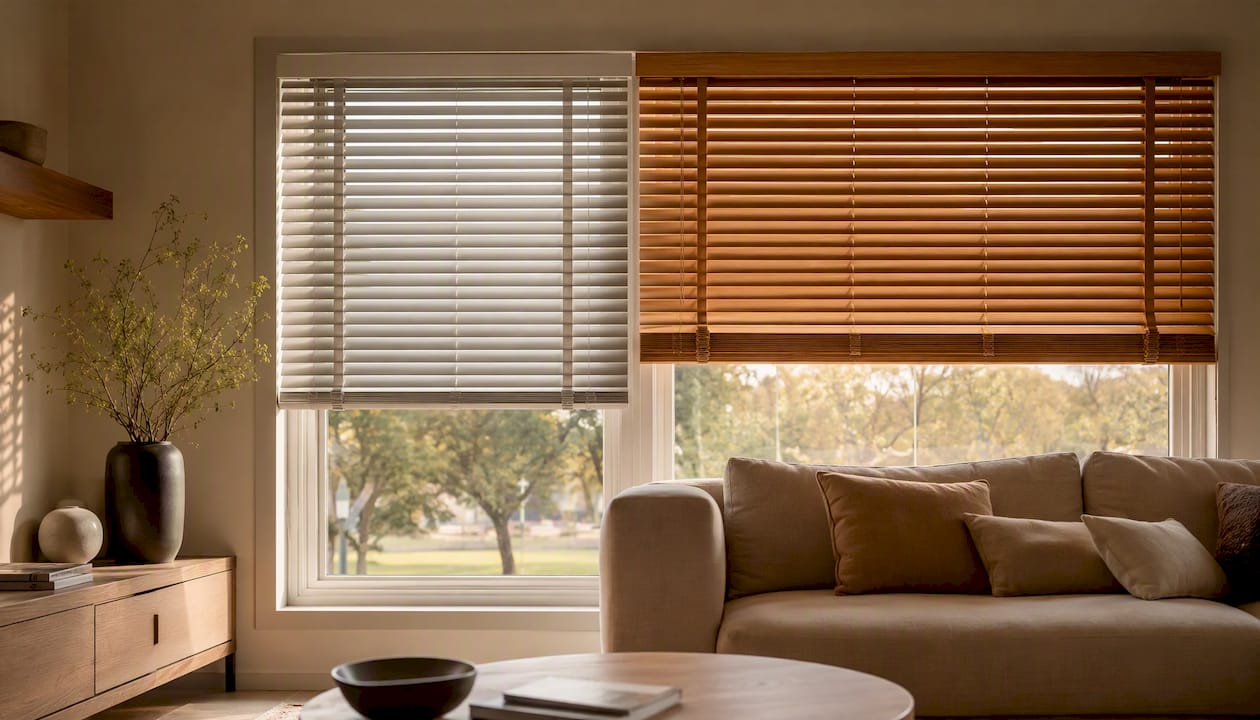
Real wood still leads on tactile depth and authentic grain. High-end composite faux wood has closed the gap considerably, but side by side in good light, the difference is visible.
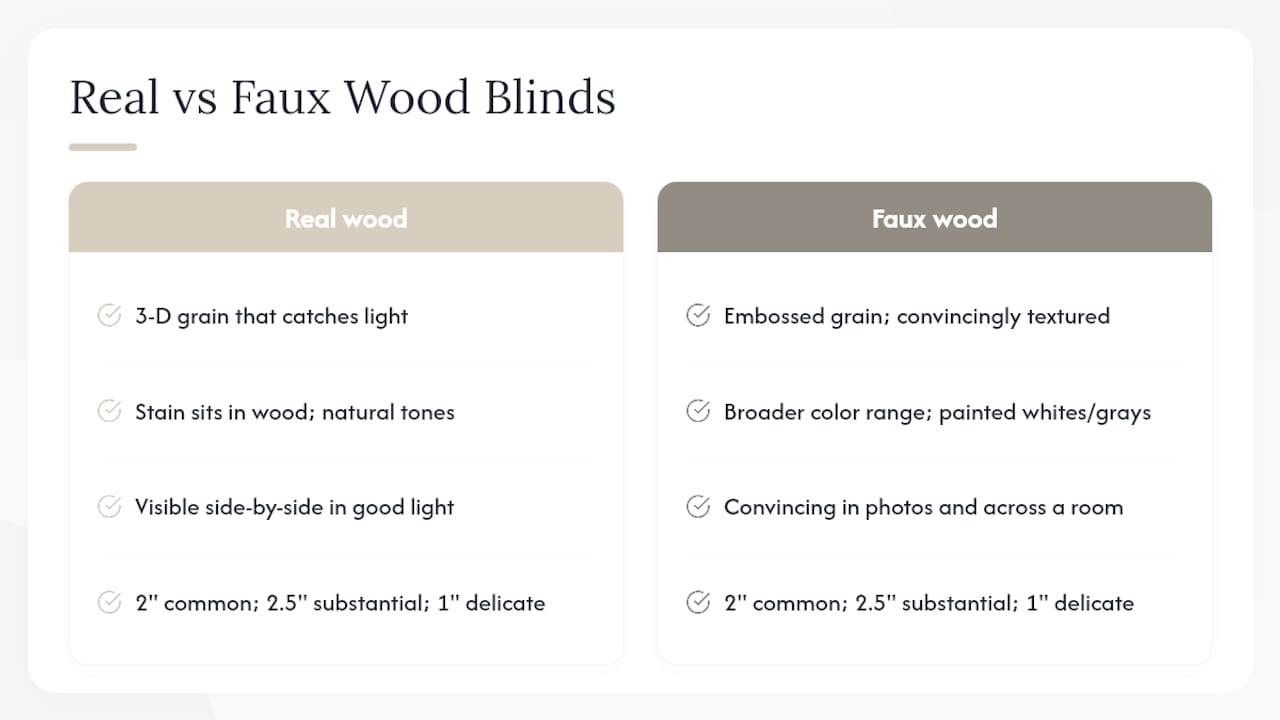
Real wood slats carry a three-dimensional grain that catches light differently at different angles. Stain options on basswood and hardwood range from light natural finishes to deep espresso tones, and the color sits in the wood rather than on top of it. That depth is what makes real wood blinds feel like furniture rather than window hardware.
Faux wood has improved dramatically. Embossed grain textures on composite slats now look convincing in photos and from across a room. The color range is actually broader than real wood because manufacturers aren’t constrained by what stain can do to a natural fiber. Painted whites and grays that would require a specialty finish on wood come standard on most faux wood lines.
Slat width affects perceived quality on both materials. The 2-inch slat is the most common and works in most rooms. A 2.5-inch slat reads as more substantial and suits larger windows and higher ceilings. A 1-inch slat looks delicate and works well on smaller windows where a wider slat would feel heavy.
Sun exposure changes the appearance of both materials over time. PVC without UV stabilizers yellows, particularly in south-facing rooms. Real wood finishes fade and can develop a chalky surface if the finish breaks down. Pairing either material with window hardware and frame finishes in complementary tones helps the overall look hold up as individual elements age at different rates.
The faux vs real wood decision is most relevant for horizontal Venetian-style blinds, where the slat material is visible and tactile. Roller blinds vs Venetian blinds is a separate choice, but once you’ve decided on a Venetian format, the slat material is the primary design variable.
Which type blocks more light and keeps rooms cooler?
Thicker, denser slats perform better on both insulation and light blocking, and real wood has a slight edge here because hardwood is denser than hollow PVC. The practical difference is small enough that most homeowners won’t notice it, but it’s worth understanding.
- Slat thickness matters more than material. A thick composite faux wood slat outperforms a thin real wood slat on light blocking. Check the slat thickness specification, not just the material.
- Closed slats don’t seal a window. Both materials leave small gaps at the headrail, sides, and between slats when closed. Privacy at night depends on fit and mounting rather than material alone. An inside mount with a precise fit reduces light leakage more than any slat material choice.
- Sound absorption is modest on both. Neither faux wood nor real wood provides meaningful acoustic insulation on its own. Real wood slats absorb slightly more sound than PVC due to density, but the effect is minor compared with adding a curtain layer.
- Pair blinds with curtains or solar film for real performance. A solar window film reduces heat gain before it reaches the blind. A lined curtain panel over the blind adds both insulation and blackout performance. This combination outperforms any blind material choice on its own.
- Motorized blinds improve functional performance. A motorized blind that closes automatically at peak sun hours does more for room temperature than the material difference between faux and real wood.
How do the two materials compare on sustainability?
Real wood is renewable; PVC is not. That’s the core trade-off, and it’s worth being clear about what it means in practice.
FSC-certified real wood blinds come from forests managed for long-term sustainability. The wood is biodegradable at end of life and carries a lower carbon footprint in manufacturing than petroleum-derived PVC. If environmental impact is a priority, FSC certification is the label to look for on wood products.
Faux wood made from PVC raises legitimate concerns:
- PVC production uses chlorine and releases dioxins during manufacturing
- Most PVC blinds are not recyclable through standard municipal programs
- Plasticizers in lower-grade PVC can off-gas volatile organic compounds (VOCs), particularly when new and in warm rooms
The practical counterpoint is longevity. A faux wood blind that lasts 15 years in a bathroom replaces a real wood blind that might fail in three. Fewer replacements mean less total material consumed, which complicates the straightforward “wood is greener” narrative.
Better choices within the faux wood category:
- Composite faux wood with recycled wood fiber content reduces virgin PVC use
- Low-VOC coatings reduce off-gassing, especially relevant in nurseries and bedrooms
- Vinyl-wrapped wood cores use less PVC than solid PVC slats while still resisting moisture
If you’re buying real wood, FSC certification is the minimum standard worth insisting on. If you’re buying faux wood, ask specifically about recycled content and VOC ratings before ordering for enclosed or frequently occupied rooms.
Installation, slat sizes, and when to call a professional
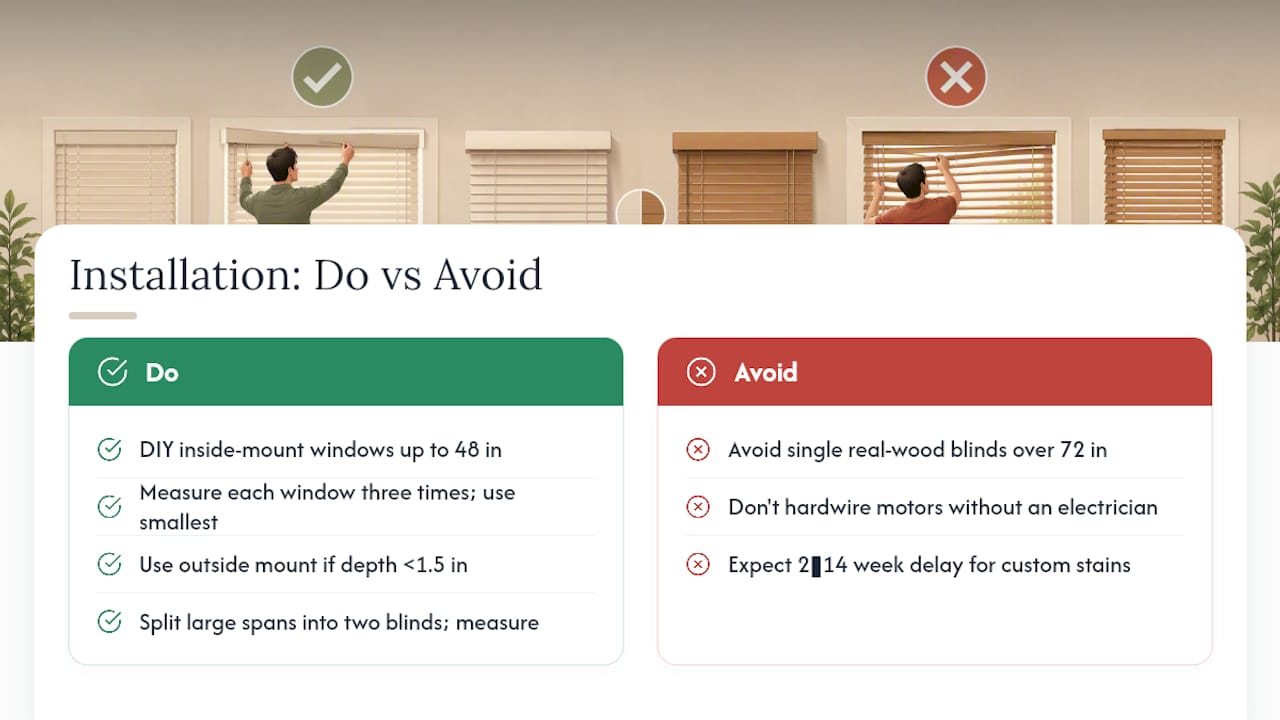
Most faux wood and real wood blinds install the same way: two or three brackets screwed into the window frame or wall, the headrail clips in, and the valance snaps on. A confident DIYer can handle a standard inside-mount installation on windows up to about 48 inches wide without much difficulty.
Beyond 48 inches, the calculus changes. Real wood blinds are typically limited to around 72 inches as a single blind because of weight; beyond that, the headrail deflects and the slats don’t hang straight. Composite faux wood can be heavier than hollow PVC, so wide composite blinds have similar limits. For large windows, splitting the span into two blinds side by side is the standard solution, but it requires precise measurement to avoid a visible gap or overlap at the center.
Motorization adds complexity. Hardwired motors require an electrician; battery and rechargeable motors are DIY-friendly but need accessible charging points. Custom stains on real wood add two to four weeks of lead time and require the manufacturer to match an existing finish, which is harder than it sounds.
Pro Tip: Before ordering, measure each window three times: top, middle, and bottom for width; left, center, and right for height. Use the smallest measurement for inside mounts. Record the exact window frame depth too, because shallow frames (under 1.5 inches) may not accommodate a standard headrail without an outside mount. Bring these numbers to your installer rather than relying on a single measurement taken at the time of order.
For any installation involving multiple wide windows, motorization, or custom finishes, professional measurement and installation from a provider like Primedecorfurnishing eliminates the most common and costly errors. Their free home measurement service covers exactly these scenarios.
How to choose the right blind for each room in your home
Start with the room, not the material. The room’s humidity level and how much the blinds will be seen determine everything else.
Step-by-step decision checklist:
Room-by-room quick guide:
- Living room: — Real wood if budget allows; high-end faux wood composite is a solid alternative.
For a living room blind selection that coordinates with existing furniture finishes, matching the stain tone to flooring or cabinetry makes the biggest visual difference regardless of material.
When mixing materials across the home, keep the finish tone consistent. A warm walnut real wood blind in the living room and a warm walnut-embossed faux wood blind in the adjacent kitchen read as a deliberate choice. The same rooms with mismatched tones look like two separate projects.
What to insist on from any seller or installer
Get the warranty in writing before you sign anything. That’s the short version.
Good warranties cover UV yellowing, warping, and motor failure for a defined period, typically three to five years. What they usually exclude: damage from improper cleaning, installation errors by the homeowner, and normal color fading beyond a stated threshold. Read the exclusions as carefully as the coverage.
Primedecorfurnishing’s warranty covers installation defects and motorization failures with documented response timelines. That kind of specificity matters because a warranty that says “we’ll fix it” without a response SLA is hard to enforce.
Questions to ask any vendor before ordering:
- Does the warranty cover UV yellowing and warping, or only manufacturing defects?
- What is the response time for warranty claims?
- Is installation covered separately, or included in the product warranty?
- Can you provide a written quote that specifies the exact product, finish, and dimensions?
- Do you offer on-site measurement, and is it included in the price?
Pro Tip: Test a vendor’s warranty responsiveness before you commit to a large order. Send an email asking a specific warranty question and note how long it takes to get a clear, written answer. A vendor who takes a week to answer a pre-sale question will take longer post-sale.
Do faux wood blinds resist termites and pests?
PVC and composite faux wood blinds offer complete resistance to termites and other wood-boring insects. There is simply no organic material for them to consume. This is a genuine practical advantage in regions where termite activity is common, including much of the southern United States, and it’s one reason faux wood is often the default choice for ground-floor rooms and homes in high-risk areas.
Real wood blinds are technically susceptible to termite damage, though the risk is lower than for structural wood because the slats are thin, finished, and not in ground contact. A severe infestation that reaches window treatments usually indicates a larger structural problem. Still, if you’re in a high-termite-risk area and replacing blinds repeatedly is not something you want to deal with, faux wood removes the variable entirely.
How much sound do wood and faux wood blinds absorb?
Neither material provides meaningful acoustic insulation on its own, but there is a measurable difference between them. Real wood slats, being denser than hollow PVC, absorb slightly more sound energy. The effect is most noticeable in rooms with hard floors and bare walls, where any soft or dense surface helps reduce echo.
Composite faux wood with a wood-fiber core performs closer to real wood on sound absorption than hollow PVC does. If acoustic comfort matters in a room, composite faux wood is a better choice than standard PVC within the faux wood category.
For genuine sound reduction, the blind is a minor contributor. A lined curtain panel layered over the blind, combined with a rug and upholstered furniture, does far more for room acoustics than any slat material choice. Think of the blind’s sound properties as a small bonus rather than a primary selection criterion.
The case for not overthinking this decision
Most homeowners spend more time on this choice than it deserves, and they usually overthink it in the same direction: they fall in love with real wood in the showroom and then install it in the bathroom.
The honest truth is that faux wood has gotten good enough that in most rooms, most people can’t tell the difference from a normal viewing distance. The grain embossing on composite slats is convincing. The color range is wider than real wood. The maintenance is genuinely easier. For the majority of windows in a typical home, faux wood is the smarter call on every practical dimension.
Real wood earns its place in the rooms where you actually look at the blinds as part of the room. A living room with hardwood floors, quality furniture, and real wood blinds in a matching stain is a coherent design statement. That coherence is worth paying for. But it requires the right conditions: low humidity, stable temperature, and a willingness to dust carefully and refinish occasionally.
The hybrid approach isn’t a compromise. It’s the correct answer for most homes. Faux wood where function matters, real wood where appearance matters, and a professional measurement to make sure both fit properly. Matching the finish tones across materials is the detail that makes a mixed installation look deliberate rather than accidental, and it’s exactly the kind of coordination that gets missed when homeowners order everything online without seeing the materials together first.
Useful sources and further reading
For readers who want to go deeper on specific aspects of this comparison, the sources below cover the key claims in this guide. For homeowners ready to specify and order, Primedecorfurnishing’s blinds and curtains catalog and product pages are the natural next step.
References used in this guide:
- Wood Blinds vs Faux Wood Blinds: Moisture, Cost, and Style - D and G Flooring
- Faux Wood vs Real Wood Blinds: Which is Right for Your Home? - BlindsOnline Blog
- Roller Blinds vs Venetian Blinds: Which Is Best for Your Space? - Louvolite
Primedecorfurnishing fits both materials into one coordinated installation
Skip the guesswork of ordering blinds online and hoping the finish matches your floors. Primedecorfurnishing supplies both wooden and composite blinds, coordinates custom stains across mixed-material installations, and sends a professional to measure every window before a single order is placed.

That last part matters more than most buyers realize. A blind ordered from a dimension you measured yourself, on a window that turns out to be 0.3 inches narrower at the bottom than the top, either won’t fit inside the frame or will let in a strip of light along one edge. Primedecorfurnishing’s free on-site measurement service eliminates that problem entirely, and the warranty covers both the product and the installation.
With over 5,000 satisfied customers and documented pricing transparency, the process is straightforward: book a consultation, get measured, choose your materials and finishes, and receive a fully installed result that fits. Browse the full product catalog or visit Primedecorfurnishing to book your free home measurement today.
Recommended
Ready to transform your home?
Chat with us on WhatsApp for a free consultation or quote.
Chat with us on WhatsApp