
How to Install Blinds in Singapore: 2026 Guide
By Prime Decor Furnishing
How to Install Blinds in Singapore: 2026 Guide
Blinds installation is defined as the precise measurement, secure bracket mounting, and correct operation setup of window blinds to achieve lasting performance and a clean finish. When you install blinds in Singapore homes, the process involves more than drilling a few holes. Singapore’s concrete-heavy construction, high humidity, and growing demand for motorized window treatments all shape how you approach the job. Get the preparation right, and the installation takes less than an hour per window. Skip it, and you risk crooked brackets, stripped anchors, and blinds that jam within weeks.
What types of blinds can you install in Singapore homes?
The right blind type determines how complex your installation will be. Singapore homeowners commonly choose from roller blinds, venetian blinds, zip track blinds, roman blinds, and motorized variants of most of these styles.
Manual blinds cover the majority of residential installations. Roller blinds mount on two brackets above the window frame or inside the recess. Venetian blinds use a headrail system with similar bracket placement. Roman blinds require a wooden or aluminum headrail and additional cord guides along the wall. All three types share one installation principle: level brackets, correct anchor type, and precise width measurement.
Motorized blinds have become common in Singapore homes due to convenience, energy savings, and a clean look that suits modern interiors. They fall into four categories:
- Battery-powered: Simple installation with no electrical work, making them ideal for renters or anyone avoiding wiring runs.
- Solar-powered: Panels mount above the window to capture natural light. Placement matters because shaded windows reduce charging efficiency.
- Hardwired: The cleanest finish, but hardwired systems require licensed electrical work to comply with Singapore’s electrical regulations.
- Hybrid: Combines a rechargeable battery with an optional wired charging port for flexibility.
Window type also affects your choice. Casement windows with protruding handles need outside-mount brackets to clear the hardware. Floor-to-ceiling glass panels in newer condominiums suit motorized roller blinds best because manual cords become impractical at large spans.
Pro Tip: Motorized blinds require specific clearance for motor housing during measurement. Always add at least 50mm to your standard bracket depth measurement to avoid blocking the window’s opening mechanism.
What tools and measurements do you need before installing?
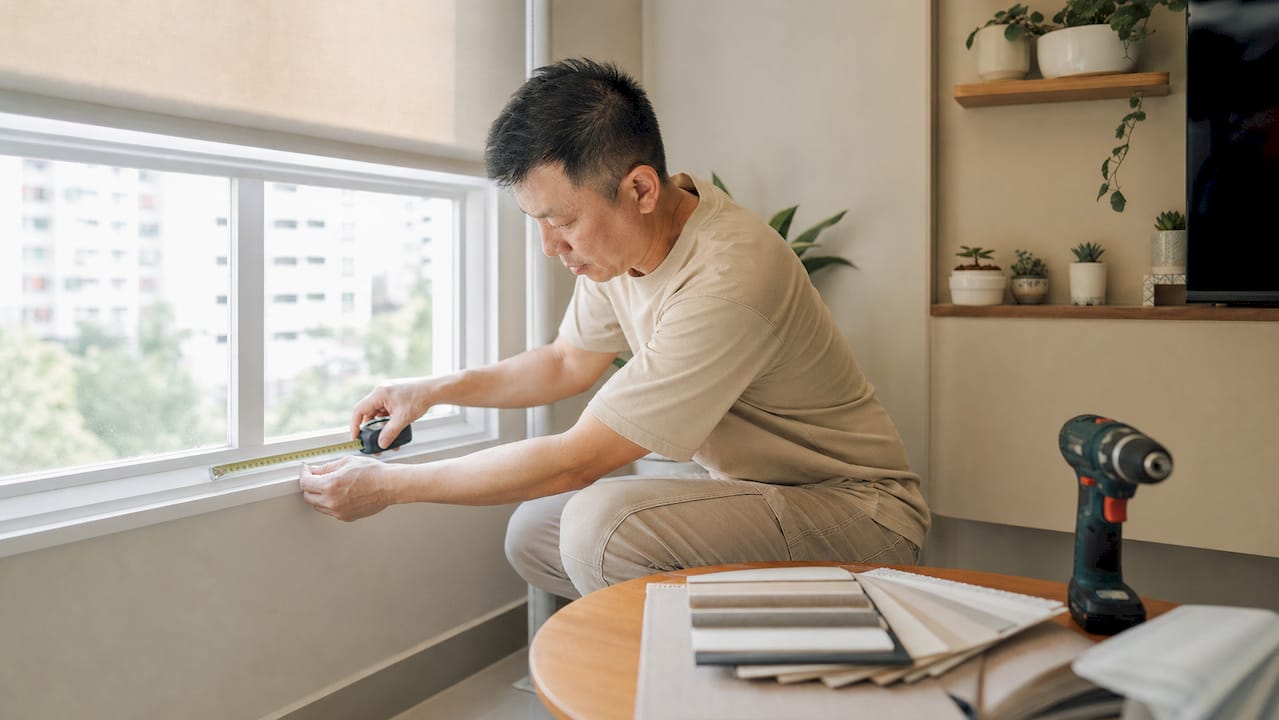
Accurate measurement is the single step that separates a clean installation from a frustrating one. Measure each window three times: width at the top, middle, and bottom, then height on the left, center, and right. Use the smallest measurement for width and the largest for height. This accounts for walls that are not perfectly square, which is common in older HDB flats and shophouses.
Check for obstructions before ordering your blinds. Window handles, air-conditioning unit casings, and protruding sills all affect whether you mount inside or outside the frame. Inside mounts give a recessed, built-in look but require a minimum frame depth of around 60mm for most roller blinds.
Wall materials affect anchor choice significantly. Most Singapore homes use reinforced concrete walls, which require masonry drill bits and concrete anchors. Timber-framed partitions take wood screws directly. Drywall partitions need toggle bolts or hollow-wall anchors to hold bracket weight.
| Surface type | Drill bit needed | Anchor type |
|---|---|---|
| Reinforced concrete | Masonry/carbide tip | Concrete expansion anchor |
| Timber frame | HSS or wood bit | Wood screw, no anchor needed |
| Drywall/plasterboard | Standard HSS bit | Toggle bolt or hollow-wall anchor |
| Aluminum window frame | HSS metal bit | Self-tapping screw |
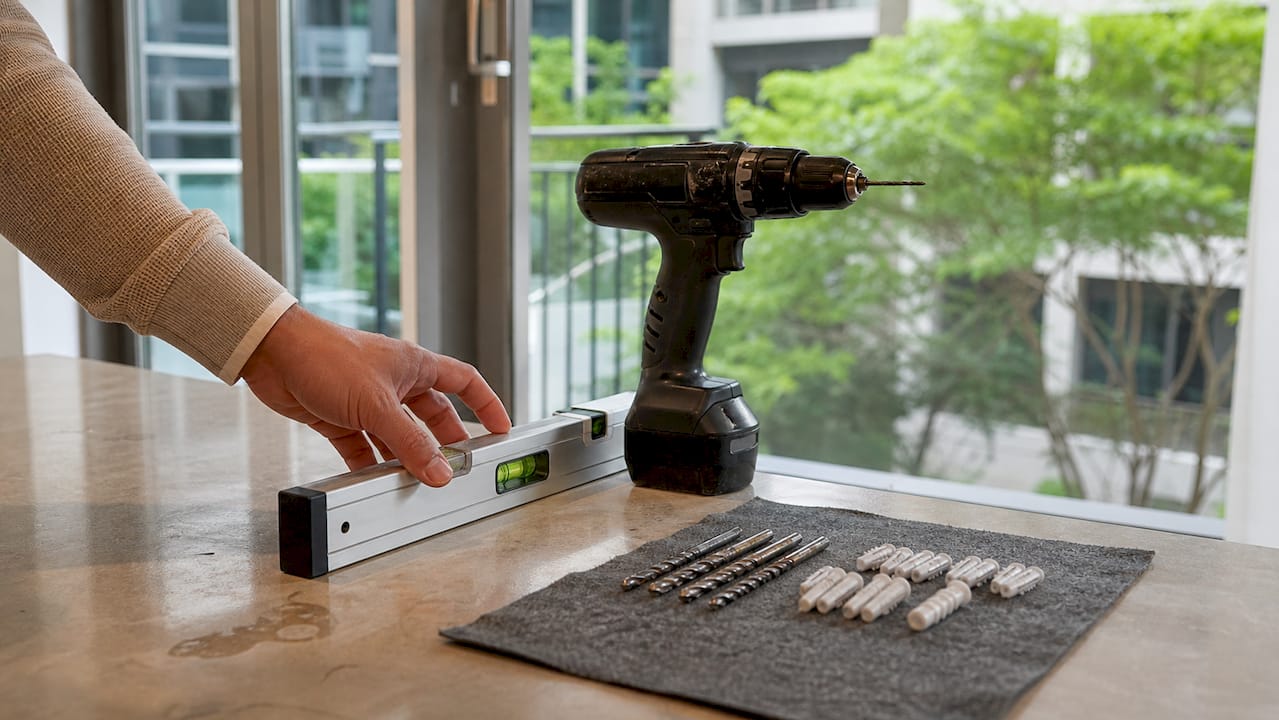
The tools you need for a standard installation include a power drill, spirit level, tape measure, pencil, screwdriver, and wall plugs matched to your surface type. For motorized blinds, add a voltage tester and cable clips if you are routing a charging cable along the wall.
Pro Tip: Use a spirit level on every bracket before drilling the second hole. A bracket that looks straight to the eye can still be off by 3–5mm, which causes the blind to drift to one side over time.
Step-by-step guide to installing blinds securely
Follow these steps for a clean, durable installation on any standard window.
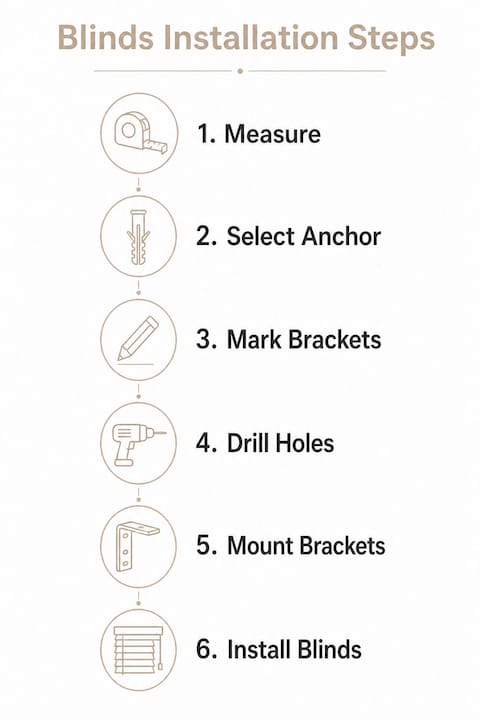
- Mark bracket positions. Hold the headrail against the wall or inside the frame recess. Mark the bracket holes with a pencil. Use your spirit level to confirm both marks sit at the same height before drilling.
- Drill pilot holes. Select the correct drill bit for your wall material. Drill to the depth of your anchor, typically 30–40mm for concrete. Blow out dust from each hole before inserting the anchor.
- Insert anchors and mount brackets. Tap concrete anchors flush with the wall surface. Screw brackets in firmly. Test each bracket by pulling it with moderate force before attaching the blind.
- Attach the blind to the brackets. Most roller blinds use a snap-in or clip-on system. Slide the headrail into the brackets and press until you hear a click. For venetian blinds, hook the headrail onto the bracket clips and close the safety latch.
- Connect power for motorized blinds. Battery-powered motors simply require charged batteries in the motor housing. For hardwired systems, a licensed electrician must connect the motor to a dedicated circuit. Do not attempt hardwired connections yourself. Singapore’s electrical regulations require all fixed wiring work to be carried out by a licensed electrical worker.
- Set motor limits. Use the remote or app to set the upper and lower travel limits. This prevents the motor from over-running and straining the mechanism.
- Test full operation. Check that blinds move smoothly, quietly, and rotate freely without obstruction at any point in their travel range.
Common mistakes to avoid:
- Measuring the wall opening instead of the window frame recess
- Using the wrong anchor type for concrete walls, which causes brackets to pull out under load
- Skipping the spirit level check and ending up with a visibly tilted blind
- Over-tightening screws on aluminum frames, which cracks the extrusion
- Forgetting to set motor travel limits before the first full-speed run
Pro Tip: For zip track blinds and other track-guided systems, install the tracks first and check vertical alignment with a plumb line before mounting the headrail. A track that is even 2mm out of plumb will cause the fabric to bunch and jam.
How do you integrate motorized blinds with smart home systems?
Smart home integration starts after the physical installation is complete and the motor limits are set. Connecting motorized blinds requires linking the blinds’ bridge to your Wi-Fi network and then pairing the bridge with a voice assistant app such as Google Home or Amazon Alexa. Most systems use a 2.4GHz Wi-Fi band, so confirm your router broadcasts on that frequency before starting the pairing process.
Common installation problems include power issues, mechanical jams, and lost Wi-Fi connection. Each has a straightforward fix:
- Power issues: Check battery charge level or verify the charging cable is seated correctly. Solar-powered panels need direct sun exposure for at least four hours to maintain charge in Singapore’s weather.
- Mechanical jams: Remove the blind from its brackets and inspect the fabric or slats for debris caught in the track. Reset the motor limits after clearing the jam.
- Lost Wi-Fi connection: Power-cycle the bridge, then re-pair the motor. Avoid placing the bridge behind thick concrete walls, which attenuate the 2.4GHz signal significantly.
Maintaining motor longevity in Singapore’s humidity requires keeping the motor housing dry and dust-free. Wipe down the headrail monthly with a dry cloth. For solar-powered blinds, clean the panel surface quarterly to maintain charging efficiency.
Pro Tip: Before finalizing the installation position of solar-powered blinds, track the sun path across that window for one full day. Singapore’s equatorial position means sun angles shift noticeably between seasons, and a panel that charges well in june may sit in shade by december.
Key Takeaways
Successful blinds installation in Singapore depends on accurate measurement, correct anchor selection for concrete walls, and proper motor setup for motorized systems.
| Point | Details |
|---|---|
| Measure three times per window | Take width and height at multiple points to account for walls that are not perfectly square. |
| Match anchor to wall material | Concrete walls need expansion anchors; drywall needs toggle bolts to hold bracket weight securely. |
| License hardwired motors | Singapore regulations require a licensed electrician for all fixed wiring on hardwired blind systems. |
| Set motor limits before first run | Configuring upper and lower travel limits prevents motor strain and fabric damage from day one. |
| Test operation after every install | Confirm smooth, quiet, and obstruction-free movement before considering the installation complete. |
What I’ve learned from Singapore blinds installations
After working through dozens of Singapore home installations, the single biggest mistake I see is homeowners underestimating the wall. Concrete in Singapore HDB blocks is dense and hard. A standard household drill with a wood bit will spin uselessly against it. You need a hammer drill and carbide-tipped masonry bits, full stop.
The second thing I’ve noticed is that people skip the spirit level because the bracket looks straight. It never is. A 3mm tilt across a 1,800mm wide blind is invisible at the bracket but obvious from across the room. Take the extra 90 seconds.
For motorized blinds, my honest advice is to hire a licensed electrician for hardwired systems without exception. The cost is modest compared to the risk of a non-compliant installation. Battery and solar options have improved enough that most homeowners do not need hardwired systems unless they are running more than six motors on a single circuit. Plan for maintenance access too. Motors need limit resets every year or two, and a blind mounted flush against a ceiling with no access gap becomes a real problem when that day comes.
The curtain and blind installation process shares many of the same preparation principles. If you have done one well, the other becomes much faster.
— Morgan
Why Primedecorfurnishing handles what DIY often cannot
Professional blinds installation removes the guesswork from measurement, anchoring, and motor compliance in one visit.

Primedecorfurnishing brings over 5,000 completed Singapore home installations to every project, with custom measurements taken on-site and factory-direct materials that fit your windows precisely. The team handles everything from manual roller blinds to fully integrated motorized systems, including the licensed electrical work that hardwired motors require. Every installation comes backed by a product warranty and a personalized consultation so you get the right blind type for your window, wall, and lifestyle. For homeowners who want a guaranteed result without the drilling trial and error, book a consultation with Primedecorfurnishing and get a transparent quote with no hidden call-out fees.
FAQ
How much does it cost to install blinds in Singapore?
Blinds installation in Singapore averages S$250–300 per window, inclusive of product and labor. Some services charge separately, with a call-out fee of around S$65 and S$6 per drilled hole.
Can I install blinds myself in an HDB flat?
Manual blinds are a practical DIY project if you have a hammer drill and the correct masonry anchors for concrete walls. Hardwired motorized blinds require a licensed electrician under Singapore’s electrical regulations and should not be self-installed.
What is the difference between inside and outside mount blinds?
Inside mount blinds sit within the window frame recess for a recessed, built-in look, and require a minimum frame depth of around 60mm. Outside mount blinds attach to the wall above the frame and work on any window regardless of recess depth.
How do I connect motorized blinds to Google Home or Alexa?
Install the blind’s bridge device, connect it to your 2.4GHz Wi-Fi network, then add the bridge as a device in the Google Home or Alexa app. Most brands complete pairing in under five minutes once the bridge is online.
How long does a professional blinds installation take?
A professional installation for a standard window typically takes 30–60 minutes per blind, including measurement verification, bracket mounting, and operation testing. Motorized systems with smart home pairing may take slightly longer.
Ready to transform your home?
Chat with us on WhatsApp for a free consultation or quote.
Chat with us on WhatsApp