
S Fold vs Pinch Pleat: Which Heading Suits Your Home?
By Prime Decor Furnishing

S Fold vs Pinch Pleat: Which Heading Suits Your Home?
Choose S-fold for a clean, modern look with minimal stackback and easy motorisation; choose pinch pleat when you want a formal, tailored finish with fuller, structured drape.
- S-fold curtains stack more compactly and keep more of the window visible when open, making them the practical pick for sliding doors, floor-to-ceiling glazing, and any room where the view matters.
- Pinch pleat creates permanently sewn pleats that hold a structured, dimensional header — the standard specification for formal living rooms, dining rooms, and luxury residential installs where heavy fabric and thermal lining are priorities.
Choose S-fold when: you have a contemporary interior, a wide span or sliding door, or you plan to motorise. Choose pinch pleat when: the room calls for traditional elegance, you are working with heavy velvet or wool, or you want the fullest possible drape.
Pro Tip: In open-plan homes where a modern family room flows into a more formal dining space, run S-fold on the sliding door wall and pinch pleat on the dining room windows. The contrast reads intentional rather than inconsistent, and each heading performs exactly where it should.
Table of Contents
- How S-fold and pinch pleat headings are actually built
- How each heading looks in a room
- How each heading stacks and operates day to day
- What installers need to know before you order
- Which fabrics and linings work with each heading
- Motorisation: which heading is easier to automate
- Cost and lead time: what actually drives the price
- Can you convert between heading styles?
- When to call a professional installer
- Key Takeaways
- The heading choice most homeowners get backwards
- Custom curtains, wave tracks, and motorisation from Primedecorfurnishing
- Useful sources
How S-fold and pinch pleat headings are actually built
The mechanical difference between these two headings is bigger than it looks from across the room.
S-fold (also called ripple fold or wave) uses no sewn pleats at the header. Instead, the fabric is attached to evenly spaced gliders on a continuous wave track, and the spacing between gliders is what creates the uniform, flowing S-curve. The track does the shaping work, not the fabric itself. Because the wave is formed by hardware rather than stitching, S-fold panels can theoretically be re-headed onto a different track system, though in practice the fabric is usually cut to a specific fullness for that track.
Pinch pleat works the opposite way. The pleats are stitched directly into the fabric at the header, grouping the material into two-finger, three-finger, or French pleat formations. Those pleats are permanent. The panel hangs from hooks threaded through the sewn pleat, which then attach to rings on a pole or carriers on a track. The structure lives in the fabric, not the hardware.
Key construction differences at a glance:
-
S-fold requires a dedicated glider/wave track; it cannot run on a standard curtain pole.
-
Pinch pleat works on poles with rings or on tracks with carriers and pleater tape, giving it more hardware flexibility.
-
S-fold waves self-maintain their shape with minimal daily adjustment; pinch pleats hold a sharp, formal header profile without reshaping.
-
Terminology note: S-fold, ripple fold, and wave curtain all describe the same heading type. Pinch pleat and French pleat are often used interchangeably, though French pleat technically refers to the three-finger variant.
How each heading looks in a room
The visual gap between these two styles is significant enough that choosing the wrong one for a room’s architecture reads immediately.
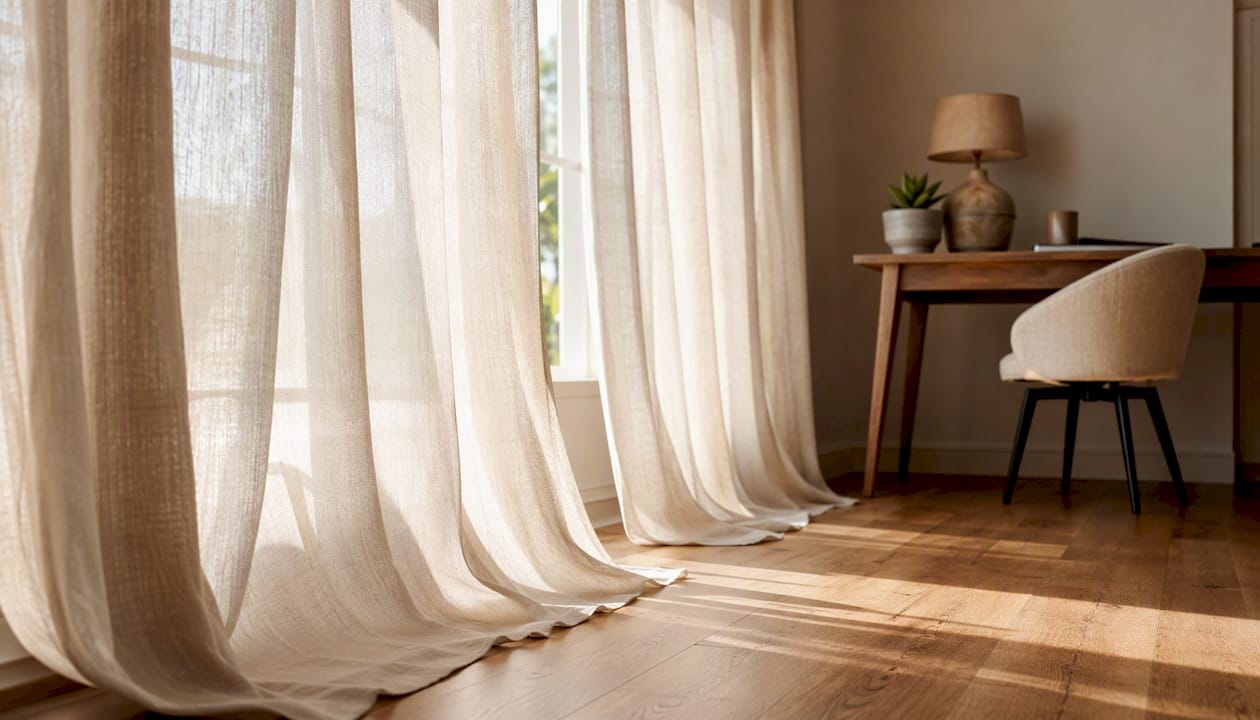
S-fold produces an even, continuous wave across the full width of the panel. When closed, the curtain reads as a soft, architectural surface with no hard breaks or defined pleat points. It suits contemporary interiors, minimalist spaces, and rooms with concealed ceiling tracks where the hardware disappears entirely. The vertical emphasis makes ceilings feel taller. Designers consistently specify S-fold for contemporary floor-to-ceiling installations because the clean lines integrate with modern architecture rather than competing with it.
Pinch pleat delivers something entirely different: defined, repeated V-shapes at the header that cascade into a full, dimensional drape. The structured top reads as tailored and formal. It suits traditional homes, period properties, and rooms where richness of texture is the point. Pinch pleat remains the standard specification for formal rooms and luxury residential installs, particularly in hospitality settings where heavy linings and thermal interlining are part of the spec.

Pro Tip: When your fabric has a large pattern repeat, pinch pleat can actually hide mismatched repeats better than S-fold. The pleat formations break up the pattern at the header, whereas S-fold’s continuous wave puts every inch of fabric on display.
How each heading stacks and operates day to day
This is where S-fold earns its reputation for practicality.
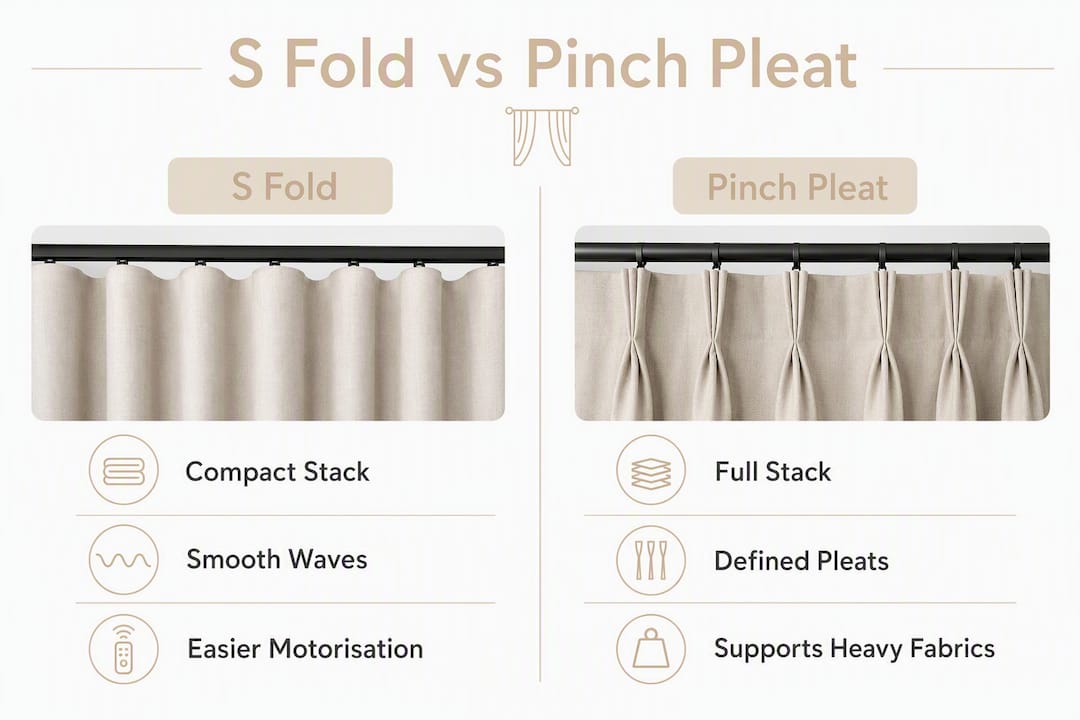
S-fold stacks narrower and keeps more of the window visible when fully open, which matters enormously on a wide sliding door or a glazed wall where every inch of light and view counts. The continuous glider track also produces a smoother, more consistent draw action — the curtain moves as one piece rather than as a series of pleated sections. For large spans, S-fold is the preferred specification precisely because the continuous track and even waves scale well without bunching.
Pinch pleat stacks fuller. The sewn pleats create a denser backstack that sits further from the wall and reduces the visible glass area when the curtain is fully open. On a narrow window that is not the problem it sounds like, but on a wide span it can cost you a meaningful amount of light. The draw action on a pinch pleat track feels more layered because each pleat moves as a unit.
| Feature | S-fold | Pinch pleat |
|---|---|---|
| Appearance when open | Compact, narrow stack | Fuller, denser stack |
| Typical fullness multiplier | moderate fullness | higher fullness |
| Stackback compactness | Narrow | Wider |
| Best use cases | Sliding doors, wide spans, modern rooms | Formal rooms, traditional interiors, heavy fabric |
Pro Tip: If you are working with a bay window, pinch pleat on a flexible track or pole with rings gives you more hardware options for the angled sections. S-fold wave tracks can be bent for bays, but the bend radius affects wave consistency — always confirm with your installer before ordering.
What installers need to know before you order
Getting the hardware specification right before fabric is cut saves significant rework cost.
- Track vs. pole: S-fold requires a continuous glider or wave track — a standard curtain pole will not work. Pinch pleat runs on poles with rings or on tracks with carriers; that flexibility is one of its practical advantages.
- Stack allowance: Both headings need clear wall space beside the window for the backstack. S-fold’s narrower stack still needs planned clearance; pinch pleat needs more. Measure from the edge of the glass to the nearest obstruction (a wall, a door frame, a built-in) before specifying width.
- Ceiling and soffit clearance: Concealed ceiling tracks for S-fold need a recess or a pelmet. If neither exists, a face-fixed track is the alternative, but it changes the visual outcome.
- Bracket placement and fixings: Wall fixings need to hit solid material — studs, masonry, or a lintel. For heavy lined pinch pleat panels, bracket load matters more than most homeowners expect.
- Hem and floor clearance: Specify whether the curtain breaks on the floor, puddles, or clears it by an inch. This affects the cut drop, and the answer differs by heading because fullness affects how the hem hangs.
- Bay window track bending: Both heading types can work in bays, but S-fold wave tracks require a minimum bend radius. Confirm this measurement with your supplier before the track is ordered.
For a detailed walkthrough of what a professional installation involves, curtain installation guidance covers the full process from measure to fit.
Which fabrics and linings work with each heading
Fabric weight is the single most important variable in heading selection, and it is the one homeowners most often get wrong.
S-fold performs best with medium-weight to light-medium fabrics: linen blends, lightweight velvets, cotton-linen mixes, and sheers. The wave needs the fabric to flow consistently across the full panel width, which means uneven weight distribution (a heavy lining on one side, a seam that creates a ridge) will disrupt the wave. For sheers specifically, S-fold is the cleaner choice because the continuous wave reads beautifully in translucent fabric.
Pinch pleat handles heavier materials well. Velvet, wool, heavy linen, and brocade all benefit from the structure that sewn pleats provide at the header. The pleats hold the fabric in formation even when the panel is dense and heavy. Adding thermal or blackout lining to a pinch pleat panel is straightforward because the structure at the top supports the additional weight.
Fullness multipliers differ by heading type: pinch pleat typically uses higher fabric fullness, while wave and S-fold applications use moderate fabric fullness. Higher fullness means more fabric per panel, which directly affects both cost and insulation performance — a fuller, lined panel traps more air and reduces heat loss.
Adding a lining after the fact almost always requires re-heading, because the additional weight changes how the header sits and how the pleats or waves fall. Plan the lining at the specification stage, not as an afterthought.
Pro Tip: For layered treatments with a sheer and a blackout panel, mixing heading types can look mismatched. S-fold sheers with S-fold blackouts on the same track system read as intentional. If you mix S-fold sheers with pinch pleat blackouts, the different header heights and stackback widths will be visible when both panels are open.
For more on fabric selection and lining options, the choices go deeper than weight alone.
Motorisation: which heading is easier to automate
S-fold wins this comparison without much contest.
Wave and S-fold tracks are specifically engineered for motorised operation, and the continuous glider system is what makes that possible. The motor drives the lead glider, which pulls the rest of the panel in a smooth, even motion. There are no pleat formations to catch on carriers, no geometry to interfere with the draw. For anyone planning smart-home integration or simply wants a remote-operated curtain on a wide span, S-fold is the right starting point.
Pinch pleat can be motorised, but it requires more careful specification. The carriers need correct spacing for the pleat geometry, the motor torque must be matched to the fabric weight and span, and header interference — where the pleat formation rubs on carriers during travel — is the most common failure mode in retrofitted systems. These problems are preventable with the right carrier spec and motor torque rating, but they require an experienced installer to get right.
Practical motorisation checklist:
- Confirm track compatibility with the motor brand before ordering.
- Match motor torque to the combined weight of fabric, lining, and panel width.
- Plan power supply (mains hardwired, battery, or solar-charged) at the design stage, not after the track is fixed.
- For smart-home integration, confirm the motor’s protocol (RF, Wi-Fi, Zigbee, Z-Wave) matches your hub before purchase.
- Set travel limits during commissioning and record the settings for warranty purposes.
For a comparison of motorised curtain options, the track and motor combinations vary significantly by span and fabric weight.
Cost and lead time: what actually drives the price
The heading style is not the biggest cost variable. Fabric area and lining type are.
| Cost driver | S-fold | Pinch pleat |
|---|---|---|
| Fabric fullness | moderate fabric fullness (less fabric) | higher fabric fullness (more fabric) |
| Labor at header | Minimal (glider spacing) | Higher (hand pleating, stitching) |
| Track/hardware cost | Higher (specialist wave track) | Lower (standard pole or track) |
| Motorisation premium | Lower (track is motor-ready) | Higher (carrier re-spec needed) |
| Heavy lining impact | Moderate | Higher (more fabric to line) |
A heavy lined pinch pleat panel can be materially more expensive than a lightweight S-fold with motorisation hardware — the fabric and lining cost often outweighs the track premium. For custom made-to-measure curtains, typical lead times from measurement to installation run 3–6 weeks depending on fabric availability, lining specification, and whether motorisation is included. Motorised systems add 1–2 weeks to that window for motor sourcing and pre-commissioning. For current pricing context, the variables above are the right place to start a budget conversation.
Can you convert between heading styles?
Technically yes. Practically, it depends on the fabric.
Converting a sewn pinch pleat to a wave heading requires removing the pleater tape, reseaming the top with specialist wave heading tape, and re-hanging on a new wave track. If the original fabric does not have enough horizontal fullness for the wave specification, the conversion leaves shortfalls and usually means adding fabric or ordering new panels. The labor cost of a proper conversion often approaches the cost of new panels, which is why most installers recommend new panels unless the fabric is exceptional.
Going the other direction — S-fold to pinch pleat — requires adding pleating work and almost always needs extra fabric for fullness, since S-fold panels are typically cut to a lower fullness multiplier than pinch pleat requires.
What installers assess before quoting a conversion:
- Fabric condition and whether the header area has wear or fading.
- Existing fullness: is there enough fabric to meet the target heading’s multiplier?
- Lining: is it attached, and does it need to be replaced?
- Track compatibility: does the existing track suit the new heading, or does hardware need replacing too?
If two or more of those factors require work, new panels are almost always the better investment.
When to call a professional installer
Some curtain projects are genuinely DIY-friendly. Others are not.
Call a professional for motorisation, floor-to-ceiling spans, recessed ceiling track installs, or any window where the stackback allowance is tight and a measurement error means reordering fabric. Professional measurement matters most when patterned fabric requires repeat matching across panels — getting that wrong is expensive and visible. Electrical work for hardwired motorised systems is not a DIY task in any jurisdiction.
Warranty is another practical reason. Most motorised curtain systems carry manufacturer warranties that are voided by non-professional installation. The same applies to specialist tracks with tight tolerance requirements.
Primedecorfurnishing has completed over 5,000 installations, covering custom curtain fabrication, wave track motorisation, and on-site measurement. That depth of project experience is what makes the difference on complex installs where stackback, ceiling fixings, and motor commissioning all need to be coordinated in a single visit.
Pro Tip: At the initial site visit, ask for a lead-time estimate and the warranty terms for both the track and the motor. A supplier who cannot answer those two questions on the spot is not ready to take your project.
Key Takeaways
S-fold suits modern, wide-span, and motorised applications; pinch pleat suits formal, fabric-heavy rooms where structured drape and fullness are the priority.
| Point | Details |
|---|---|
| Heading choice drives hardware | S-fold needs a wave track; pinch pleat works on poles or standard tracks. |
| Fullness affects cost and insulation | Pinch pleat uses 2.0–2.5x fullness; S-fold uses 1.5–2.0x, changing fabric cost and thermal performance. |
| Motorisation favors S-fold | Wave tracks are engineered for motors; pinch pleat motorisation requires careful carrier and torque specification. |
| Conversion is rarely cost-effective | Converting between heading types usually costs close to new panels; assess fabric fullness and condition first. |
| Primedecorfurnishing for complex installs | Primedecorfurnishing offers on-site measurement, custom fabrication, motorised track installation, and warranty coverage across all heading types. |
The heading choice most homeowners get backwards
Most homeowners pick a heading style based on how it looks in a showroom photo, then work backwards to figure out if it fits their window. That is the wrong sequence, and it is why so many curtain projects end up with insufficient stackback, a motor that barely moves the panel, or a wave that looks flat because the fabric is too heavy.
The better approach is to start with the window and the use case. A wide sliding door with a view is an S-fold window. A formal dining room with a traditional cornice and heavy drapes is a pinch pleat room. The style follows the function, not the other way around.
The other thing installers see constantly: homeowners choosing S-fold because it looks minimal and modern, then specifying a heavy velvet fabric because they want warmth and texture. Those two choices fight each other. S-fold needs fabric that flows. If you want heavy velvet, pinch pleat will serve you better and the result will look more intentional.
One more thing worth saying plainly: mixing heading styles across adjacent rooms is not a mistake if it is done deliberately. S-fold in the open-plan living area and pinch pleat in the formal study reads as considered. The same two headings in the same room, on adjacent windows, reads as an error. Keep each heading consistent within a single room, and the transitions between rooms take care of themselves.
When considering how curtain choices interact with the broader interior, interior door style decisions follow the same logic: the architectural finish should match the room’s register, not just the trend.
Custom curtains, wave tracks, and motorisation from Primedecorfurnishing
Getting the heading right is only half the job. The other half is having the measurement, fabrication, and installation handled by people who have done it thousands of times.
Primedecorfurnishing offers the full scope: on-site measurement with stackback calculation, custom curtain fabrication in both S-fold and pinch pleat headings, wave track supply and motorisation, and installation with warranty coverage. The single-supplier model means one point of accountability from measure to motor commissioning — no gap between the track installer and the curtain maker. With over 5,000 completed projects, the team has seen every window configuration and every common planning mistake.
Ready to get the right heading for your windows? Book a free home measurement and get a quote that covers fabric, track, and installation in one visit. Browse the full curtains and blinds range to start narrowing down your specification before the consultation.
Useful sources
- French Pleat vs S-Fold Curtains: Which Style Is Right for Your Home? — AI Curtain
- All About the Pinch Pleat — Circle Visual
- Eyelet vs Pleated Curtains: Which Looks Better? — Stråla
- Curtain Style Guide for Buyers: Eyelet vs Pleated Curtains — The Yellow Dwelling
- Curtain Installation Guide — Primedecorfurnishing
- Motorised Curtain Providers — Primedecorfurnishing
- Curtain Material and Fabric Guide — Primedecorfurnishing
Recommended
Ready to transform your home?
Chat with us on WhatsApp for a free consultation or quote.
Chat with us on WhatsApp