
Ageing Parents at Home: Senior-Friendly Curtains and Blinds for HDB Flats
By Prime Decor Furnishing
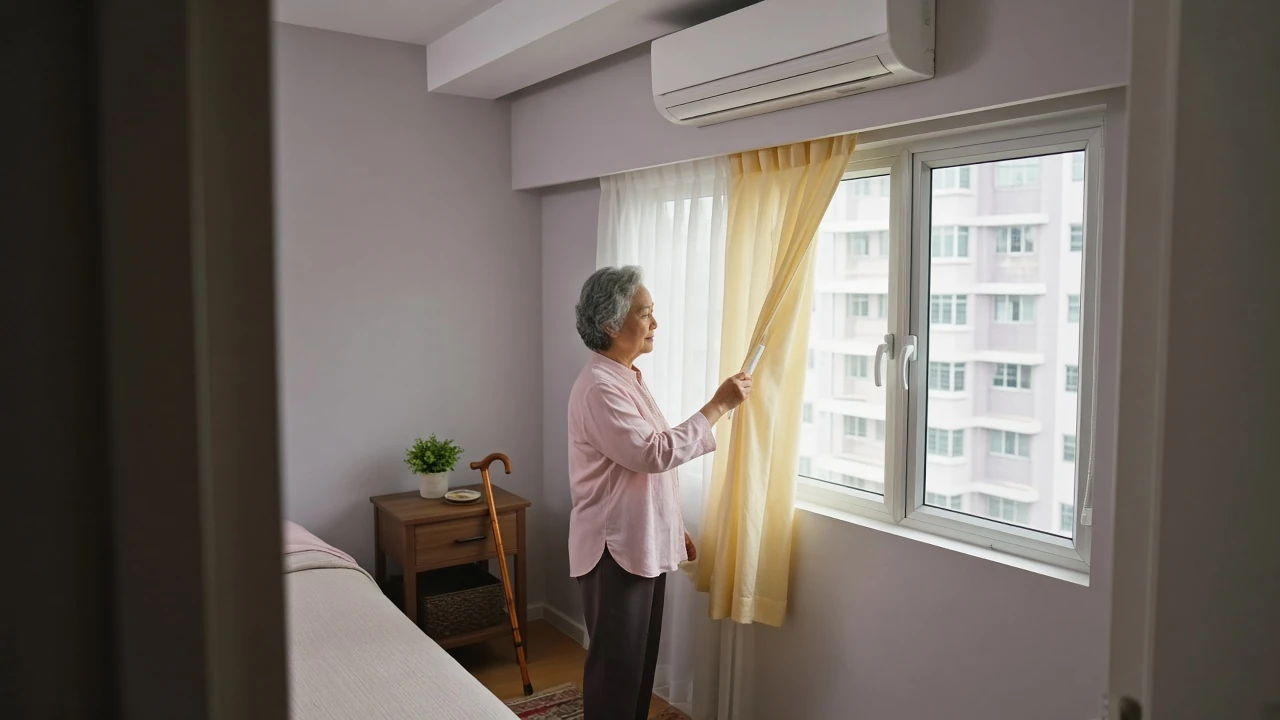
Your mother still draws the bedroom curtains every morning, but these days she leans over the bed to reach the edge, tugs twice because the hooks catch on the rod, and steadies herself on the sill. Nobody planned that window for someone in her seventies. It was simply what went up when the flat was new.
A lot of Singapore families are having that kind of moment now. Singapore has become a super-aged society. The National Population and Talent Division (NPTD), in figures updated on 30 September 2026, puts the share of citizens aged 65 and above at 21.4% in 2026, up from 13.7% in 2016, and estimates that by 2035 more than 1 in 4 citizens will be 65 or older. The United Nations calls a country "super aged" once that share reaches 21%.
HDB already helps with the big safety items through its Enhancement for Active Seniors (EASE) programme. This guide covers what EASE does, what it leaves out, and how to choose curtains and blinds that an older parent can open, close and live with safely.
What EASE covers, and what it leaves to you
HDB describes EASE as a programme that "subsidises items installed in your flat to improve mobility and safety within the flat". It comes with the Home Improvement Programme (HIP). If your block is not due for HIP, or you would rather not wait, you can apply directly under EASE (Direct Application).
On HDB's EASE page, Singapore Citizen households (sold flats) and Registered Tenants (rental flats) qualify for EASE (Direct Application) if a family member is:
- 65 years old and above; or
- between 60 and 64 years old and needs help with at least one Activity of Daily Living, such as bathing, dressing, toileting or moving around.
The EASE list covers grab bars, slip-resistant treatment for toilet and bathroom floors, lowering or widening toilet and bathroom entrances, a wall-mounted foldable shower seat, a handrail at a main entrance with steps, ramps or a wheelchair lifter, bidet sprays, rocker switches to replace small light switches, and a Home Fire Alarm Device in the living room. You apply through the EASE e-Service or the MyHDB app. HDB says it will reply within 14 working days, and you can expect the items to be installed within 10 weeks of application. Customised ramps and wheelchair lifters take longer.
Curtains, blinds and curtain tracks are not on the list. That makes sense, because they are your own fittings, not part of the flat's structure. But they are also one of the few things your parent handles at least twice a day, often while reaching or standing on tiptoe. That part is left to the family.
If your parents live in a private home, HDB notes that EASE (Private) began a phased rollout on 1 April 2026 and is run by the Building and Construction Authority (BCA).
Why the window belongs in a safety plan
Think about where your parent actually stands when they open and close the curtains:
- Reaching across furniture. A bed, sofa or study table pushed against the window wall means leaning over it to reach the curtain edge.
- Climbing to take curtains down. Curtains with fiddly hooks often mean a stool or a ladder on wash day.
- Long hems on the floor. Curtains that pool on the floor look soft in photos, but they are easy to catch with a foot or a walking stick.
- Loose cords and chains. A cord hanging free near a bed or chair is one more thing to catch on.
- Dark rooms at the wrong time. A bedroom kept fully dark through the afternoon makes it harder to see the floor when getting up from a nap.
None of these needs a renovation. Most can be fixed with a better track, a different heading, the right length and a simpler way to operate.
Curtains that open with one easy pull
The first thing to fix is how hard the curtain is to move. A smooth track with gliders usually takes less effort than rings on a rod, especially across a wide HDB living-room window. If you are weighing up the two, it is worth trying both before you decide.
- Look for a draw wand. Some homes use a slim wand clipped to the leading edge, so the curtain can be pulled from where your parent is standing, without gripping fabric or leaning over furniture.
- Choose a heading that stacks neatly. Ripple-fold and S-fold headings glide evenly and stack tidily at the side, so the panel does not bunch and snag halfway.
- Keep the hem just off the floor. For most seniors' rooms we suggest a hem that just clears the floor, not one that pools.
- Keep tie-backs out of the way. Fix tie-back hooks where an arm or a walking frame will not catch them.
- Go lighter. Heavy, fully lined velvets look lovely, but a lighter fabric is easier to move and easier to take down for washing.
Blinds without loose cords
For bedroom, kitchen and study windows, a blind can be easier than a curtain because there is no fabric to gather. The rule for seniors' rooms is the same as for children's rooms: no loose cords.
- Cordless or spring-assisted roller blinds, where available, are raised and lowered by hand at the bottom rail, so there is no cord at all.
- Chain-operated roller and combi blinds: when comparing blinds, check whether the chain can be fixed to the wall with a tensioner so it hangs tight, not in a loop.
- Venetian blinds: look for a wand tilt so your parent is not juggling two cords.
For fabric and style ideas, see the curtains and blinds page.
When a motor is worth it
Motorised curtains and blinds can sound like a luxury, but for some seniors they are the simplest option of all. A motor earns its place when:
- the window is behind a bed or a fixed piece of furniture;
- the window is wide or tall and the curtain is heavy;
- your parent has arthritis, a weak grip or uses a wheelchair; or
- a family member or helper wants to set them to open and close at fixed times.
Keep the controls simple: a wall switch at the same height as the light switches, or a remote with large, clear buttons. A motor needs a power point near the head of the track. If HDB is replacing switches under EASE, finish that work first, then measure for the motor, so the electrical work is not done twice. Motorised options are available on selected styles.
Daylight by day, dark for naps
Many older people nap after lunch, and the room also needs to stay bright enough to move around safely. A two-layer setup handles both. A sheer keeps the room bright and private through the day. A blackout or dim-out layer closes for a nap or early bedtime.
Our day-night curtains combine both layers on one track. For a senior's room, set it up so the room is never fully dark during the day. Keep the sheer closed and the blackout open as the default, and close the blackout only for naps and at night.
Parents moving into a new flat
Some families are taking the chance to move parents into a smaller new flat nearer to them. If the keys are coming soon, it is much easier to plan window coverings around how your parent will use each room than to change them later. Our BTO curtains page covers how we measure after key collection, and the same general rules apply: an easier way to operate where reaching is hard, hems that clear the floor, and no loose cords.
A short checklist for the measure
When we visit, it helps if your parent is home, because the best setup depends on how they move around the room. We will look at:
- where they stand to open each window covering, and what furniture is in the way;
- grip and reach, and whether a motor makes sense;
- hem length and tie-back positions near walkways;
- where the power points are, if a motor is on the table, and whether any EASE work is still to come;
- how bright each room needs to be in the day, and which rooms need a dark layer for naps.
Warranty and the measure
Our indoor curtains and blinds come with a 3-year warranty. The measure is free. Message us to book a measure at a time when your parent can be there too.
FAQ
Does HDB's EASE programme cover curtains or blinds?
No. HDB's EASE list covers items such as grab bars, slip-resistant floor treatment, ramps, a foldable shower seat, rocker switches and a Home Fire Alarm Device. Curtains, blinds and tracks are your own fittings, so you arrange them separately.
Who can apply for EASE (Direct Application)?
According to HDB, Singapore Citizen households in sold flats and Registered Tenants in rental flats can apply if a family member is 65 or older, or is between 60 and 64 and needs help with at least one Activity of Daily Living. Applicants aged 60 to 64 also need a Functional Assessment Report. Check HDB's EASE page for the latest conditions.
Are motorised curtains a good idea for elderly parents?
They can be, especially when the window is behind a bed, the curtain is heavy, or your parent has a weak grip or uses a wheelchair. Keep the controls simple, with a wall switch or a remote with large buttons, and plan a power point near the track.
Should a senior's bedroom have blackout curtains?
Blackout helps with afternoon naps and early bedtimes, but the room should not stay fully dark during the day. A day-night setup, with a sheer as the daytime default and blackout closed only for rest, keeps the room bright enough to move around safely.
Which blinds are easiest for older people?
Look for blinds without loose cords. When comparing options, some households look at cordless or spring-assisted rollers, chains fixed to the wall with a tensioner, or wand-operated venetians. Motorised rollers suit windows that are hard to reach.
What warranty do your curtains and blinds come with?
Indoor curtains and blinds come with a 3-year warranty.
Sources
- National Population and Talent Division, Population trends: Longevity (last updated 30 September 2026; Department of Statistics data)
- Housing & Development Board, Enhancement for Active Seniors (EASE)
Ready to transform your home?
Chat with us on WhatsApp for a free consultation or quote.
Chat with us on WhatsApp