
Shoe Cabinet Depth: What Every Homeowner Should Know
By Prime Decor Furnishing
Shoe Cabinet Depth: What Every Homeowner Should Know
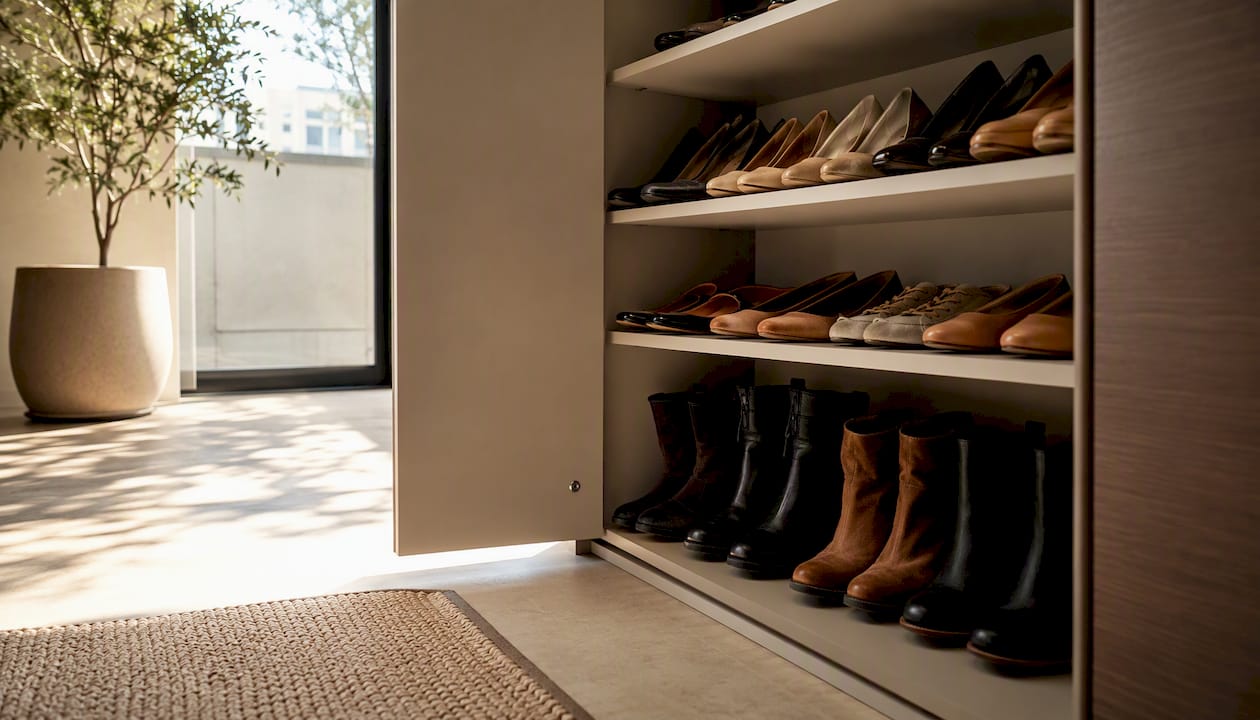
For most adult shoes, aim for 12–14 inches of depth. That range covers sneakers, dress shoes, flats, and sandals without wasting floor space. Slim entryway cabinets can work at 10–12 inches for everyday footwear, while boots and shoebox storage push the requirement up to 16–24 inches. Dimensions as the practical sweet spot for nearly all users, noting that going deeper mainly benefits those storing boxes rather than shoes. Size Helper’s shoe cabinet size chart confirms the same bands: standard 12–16 inches, slim 10–12 inches, boot storage 20–24 inches.
Quick exceptions worth knowing before you measure:
- Children’s shoes: 8–10 inches is plenty for most kids’ sizes
- Bulky hiking boots or work boots: plan for at least 16–18 inches
- Bench seating with storage: 14–16 inches balances shoe fit and comfortable seat depth
- Shoebox storage: 12–14 inches per box, stacked or side by side
When standard dimensions don’t match your entryway or closet, Primedecorfurnishing’s customized carpentry service builds mixed-depth built-ins sized exactly to your shoe collection and available footprint.
Pro Tip: Measure your largest pair of shoes before buying or building anything. One overlooked pair of hiking boots can make an otherwise perfect cabinet useless.
Key Takeaways
For most households, the right shoe cabinet depth is 12–14 inches for everyday footwear, with boots and shoebox storage requiring 16–24 inches and slim entryway units working at 10–12 inches.
| Point | Details |
|---|---|
| Standard depth range | 12–14 in covers most adult sneakers, dress shoes, flats, and sandals. |
| Boots and boxes need more | Boot storage and shoebox compartments require 16–24 in of depth. |
| Add 1–2 in clearance | Always add 1–2 in beyond your longest shoe for easy access and future-proofing. |
| Measure before you buy | Lay out every shoe type, measure the longest pair, then mock up the footprint with painter’s tape. |
| Primedecorfurnishing custom option | Onsite measurement and mixed-depth built-ins for households with varied footwear and non-standard spaces. |
Table of Contents
- What shoe cabinet depth works for each type of shoe?
- How far apart should shoe shelves be?
- How cabinet type changes the depth you actually need
- How to measure your shoes and calculate the right cabinet depth
- When to choose a shallower vs. deeper cabinet
- When does a custom built-in make sense?
- The measurement mistake that costs homeowners the most
- Primedecorfurnishing builds shoe storage sized to your actual shoes
- Sources
What shoe cabinet depth works for each type of shoe?
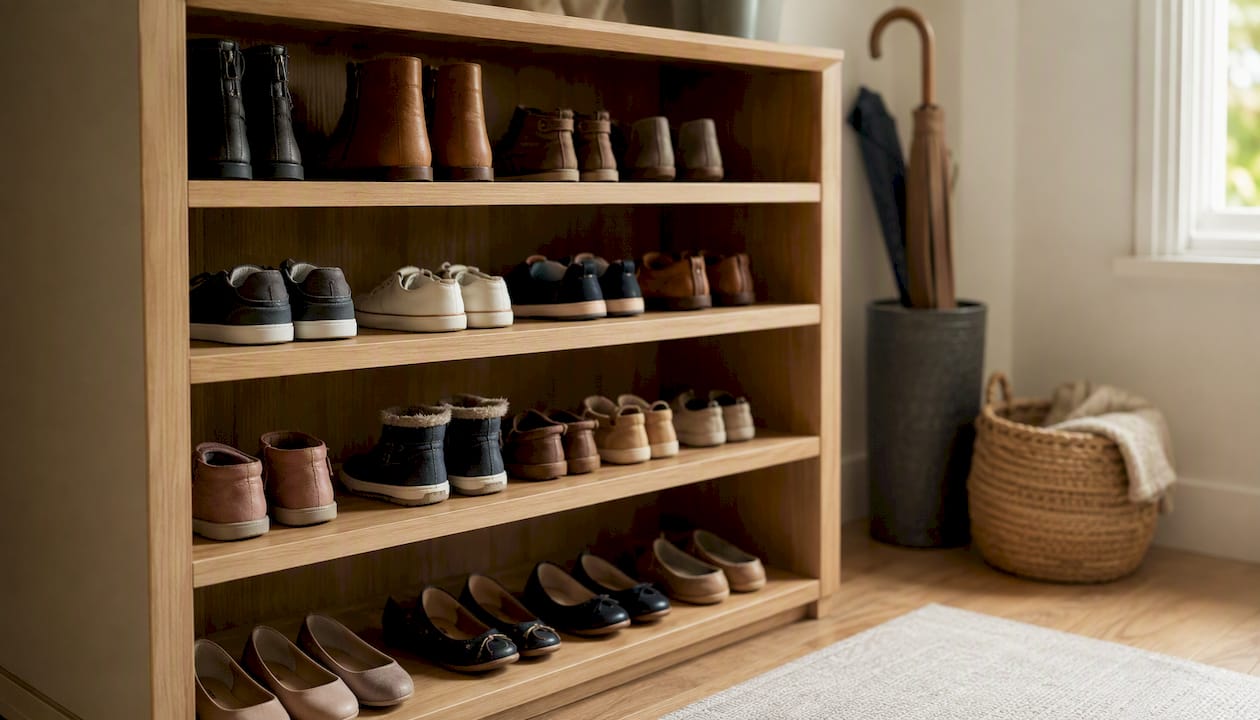
Shoe depth requirements vary more than most people expect, and the difference between a flat and a chunky sneaker is often 2–3 inches of shelf depth. Getting this right means fewer overhanging heels and no wasted voids at the back of the cabinet.
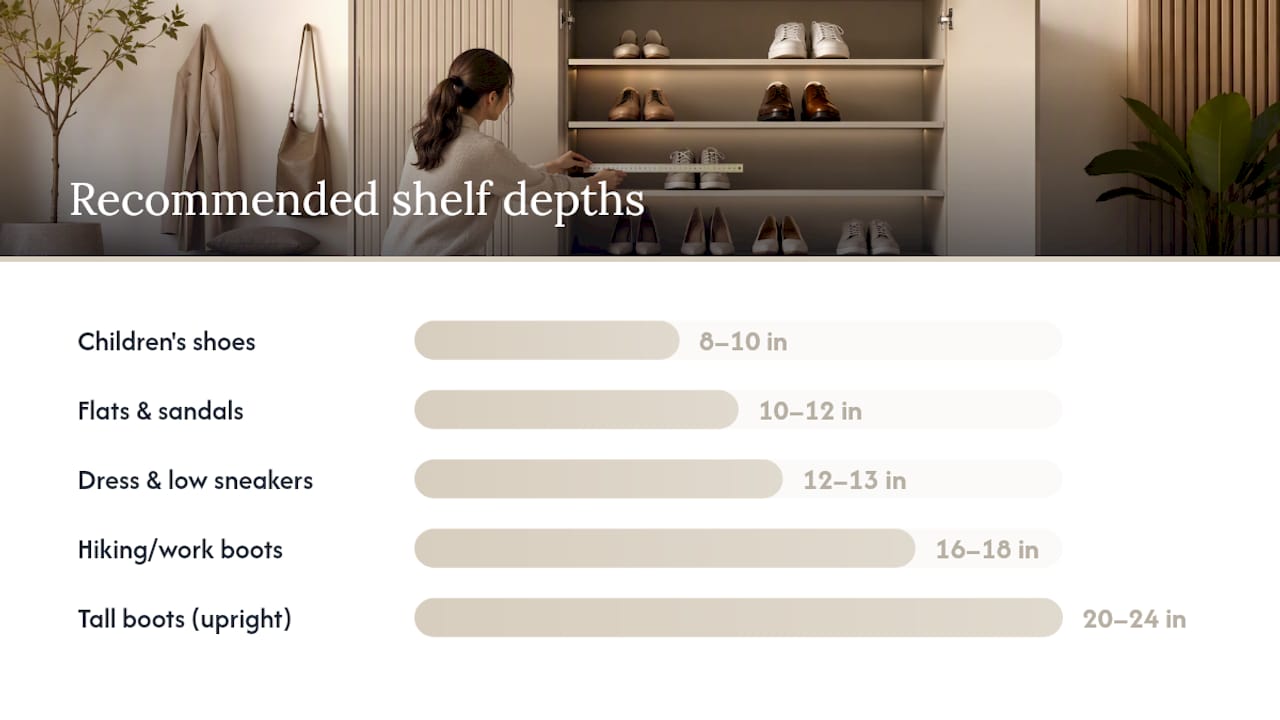
| Shoe Type | Recommended Depth |
|---|---|
| Children’s shoes (up to size 5) | 8–10 in |
| Flats and sandals | 10–12 in |
| Dress shoes and low sneakers | 12–13 in |
| Bulky sneakers and athletic shoes | 13–14 in |
| Hiking shoes and work boots | 16–18 in |
| Tall boots (stored upright) | 20–24 in |
| Shoebox storage | 12–14 in per box |
The logic is straightforward: shoe length plus 1–2 inches of clearance equals your minimum shelf depth. Most adult men’s sneakers run 11–12 inches long; women’s dress shoes typically land at 9–11 inches. Add that 1–2 inch buffer and you land squarely in the 12–14 inch range that covers the majority of everyday footwear.
Retail manufacturers design to this reality. The IKEA KLEPPSTAD sits at 13¾ inches deep; the IKEA GULLABERG comes in at 11¾ inches, a slim profile built specifically for narrow hallways. Both fit daily footwear without projecting far into a walkway.
One thing worth flagging: deeper cabinets beyond typical shoe length tend to leave unused space unless for boots or boxes. A Houzz discussion on closet shelf depth captures this tension well — homeowners with 18-inch built-in shelves often question whether that extra depth is doing anything useful for everyday shoes.
Pro Tip: Build in 1–2 inches of clearance beyond your longest shoe. It makes pulling shoes out easier and leaves room if you add a bulkier pair later.
How far apart should shoe shelves be?
Shelf spacing is the dimension most homeowners forget to plan. You can nail the depth and still end up with shelves too close together to fit ankle boots, or so far apart that you’ve wasted 4 inches of vertical space per row.
| Shoe Type | Vertical Clearance Needed |
|---|---|
| Flats and sandals | 4–5 in |
| Low sneakers | 5–6 in |
| Mid-top sneakers and loafers | 6–7 in |
| Ankle boots | 7–9 in |
| Tall boots (stored upright) | 12–16 in |
To plan a full cabinet, start with your total interior height and work down. A 72-inch tall cabinet with ½-inch shelves can fit roughly 10–12 rows of flats at 6-inch spacing, or 7–8 rows of sneakers at 8-inch spacing (including shelf thickness), or 4–5 rows of ankle boots at 10-inch spacing. Tall boots need a dedicated zone, typically the bottom section where vertical clearance is easiest to preserve.
A few structural points that affect the math:
- Shelf thickness: Standard ¾-inch plywood or MDF adds up across multiple shelves; account for it in your row count
- Door clearance: On a hinged-door cabinet, the door itself can eat ½–1 inch of usable interior depth when closed
- Adjustable shelf pins: Space pin holes every 1–2 inches so you can reconfigure for seasonal footwear changes without rebuilding
Adjustable shelves are the single best investment in a shoe cabinet. A fixed-shelf unit that works perfectly for your current shoe mix becomes a problem the moment you add a pair of tall boots or switch from sneakers to heeled boots in winter.
How cabinet type changes the depth you actually need
The type of storage you choose affects how much depth you need and how you use it. Closed cabinets, open racks, pull-out trays, and benches each have different depth logic.
Closed cabinets keep shoes out of sight and work well in entryways and living spaces. Standard depths run 12–14 inches for most shoe types. The catch: door thickness and hardware reduce usable interior depth by roughly ½–1 inch, so a cabinet labeled 13 inches deep may offer only 12 inches of actual shoe space. Ventilation matters here too. Enclosed cabinets with no airflow trap moisture and odor; look for louvered doors, ventilation gaps at the back, or perforated panels.
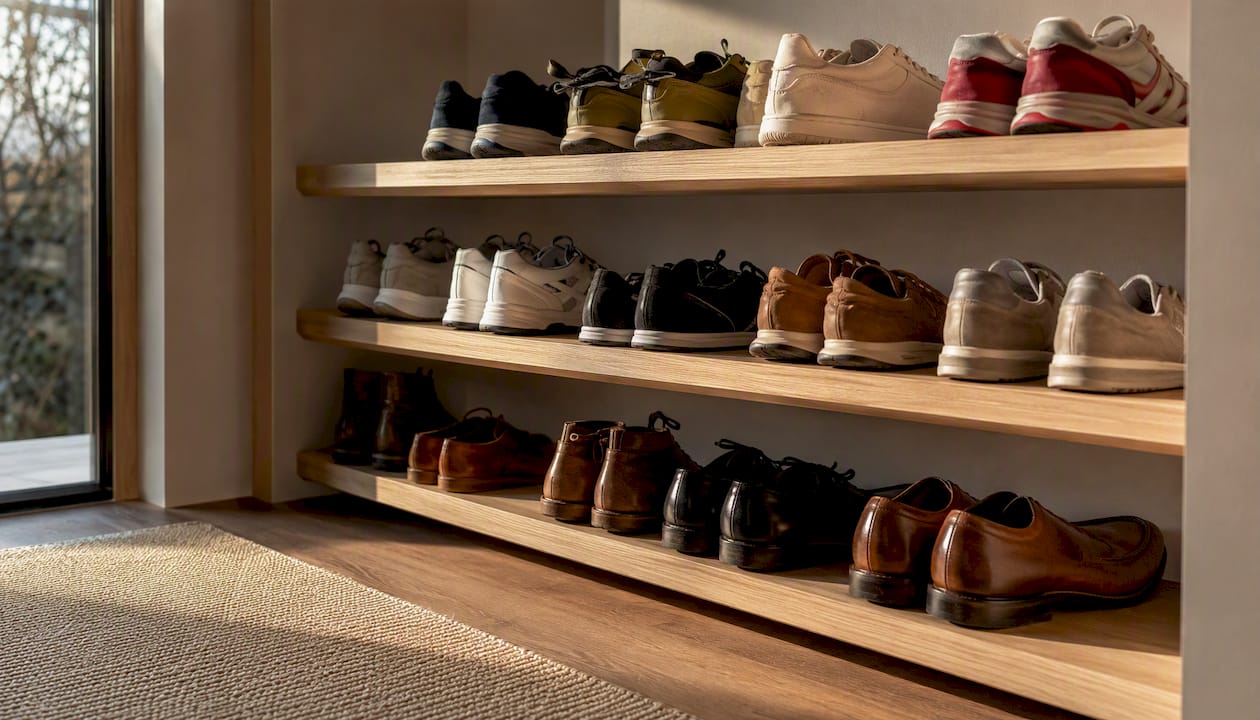
Open racks are more forgiving on depth because there’s no door penalty. A 12–14 inch open rack handles most sneakers and dress shoes cleanly. Going deeper than shoe length on an open rack just means you’re paying for air at the back. The practical rule: match rack depth to your longest everyday shoe, nothing more.
Pull-out trays let you use a deeper cabinet footprint without losing access to shoes at the back. A 16–18 inch cabinet with pull-out trays is more functional than the same depth with fixed shelves, because the tray brings the back of the shelf to you.
Benches with storage need a different calculation. Comfortable bench seating requires a seat depth of at least 14–16 inches for an adult to sit without perching on the edge. Shoe storage below the seat can match that depth, giving you a dual-purpose unit that works harder than a standalone cabinet.
Pro Tip: For a bench, prioritize the seating depth first (14–16 inches minimum), then design the shoe compartment to fit within that footprint. Reversing the priority leads to benches that are either uncomfortable to sit on or too shallow to store shoes properly.
How to measure your shoes and calculate the right cabinet depth
This is a five-minute job that prevents expensive mistakes. Do it before you order anything.
- Measure your longest shoe. Lay it flat on a hard floor and measure heel to toe. Do this for every type of shoe you plan to store, not just one pair.
- Add 1–2 inches of clearance. This is your minimum shelf depth for that shoe type.
- Account for door thickness and hardware. If the cabinet has a hinged door, subtract ½–1 inch from the labeled depth to get usable interior depth.
- Record your available footprint. Measure the floor space where the cabinet will sit, including any door swing that could block access.
- Check shelf thickness. Add ¾ inch per shelf when calculating total vertical space needed.
A worked example: your longest sneaker measures 12 inches. Add 1.5 inches clearance = 13.5 inches minimum depth. The cabinet has a hinged door that insets ¾ inch = you need a cabinet labeled at least 14.25 inches deep. Round up to the next standard size.
Before ordering or building, mark the cabinet depth on your floor with painter’s tape. Stand in front of it, simulate pulling shoes in and out, and check that the door swing doesn’t conflict with adjacent walls or furniture. A cardboard mock-up of the full cabinet footprint takes 10 minutes and can save you from a return or a rebuild.
- Adjustable shelf pins: space them every 1–2 inches for flexibility
- Boot compartments: allow at least 16 inches of shelf depth and 14–16 inches of vertical clearance
- Heavier boots: use ¾-inch or thicker shelves with a support every 24 inches to prevent sagging
Pro Tip: Measure both shoes in a pair. Left and right shoes are occasionally cut slightly differently, and the wider one sets your real clearance requirement.
When to choose a shallower vs. deeper cabinet
The depth decision comes down to two competing risks: too shallow and shoes overhang the shelf edge, becoming unstable and hard to grab; too deep and you waste floor space while creating a dark void at the back that collects dust and traps odor.
Practical strategies for common situations:
- Slim entryway (under 6 feet wide): a 10–12 inch cabinet keeps the walkway clear; use angled shelves to fit shoes at a diagonal and gain 1–2 extra inches of effective depth
- Staggered two-tier rows: place one row of shoes pointing toe-in and the next pointing heel-in; this lets two rows share roughly 20 inches of depth instead of 26
- Vertical cubbies for boots: a single tall cubby at one end of the cabinet handles boots without forcing the entire unit to be 20 inches deep
- Under-bench storage: pull-out drawers or open cubbies below a bench seat use the full 14–16 inch seat depth efficiently
The structural side matters too. Shelves spanning more than 24 inches without a center support will sag under the weight of boots over time. Use ¾-inch plywood or MDF minimum, and add a center support for any span over 24 inches. Thicker shelves also reduce the usable vertical space per row, so factor that into your row count.
An 18-inch footprint, which is what many closet builders default to, is worth questioning for everyday shoes. Converting that same footprint into two staggered rows (toe-in/heel-in) can store nearly twice as many pairs in the same depth. A custom pull-out solution does the same with better access. For home organization systems that maximize every inch, the configuration matters as much as the raw dimensions.
When does a custom built-in make sense?
Off-the-shelf cabinets work well when your shoe mix is uniform and your space is standard. They stop working when you have a mix of flats, sneakers, and tall boots, a non-standard entryway width, or a desire to integrate seating with storage.
Custom built-ins solve problems that retail units can’t:
- Mixed-depth zones: shallow rows (10–12 inches) for everyday flats and dress shoes alongside deeper compartments (16–20 inches) for boots, all in one continuous unit
- Pull-out trays and tilt-out drawers: make deep cabinets fully accessible without bending or reaching
- Under-bench storage: integrates seating and shoe storage in a single footprint, sized to the exact seat depth you need
- Ventilated cabinetry: louvered panels or rear gaps built in from the start, not retrofitted
When the footprint is tight and the shoe mix is varied, a custom built-in is almost always the better long-term investment. A single unit with mixed-depth zones, adjustable shelves, and integrated seating does the work of three separate pieces of furniture while fitting the exact space you have.
Primedecorfurnishing’s customized carpentry covers all of these configurations, with onsite measurement so the unit is designed around your actual space rather than a standard box. The service includes installation and warranty coverage, which matters when you’re building something meant to last. If you’re unsure whether a custom solution is worth it for your situation, the onsite measurement visit is the right first step: a professional measures your space, looks at your shoe mix, and tells you what’s actually possible within your footprint. Learn more about space-saving built-in options that apply the same logic to entryways, closets, and mudrooms.
The short answer on when to go custom: if you have more than two shoe types with significantly different depth requirements, a non-standard entryway, or you want bench seating integrated, a built-in will serve you better than anything off a shelf.
The measurement mistake that costs homeowners the most
The single most common error I see is planning a shoe cabinet around the average shoe and ignoring the outliers. Someone measures their everyday sneakers, orders a 13-inch cabinet, and then discovers their partner’s knee-high boots don’t fit. The cabinet is returned, or worse, kept and used badly.
The fix is simple: measure every shoe type in the household before you plan anything. Lay them all out, measure the longest and the bulkiest, and design the cabinet around those. The everyday shoes will fit in whatever space remains. A cardboard template on the floor, cut to the planned cabinet footprint, takes ten minutes and makes the depth decision obvious before any money changes hands.
One installer trick worth borrowing: measure both the shoe and its box. If there’s any chance you’ll store shoes in boxes (seasonal footwear, dress shoes you rarely wear), the box depth sets the requirement, not the shoe itself. Most shoeboxes run 13–14 inches long, which aligns with standard cabinet depths, but oversized boxes for boots or specialty footwear can push that to 16 inches.
Primedecorfurnishing builds shoe storage sized to your actual shoes
Most shoe cabinets are designed around an average shoe in an average space. If your entryway is narrower than standard, your household has a mix of flats and tall boots, or you want seating built into the same footprint, an off-the-shelf unit will leave you with compromises.
Primedecorfurnishing builds custom shoe storage sized to your actual shoe collection and available space, with onsite measurement included. Mixed-depth zones, pull-out trays, bench integration, and ventilated cabinetry are all on the table. The process starts with a site visit: a professional measures your space, reviews your needs, and designs a unit that fits both. Warranty coverage and full installation are included. To get started, visit Primedecorfurnishing and schedule your onsite measurement.
Sources
The depth ranges and recommendations in this guide draw from the following sources:
- Dimensions
- Shoe Cabinet Size Chart: Complete Guide With Dimensions - Size Helper
- How deep should my shoe shelves be in my closet? - Houzz discussion
Recommended
- Best Full Height Cabinets in Singapore: 2026 Buyer’s Guide | Prime Decor Furnishing
- Curtains vs Blinds: What Every Homeowner Should Know | Prime Decor Furnishing
- Kitchen Cabinet Design Ideas for Singapore Homes in 2026 | Prime Decor Furnishing
- Custom Carpentry Singapore: Space-Saving Built-Ins for Homeowners | Prime Decor Furnishing
Ready to transform your home?
Chat with us on WhatsApp for a free consultation or quote.
Chat with us on WhatsApp