
Window Film UV Protection: What Homeowners Need to Know
By Prime Decor Furnishing
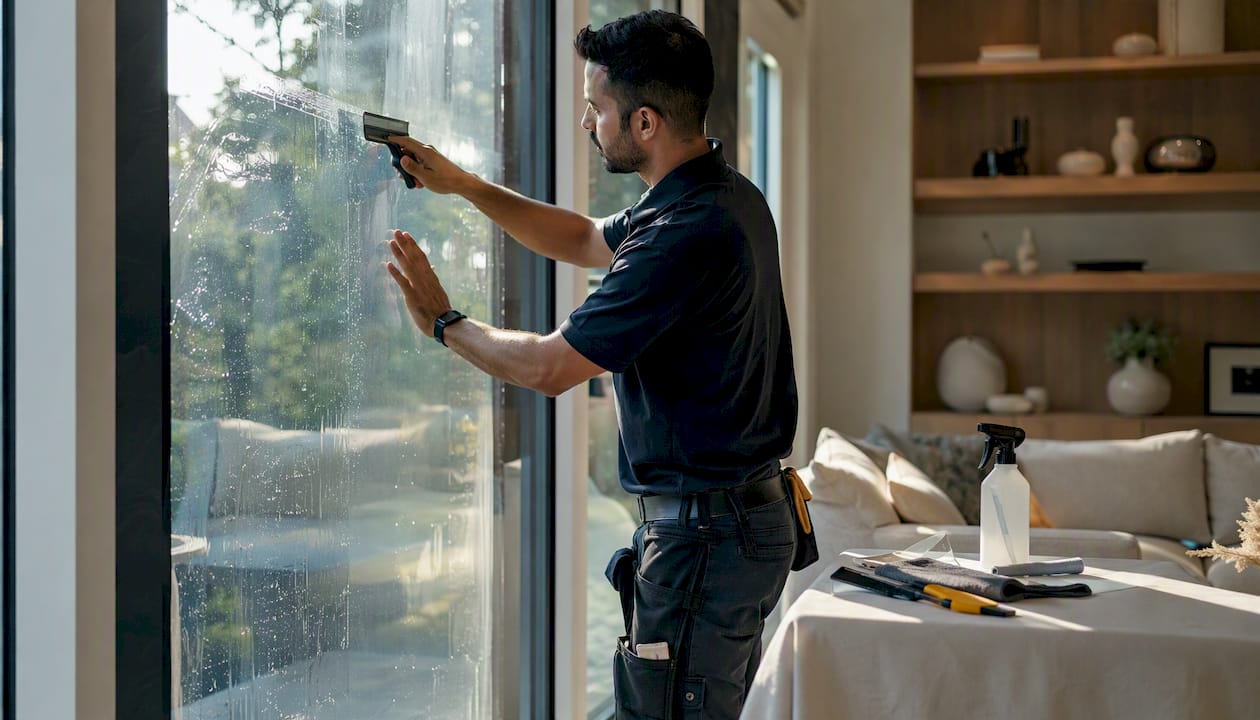
Window Film UV Protection: What Homeowners Need to Know
High-quality window film blocks about 99% of harmful UVA and UVB rays while keeping your view intact. That single fact is the reason the Skin Cancer Foundation recommends UV window film as part of an indoor sun-protection strategy, not just a home upgrade. The practical decision most homeowners face comes down to two paths:
- Clear UV-only film: Essentially invisible, blocks UV, minimal effect on heat. Best when your priority is preserving the view and slowing furniture fade.
- Spectrally selective / ceramic film: Blocks UV plus significant infrared heat with very little darkening. Best when you also want lower cooling bills and better comfort near sun-facing windows.
If skin protection and fading are your only concerns, a clear UV film rated at 99%+ UV rejection is enough. If south- or west-facing windows are turning your living room into a greenhouse, step up to ceramic.
Table of Contents
- How does window film actually block UV rays?
- What types of window film are available, and which suits your goal?
- Which specs actually matter when comparing films?
- How do you choose the right film for your windows?
- Should you install window film yourself or hire a professional?
- How long does UV-blocking film last, and how do you maintain it?
- Why UVA through glass is a bigger problem than most people realize
- Key Takeaways
- The case for treating UV film as a health decision, not a decor one
- Primedecorfurnishing’s solar film service: supply, measurement, and installation
- Useful sources to verify UV film claims
How does window film actually block UV rays?
Standard window glass does a reasonable job stopping UVB (the shorter, burn-causing wavelength), but it lets most UVA through. UVA sits in the 315–400 nm range, penetrates deeper into skin, and is the primary driver of both interior fading and the kind of cumulative skin damage you don’t feel until years later. That’s the gap window film fills.
The film itself is a thin polyester or multi-layer optical laminate applied to the interior glass surface. Manufacturers embed UV-absorbing compounds directly into the polymer matrix, sometimes combined with metallic or ceramic coatings. When UV photons hit the film, the absorbers convert that energy to heat rather than passing it through. The result: manufacturer lab specs from 3M document UV rejection up to 99.9% for certain product lines, tested across the 300–380 nm band under standardized conditions.
99%+ UV rejection is the threshold most quality films hit in lab testing. That means fewer than 1 in 100 UV photons passes through the treated glass under controlled conditions.
The “300–380 nm” range you’ll see on spec sheets is the industry-standard test band for UV rejection claims. Films that pass this test consistently are the ones worth buying.
What types of window film are available, and which suits your goal?
Not all films are built the same. The category you choose determines how much UV gets blocked, how much heat stays out, and whether your windows look any different afterward.
- Clear UV-only films are nearly invisible after installation. Products like the BDF S2M clear UV-blocking film advertise 99% UV rejection with a scratch-resistant coating and no tint. Heat rejection is minimal, but if you’re protecting artwork, hardwood floors, or a sun-sensitive family member without changing the look of your home, this is the right category.
- Dyed and metalized films add some heat rejection on top of UV blocking, but they change the appearance of the glass. Metalized versions can create a reflective, mirror-like exterior look. They work, but they’re a visual trade-off.
- Ceramic / spectrally selective films are the performance tier. Solar Gard’s PureVue ceramic series blocks more than 99% of UV (300–380 nm) while also rejecting significant infrared heat with VLT options that keep the glass looking clear. These are the films to choose when you want UV protection and climate control without darkening your rooms. For more detail on what makes ceramic films different, this installer-focused breakdown of ceramic window film covers the spectral mechanics well.
- Safety and security films are thicker laminates designed to hold shattered glass in place. Many include UV-blocking layers as a secondary benefit, but UV protection is not their primary job. Choose them for impact resistance; treat the UV blocking as a bonus.
| Feature | Clear UV-only | Dyed/Metalized | Ceramic/Spectrally Selective | Safety/Security |
|---|---|---|---|---|
| UV protection | 99%+ | Good | 99%+ | Varies |
| Heat rejection | Low | Moderate | High | Low–Moderate |
| Visual clarity | Excellent | Reduced | Excellent | Good |
| Glare reduction | Minimal | Moderate–High | Moderate | Minimal |
| Cost | Low–Mid | Mid | Mid–High | High |
| Installation complexity | Low–Mid | Mid | Mid–High | High |
Which specs actually matter when comparing films?
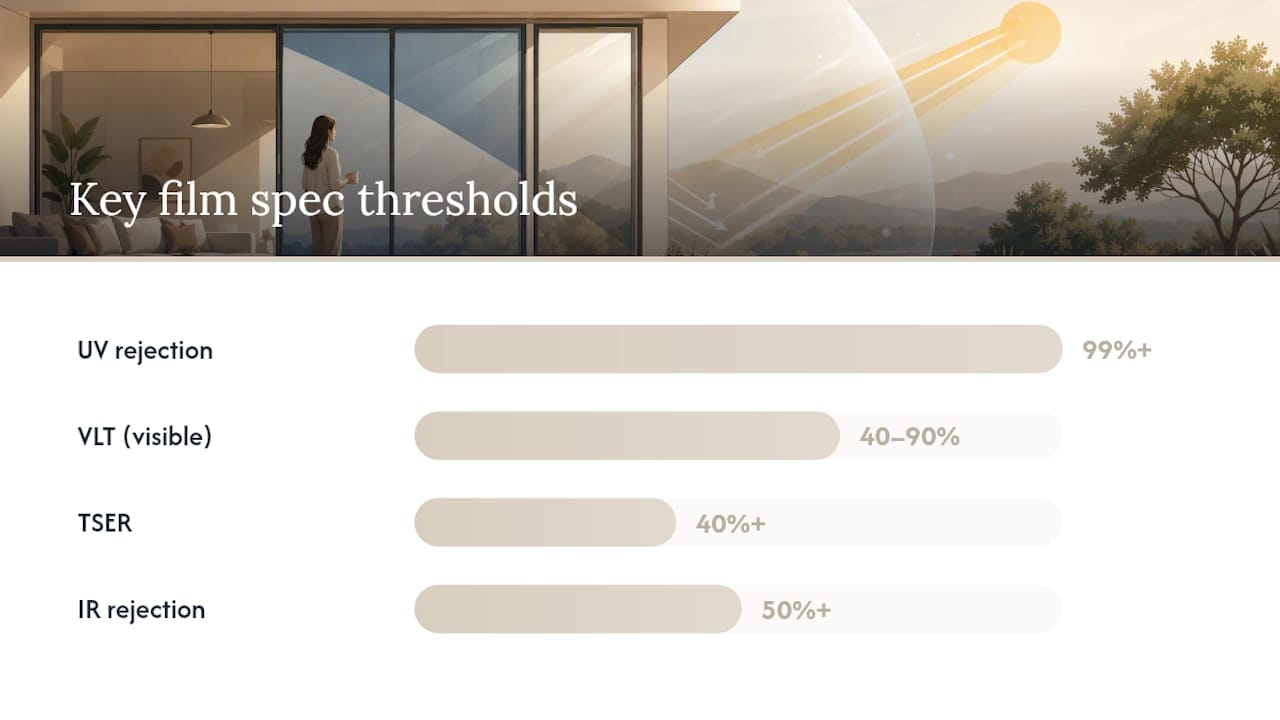
Three numbers tell you almost everything: UV rejection %, visible light transmittance (VLT), and total solar energy rejected (TSER) or IR rejection.
UV rejection % is the headline figure. Anything below 95% is worth questioning. Most quality films land at 99% or above. The test band matters too: a film claiming “99% UV block” tested only at 380 nm is not the same as one tested across the full 300–380 nm range.
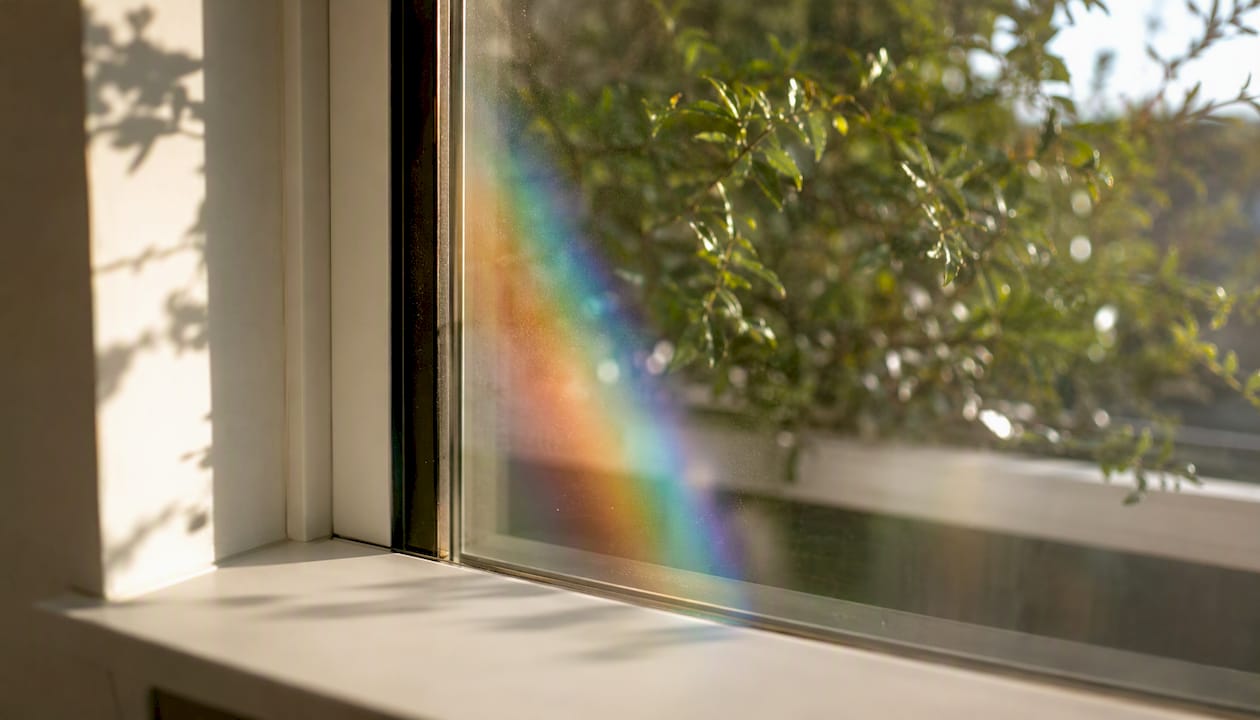
VLT measures how much visible light passes through. A VLT of 70% feels nearly transparent; 35% creates a noticeably darker room. Clear UV films typically sit at 70–90% VLT. Ceramic films can hold 40–70% VLT while still rejecting substantial heat.
TSER (Total Solar Energy Rejected) or IR rejection tells you how much of the sun’s heat load the film stops. A film with 50% TSER cuts the solar heat gain roughly in half. This is the number that affects your air conditioning bill, not UV rejection alone.
| Metric | What it measures | Good threshold | User impact |
|---|---|---|---|
| UV rejection % | UV photons blocked (300–380 nm) | 99%+ | Fading and skin protection |
| VLT | Visible light transmitted | 40–90% depending on goal | Room brightness and view |
| TSER | Total solar energy rejected | 40%+ for heat control | Comfort and energy savings |
| IR rejection | Infrared (heat) radiation blocked | 50%+ for hot climates | Temperature near windows |
Lab conditions use standard glass at a fixed angle. Real-world performance can vary slightly based on your glass type (double-pane vs. single), window orientation, and how cleanly the film was applied. The specs are still the right starting point; just don’t expect lab-perfect numbers in every room.
How do you choose the right film for your windows?
Start with your primary goal, then work through the specs.
- Identify your priority. Skin protection and fade prevention only? A clear UV-only film rated at 99%+ UV rejection is sufficient. Adding heat control to the list? Move to a spectrally selective or ceramic film with a TSER above 40%.
- Check window orientation and glass type. South- and west-facing windows receive the most solar load. Double-pane windows may have restrictions on film application from the glass manufacturer; confirm before buying.
- Read the UV % and VLT on the spec sheet. Ask for the 300–380 nm test result specifically. A vague “blocks UV” claim with no lab data is a red flag.
- Look for the Skin Cancer Foundation Seal of Recommendation. Films that carry this endorsement have been independently reviewed for UV-blocking performance. It’s not mandatory, but it’s a meaningful trust signal.
- Confirm warranty terms and installer certification. Many manufacturers require professional installation for the full product warranty to apply.
Questions to ask before you buy or hire:
- What is the UV rejection % tested across 300–380 nm?
- Does the film carry the Skin Cancer Foundation Seal of Recommendation?
- What is the warranty length, and does it require professional installation?
- Will applying this film void my existing glass or window manufacturer warranty?
- Can you provide the lab test report for this specific product?
Red flags: vague UV claims with no lab data, warranties that only apply to professional installs but the seller pushes DIY, and products with no listed VLT or TSER figures.
On price, clear UV-only films are the entry point. Ceramic and spectrally selective films cost more per square foot because of the more complex manufacturing. Window size, edge complexity, and whether you’re retrofitting existing glass or working with new construction all influence the final number. For a broader look at UV protection window film options and what installers typically evaluate, that resource is worth a read before you request quotes.
Should you install window film yourself or hire a professional?
For a single small window, DIY is manageable. For anything larger, professional installation is the smarter call.
DIY pros and cons:
- Lower upfront cost and available as kits for most standard window sizes
- Requires patience, a clean environment, and the right tools (squeegee, spray bottle, sharp trim knife)
- Bubbles, dust trapped under the film, and uneven edges are common mistakes that affect both appearance and UV performance
- Many manufacturers void the full warranty on DIY-applied film
Professional installation pros and cons:
- Consistent results on large, multi-pane, or high-value windows
- Installers control dust, edge trimming, and film tension during wet application — the factors that most affect long-term clarity
- Consumer Reports testing confirms that professional installation improves appearance and longevity compared to DIY attempts
- Higher upfront cost, but the warranty typically remains intact
Pro Tip: Before the installer leaves, ask for a photographed pre- and post-installation condition record. This documents the glass condition before film was applied and protects both you and the installer if a warranty claim comes up later.
When hiring, check whether the installer is certified by the film manufacturer. Some brands maintain installer networks with training requirements; a certified installer is more likely to apply the film correctly and honor the warranty process.
How long does UV-blocking film last, and how do you maintain it?
Most high-quality films retain their UV-blocking ability for many years. Typical lifespans run for many years under normal residential conditions, though surface appearance (minor scratching, slight hazing) can change before the UV performance degrades.
Maintenance steps:
- Wait at least 30 days after installation before cleaning. The adhesive needs time to cure fully.
- Use a soft cloth or rubber squeegee with a mild, ammonia-free cleaner. Ammonia breaks down the film’s adhesive and surface coatings over time.
- Avoid abrasive scrubbers, steel wool, or any cleaner with a high alcohol content.
- Dry the surface gently; don’t let cleaner pool at the edges where it can work under the film.
| Film type | Typical lifespan | Common warranty voiders |
|---|---|---|
| Clear UV-only | — | Ammonia cleaners, abrasive scrubbing, exterior application of interior film |
| Ceramic/spectrally selective | — | Same as above, plus improper edge sealing during install |
| Safety/security | — | Physical impact damage, improper trimming |
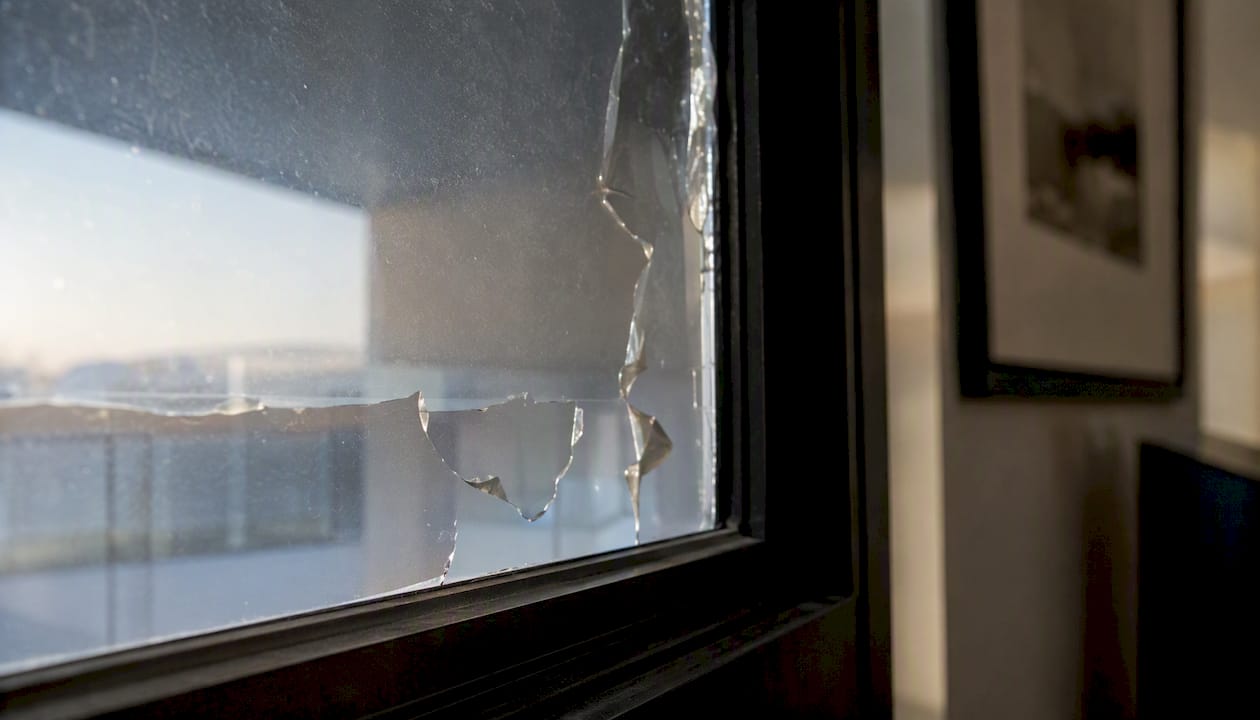
Replace the film when you see visible delamination (the film lifting from the glass), persistent peeling at the edges, or scratches deep enough to affect VLT noticeably. A film that looks cloudy or heavily scratched is also blocking less light than it should, which means its UV performance may be compromised even if it’s technically still adhered.
Why UVA through glass is a bigger problem than most people realize
Standard glass stops most UVB, so many homeowners assume their windows are already doing the protective work. They’re not. According to the Library of Congress, UV radiation’s higher-energy photons interact directly with pigment molecules, breaking chemical bonds and causing the color changes we call fading. UVA, which passes through ordinary glass with very little resistance, drives that process year-round.
The skin-health stakes are just as real. The Skin Cancer Foundation notes that UVA penetrates glass and contributes to cumulative skin damage even during routine indoor exposure near windows. FSEC research confirms that UV, visible light, and heat together accelerate fading, and that reducing UV slows the process significantly, though it doesn’t stop it entirely. Film handles the UV component passively, every day, without any action from you.
That passivity is the underrated part. Curtains and blinds help, but only when closed. Film works whether the window is bare or covered, in winter as much as summer.
Key Takeaways
High-quality window film rated at 99%+ UV rejection is the most effective passive measure for protecting both skin and interior furnishings from UVA damage through glass.
| Point | Details |
|---|---|
| Check UV rejection % first | Require 99%+ tested across the 300–380 nm band; reject vague claims with no lab data. |
| Match film type to your goal | Clear UV-only for view and fade protection; ceramic/spectrally selective when heat control also matters. |
| Verify the Skin Cancer Foundation Seal | Films with this endorsement have been independently reviewed for UV-blocking performance. |
| Prefer professional installation | Pro installs preserve warranty coverage and deliver better long-term clarity on large windows. |
| Primedecorfurnishing for supply and installation | Primedecorfurnishing offers solar film supply with onsite measurement and professional installation backed by warranty. |
The case for treating UV film as a health decision, not a decor one
Most homeowners shop for window film the way they shop for blinds: they think about light levels, privacy, and whether it looks good. UV performance is treated as a bonus spec, something to glance at before deciding on color or price. That framing gets it backwards.
The real reason to install UV-blocking film is the same reason you’d apply sunscreen before a long drive: UVA doesn’t announce itself. It passes through glass silently, year-round, and the damage it causes to skin cells and interior pigments is cumulative. By the time you notice faded hardwood or a dermatologist’s concern, years of exposure have already happened.
The practical implication is that UV rejection % should be the first filter, not the last. A film that looks great but only blocks 85% of UV is doing less than half the protective work of a 99%+ film, even though the visual difference is negligible. Ceramic films that combine high UV rejection with meaningful heat control are worth the premium for south- and west-facing rooms, not because they’re more expensive, but because they address two compounding problems at once.
The Skin Cancer Foundation Seal exists precisely because this distinction matters. It’s not a marketing badge; it’s a signal that the film has been reviewed against a defined UV-blocking standard. Asking for it, along with the 300–380 nm lab test report, takes about 30 seconds and separates products that perform from products that merely claim to.
Primedecorfurnishing’s solar film service: supply, measurement, and installation
Protecting your home from UV damage is straightforward when you have the right film and a clean installation. Primedecorfurnishing supplies solar films with verified UV-blocking specs and handles the full process: onsite measurement, professional fitting, and warranty-backed installation so you’re not guessing at coverage or risking a voided guarantee.
An onsite visit covers measured window dimensions, a review of your glass type and orientation, and a recommendation matched to your priority, whether that’s clear UV-only protection or a spectrally selective film for heat control. Lead times and warranty terms are confirmed before any work begins.
Browse the available solar film products to see current options, or visit Primedecorfurnishing to request an onsite quote and get a film recommendation matched to your windows.
Useful sources to verify UV film claims
Before you commit to a product or installer, these sources let you check performance claims independently:
- UV window film | Skin Cancer Foundation
- PureVue™ Ceramic Window Film — Clear UV Protection | Solar Gard
- UV-Blocking window film and Sun control information | 3M
- Best window films for a cooler home | Consumer Reports
- Why does ultraviolet light cause color to fade? | Library of Congress (Loc.gov)
- Fading and windows | Florida Solar Energy Center (FSEC)
- Does window film block UV rays completely? The truth explained | American Window Film
- BDF S2M Window Film Clear UV Blocking — BDF BuyDecorativeFilm
When requesting quotes, ask every supplier for the manufacturer’s lab test report covering the 300–380 nm UV band and confirm whether the installer is manufacturer-certified. Those two requests filter out most underperforming products before you spend a dollar. For a broader look at solar film providers and installer selection, Primedecorfurnishing’s guide covers what to look for when comparing options.
This article provides general information about window film products and UV protection. For medical advice about UV exposure and skin health, consult a qualified dermatologist or healthcare professional.
Recommended
- Top 3 Solar Film for Windows Providers 2026 | Prime Decor Furnishing
- Curtains vs Blinds: What Every Homeowner Should Know | Prime Decor Furnishing
- Curtain Material Singapore: Best Fabrics for Home Windows | Prime Decor Furnishing
- Outdoor Roller Blind for Singapore Balconies: 2026 Guide | Prime Decor Furnishing
Ready to transform your home?
Chat with us on WhatsApp for a free consultation or quote.
Chat with us on WhatsApp