
Afternoon Thunderstorms: A Window, Curtain and Blind Check for HDB Homes
By Prime Decor Furnishing
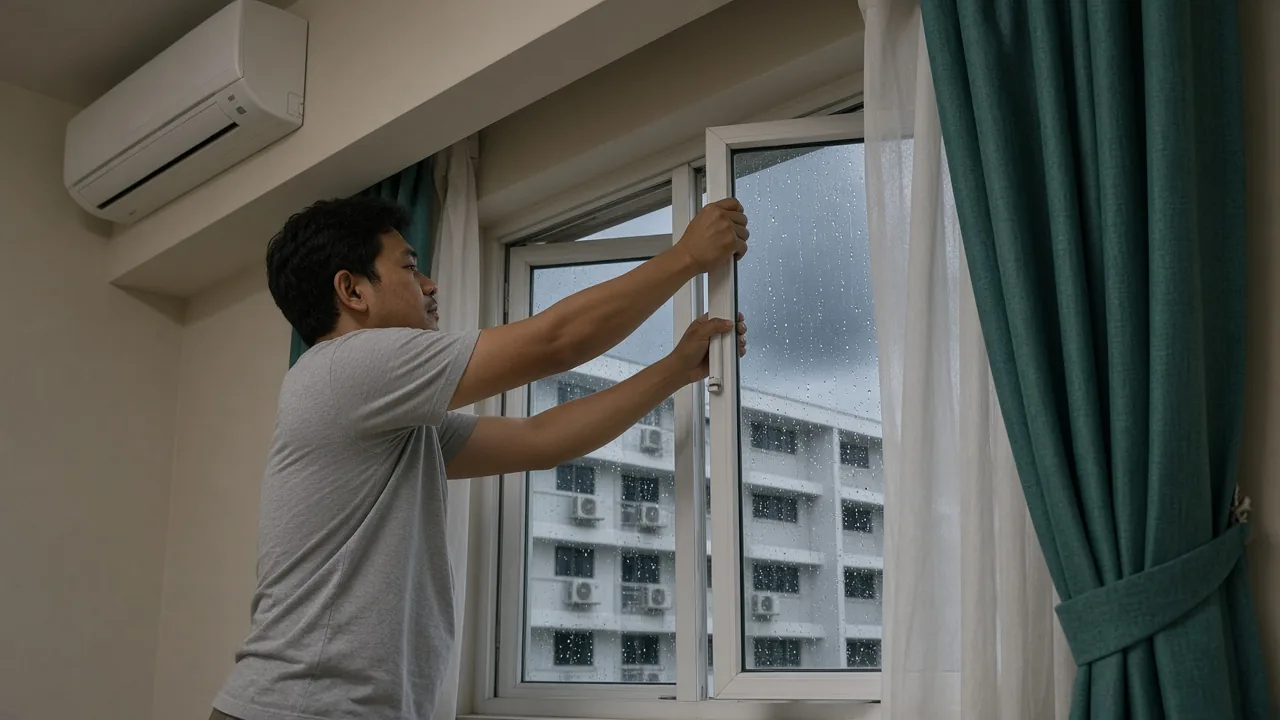
It is 34°C at three in the afternoon, every window in the flat is open, and the sky over the next block turns grey in about ten minutes. By the time you reach the bedroom, the sill is wet and the curtain hem is soaking it up.
That is the pattern the Meteorological Service Singapore (MSS) has flagged for the rest of October. In its fortnightly outlook issued on 16 October 2026, MSS said that "localised short-duration thundery showers are expected over parts of the island in the afternoon on most days", with daily highs "likely to range between 33 degrees Celsius and 35 degrees Celsius on most days". Hot afternoons mean open windows. Short, sudden showers mean you do not always get to them in time.
This is a short, practical check for HDB and BTO homes: the windows first, then the curtains and blinds that hang beside them, then the balcony and service yard.
What the weather service is actually saying
MSS is not forecasting a washout. The same outlook says total rainfall for the second fortnight of October "is forecast to be below average over most parts of the island", and that Southwest Monsoon conditions are expected to continue through to 1 November. The issue is timing, not volume: brief, localised storms on hot afternoons, when most homes have their windows wide open.
Looking further ahead, MSS's long-term climate records show why year-end is worth preparing for. Its Climate of Singapore page describes October and November as an inter-monsoon period in which "Thunderstorms, at times severe, occur in the afternoon and early evening". On the 1991–2020 averages, November has 19 rain days and 252.3mm of rain, and December 331.9mm, the highest of any month. The Northeast Monsoon follows from December to early March, and in its early wet phase MSS notes that monsoon surges can bring "widespread continuous moderate to heavy rain, at times with 25-35 km/h winds".
Those are long-term averages, not a forecast for this year. They are still a good reason to do the checks below now, while the afternoons are dry enough to work on.
Check the windows before anything else
Curtains and blinds are only as good as the window behind them. The Building and Construction Authority (BCA) notes that windows "are constantly exposed to weather elements like wind and rain" and asks homeowners to follow three steps: check, clean, change.
For the aluminium casement windows found in most HDB flats, BCA's checklist is simple:
- Rivets are not broken or corroded.
- Screws are not loose or rusty.
- Friction stays are not bent or loose.
BCA suggests using a mirror to see the screws and rivets on the top and underside of the window panel. Its maintenance tips also say that if rivets or screws are made of aluminium, "replace them with stainless steel ones", and to lubricate the moving parts. For sliding windows, check that the safety stopper and angle strip are in place.
If anything needs repairing or replacing, HDB is clear that window works may only be done by BCA-approved window contractors listed with HDB. HDB also reminds owners: "As a flat owner or occupant, you are responsible for the upkeep of the windows in your flat." We make curtains and blinds, not windows, so if we spot a loose stay or a corroded rivet during a measure, we will point it out and suggest you call an approved window contractor before anything is mounted near it.
Curtains that hang next to an open window
Most rain damage to curtains is slow, not dramatic. A hem sits on a wet sill, the lining stays damp overnight, and a few weeks later there is a grey line of mildew along the bottom. A few small choices help:
- Length. For windows you open often, a curtain that clears the sill or floor by a finger's width dries faster and does not wick water. Puddled hems look lovely but suit closed windows better.
- Lining. Lining protects the face fabric from sun, but it also holds moisture. If a window is opened most afternoons, it is worth thinking about which lining you choose. Our guide to curtain lining types walks through the options.
- Layers. Day-night curtains let you keep the sheer drawn while the window is open and pull the heavier layer back. If a shower catches you, it is the light sheer that gets wet, and sheers dry far faster than lined blackout panels.
- Tiebacks and stack space. When the curtains stack clear of the window opening, you can reach the handle quickly and the fabric stays out of the splash zone.
- After a wet afternoon. Let the fabric dry with air moving through the room before you close it up for the night. Damp fabric folded into a tight stack is what invites mildew.
If you are fitting out a new flat, our BTO curtains page shows the fabrics and tracks we usually suggest for each room.
Blinds for windows that get wet
Some windows are simply wetter than others: the kitchen window over the sink, the bathroom louvre, the service yard. These are places where a blind usually makes more sense than fabric curtains.
- Venetian blinds wipe down easily and handle splashes well.
- Roller blinds in easy-clean fabrics keep a clean line on smaller windows and roll up clear of the sill when the window is open.
- Motorised options available on selected styles. These are worth a look for tall or hard-to-reach windows, where a quick close from across the room means you are not climbing over furniture when the sky darkens.
You can see the full range of indoor options on our curtains and blinds page.
Balcony and service yard: where outdoor zip blinds fit
Short afternoon storms on hot days often come with gusts and slanting rain, which is why balconies, planters and yard laundry take the worst of it. Outdoor zip blinds run their fabric inside side channels, so the blind stays in its track in a breeze instead of flapping. We supply and install ZipBlind outdoor zip blinds for this reason.
Two honest points before you decide:
- HDB rules come first. If your flat has an open balcony where permanent enclosure is not allowed, for example DBSS flats and flats handed over after 1 July 2007, HDB's renovation guidelines for window works set conditions for blinds there. HDB states that "The blinds have to be able to be drawn open or retracted fully" and that the "Installation must allow for natural ventilation within the balcony at all times, even when the screens/ blinds are fully drawn and closed". The material of the blinds "must be porous and permeable to allow natural lighting and ventilation to flow through", and "Glass, PVC or any material which will completely block off sun, light, rain and wind is not allowed". Not every outdoor fabric meets that, so which ZipBlind fabric suits your balcony is something we check at the measure.
- A screen is not a wall. A breathable outdoor blind cuts sun, glare and much of the slanting spray, but it is not a sealed enclosure. Expect a drier balcony, not a dry one.
Condo owners should also check their MCST's by-laws before installing anything on a balcony.
A ten-minute storm-ready routine
- Do the BCA mirror check on every casement window: rivets, screws, friction stays.
- Wipe the window sills and tracks so water drains instead of pooling.
- Lift or tie back any curtain hem that touches a sill you open daily.
- Draw the sheer, not the lined layer, on windows you leave open in the afternoon.
- Move cushions and laundry off the balcony edge when the sky turns.
- Note any window that is hard to reach in a hurry. That is the one to think about motorising.
Warranty and the measure
Our indoor curtains and blinds carry a 3-year warranty, and ZipBlind outdoor zip blinds carry a 5-year warranty. If you would like a second pair of eyes on which windows need what, message us to book a measure. The measure is free, and we will tell you plainly if a window needs a window contractor before it needs a curtain.
FAQ
Is Singapore in the monsoon season now?
Not yet. MSS's outlook for 16 October to 1 November 2026 says Southwest Monsoon conditions are prevailing and expected to continue through the fortnight. On MSS's long-term climate records, the Northeast Monsoon usually runs from December to early March, with October and November normally an inter-monsoon period.
How do I check my HDB casement windows?
BCA suggests using a mirror to check the top and underside of each window panel, making sure rivets are not broken or corroded, screws are not loose or rusty, and friction stays are not bent or loose. Any repair or replacement must be done by a BCA-approved window contractor listed with HDB.
Which curtains handle open windows and sudden showers best?
Day-night curtains work well because you can keep the light sheer drawn while the window is open. Sheers dry quickly, and the heavier lined layer stays pulled back and dry. Keep hems clear of the sill on windows you open often.
Can I install outdoor zip blinds on an HDB balcony?
It depends on the balcony. On open balconies where permanent enclosure is not allowed, such as those of DBSS flats and flats handed over after 1 July 2007, HDB's window works guidelines require that the blinds can be drawn open or retracted fully and that the balcony keeps natural ventilation even when the blinds are fully closed. HDB also states that the material of the blinds "must be porous and permeable to allow natural lighting and ventilation to flow through", and that "Glass, PVC or any material which will completely block off sun, light, rain and wind is not allowed". Not every outdoor fabric qualifies, so we check at the measure and suggest a ZipBlind fabric that suits your balcony.
What warranty do your curtains and blinds come with?
Indoor curtains and blinds come with a 3-year warranty. ZipBlind outdoor zip blinds come with a 5-year warranty.
Sources
- Meteorological Service Singapore, Fortnightly Weather Outlook, 16 October – 1 November 2026 (issued 16 October 2026)
- Meteorological Service Singapore, Climate of Singapore (1991–2020 climatology)
- Building and Construction Authority, Windows safety
- Building and Construction Authority, What to look out for when checking windows and Maintenance tips
- Housing & Development Board, Renovation guidelines for window works
- Housing & Development Board, Keeping windows of HDB flats in good condition
Ready to transform your home?
Chat with us on WhatsApp for a free consultation or quote.
Chat with us on WhatsApp