
Q4 2026 Electricity Tariff: Curtains for West-Sun HDB Rooms
By Prime Decor Furnishing
From 1 October to 31 December 2026, the regulated household electricity tariff is 28.59 cents per kWh before GST, or 31.16 cents per kWh with GST, according to SP Group. That is 10.4% (3.32 cents per kWh) lower than last quarter, and SP Group puts the average monthly bill for an HDB four-room flat at $12.99 lower before GST (SP Group media release, 30 Sep 2026).
A smaller bill is welcome. But the room that makes your aircon work hardest every afternoon is still there: the bedroom or living room with west-facing glass. This quarter is a sensible time to sort that window out.
What changed on 1 October
- Household tariff, Q4 2026: 28.59 cents/kWh before GST; 31.16 cents/kWh with 9% GST (SP Group tariff information).
- Change from Q3 2026: down 10.4%, or 3.32 cents/kWh, from 31.91 cents/kWh before GST (SP Group).
- Why it fell: the energy cost part of the tariff follows natural gas prices from 1 July to 15 September 2026, which were lower (SP Group).
Why the dip may not last
SP Group's own release says global fuel prices have risen since September 2026 and that, if this continues, tariffs are expected to go up in the next quarter (SP Group). Since the tariff follows fuel prices with a delay, today's lower rate tells you little about what January to March 2027 will look like.
So treat this quarter as breathing room, not a fix. Whatever you do now to stop afternoon sun from heating up a room keeps helping when the tariff moves again.
Where your aircon is fighting the sun
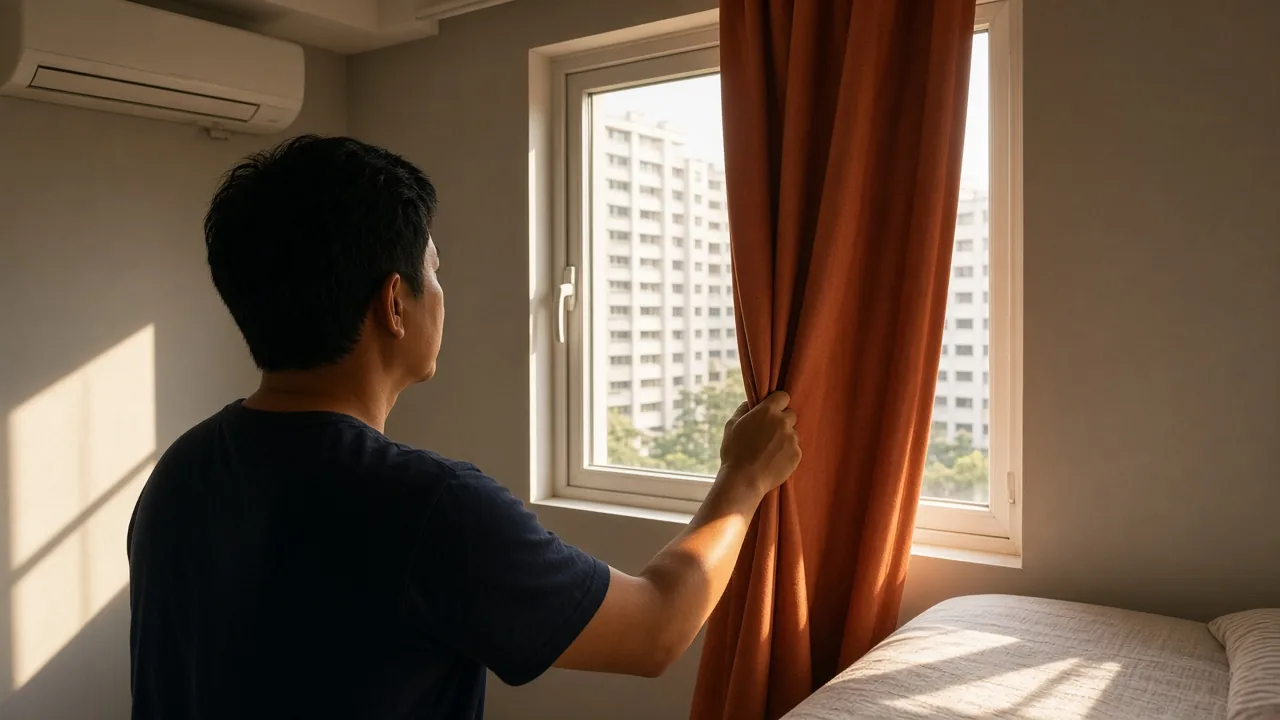
In many HDB and BTO flats, one or two rooms take the full afternoon sun. Window frames heat up, the floor near the glass feels warm, and the aircon in that room seems to run non-stop until evening.
NEA notes that rooms with large window areas or windows facing the sun on the east–west axis may even need a bigger aircon (NEA). Both NEA and EMA give the same simple advice: keep curtains or blinds closed during the hottest part of the day to block direct sunlight (EMA; NEA). NEA's interior design tips also list curtains or blinds over windows as a way to block unwanted heat from the sun (NEA).
That advice only works if what's on the window can actually block the sun. A thin unlined sheer looks nice but lets most of the glare and heat through.
Pick the layer by room
West-facing master or kids' bedroom: blackout or thermal-lined
A blackout or thermal-lined curtain gives you a dense layer between the glass and the room. Draw it after lunch, and the bed and walls stay out of direct sun through the hottest hours. It also helps the room feel cooler sooner when the aircon goes on in the evening. If you're unsure which backing to pick, our guide to curtain lining types explains the options.
Living room: day-night curtains
Most families don't want a dark living room at 3pm. Day-night curtains pair a sheer with a heavier main curtain on a double track, so you can stay on the sheer in the morning and draw the main curtain when the sun comes round to the west. You keep daylight and privacy and still have something solid for the harsh hours.
New BTO keys: plan it with the rest of the move-in
If you're collecting keys soon, check which windows face west before the furniture goes in, and plan those rooms first. Our BTO curtains page shows how we stage day-night and blackout across a new flat.
Balcony or yard facing west: ZipBlind
When the sun hits a balcony first and then the living-room glass behind it, an outdoor screen helps. ZipBlind outdoor zip blinds run in side channels, so the fabric stays taut and shades the balcony before the heat reaches your sliding doors. They're built for outdoor use and come with a 5-year warranty.
Habits that pair well with the right curtains
- Set the aircon to 25°C. NEA says: “For every degree raised, you can save about 3% of utility costs,” based on its stated assumptions (NEA).
- Draw the heavy layer before the sun hits the glass, not after the room has already heated up (EMA).
- Use a fan where you can, or cool the room briefly and then switch to a fan (NEA).
- Clean the aircon filter regularly and service the unit (NEA).
Curtains won't replace good aircon habits, and no one can promise a fixed saving from fabric alone. But a room that isn't soaking up direct sun all afternoon is simply easier to keep comfortable.
Getting the west-facing rooms measured
Start with the room that feels hottest at 4pm. We'll measure every window, check how the casements open and whether there's a bulkhead, and suggest blackout, day-night or ZipBlind for each one. The measure is free. Indoor curtains and blinds come with a 3-year warranty, and ZipBlind with 5 years. You can browse the full range on our curtains and blinds page, then message us to book a measure.
FAQ
What is the electricity tariff from October to December 2026?
SP Group's regulated household tariff is 28.59 cents per kWh before GST, or 31.16 cents per kWh with GST, from 1 October to 31 December 2026. That is 10.4% lower than the previous quarter (SP Group).
Will the tariff go up again?
SP Group says global fuel prices have risen since September 2026 and that, if this persists, tariffs are expected to increase in the next quarter (SP Group).
Do blackout curtains really help with heat?
NEA and EMA both advise keeping curtains or blinds closed during the hottest part of the day to block direct sunlight. A dense blackout or thermal-lined curtain does that better than a thin sheer. How much difference it makes depends on your window, orientation and aircon, so we don't quote a fixed saving.
Blackout or day-night for a west-facing living room?
Day-night usually suits a living room better: the sheer for daylight and privacy, the heavier curtain for the harsh afternoon hours. Bedrooms where you nap or sleep in tend to do better with full blackout.
Is ZipBlind the same as Ziptrak®?
No. Ziptrak® is another company's trademark. We supply and install ZipBlind outdoor zip blinds, with a 5-year warranty.
Ready to transform your home?
Chat with us on WhatsApp for a free consultation or quote.
Chat with us on WhatsApp